
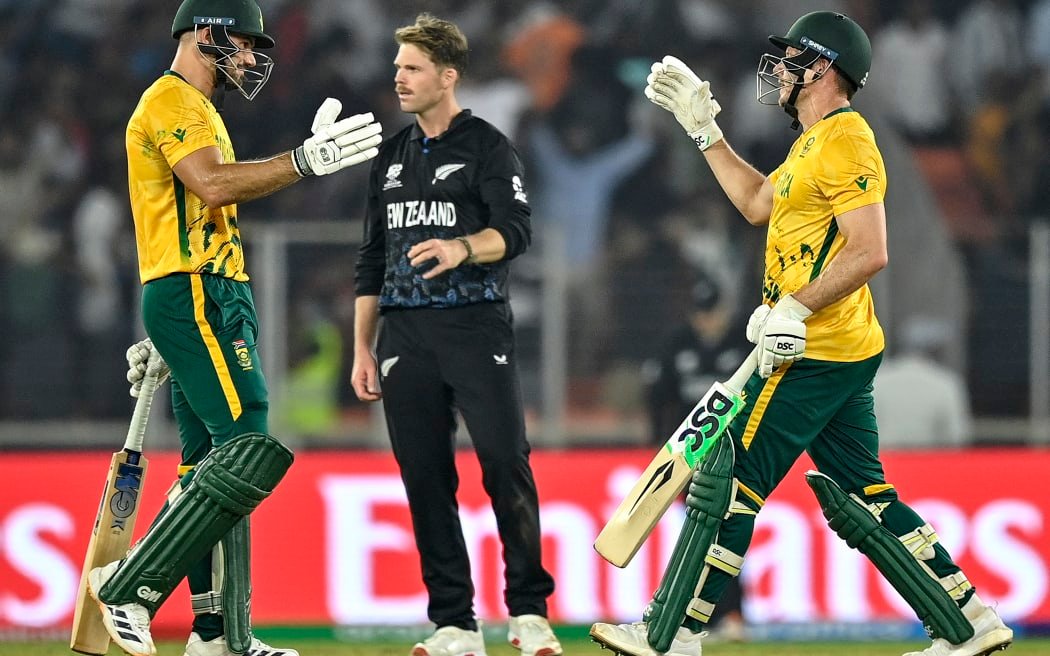
The Proteas embrace favourites tag but face familiar knockout fears against a Black Caps side eyeing another upset
LAHORE – Form guides and tournament statistics often go out the window when the knockout lights flicker on. South Africa, the only unbeaten side in the T20 World Cup, will put their flawless record on the line Wednesday when they face a battle-hardened New Zealand in the first semi-final at Lahore’s Gaddafi Stadium.
While India and England prepare for their marquee clash on Thursday, the Proteas find themselves in a familiar yet uncomfortable position: overwhelming favourites with everything to prove.
Embracing the Favourite’s Mantle
Unlike South African teams of the past that crumbled under expectation, this unit is leaning into the pressure.
“I’m glad that we’re favourites, because I’ve always felt that as a South African team you want to be able to play as a favourite,” head coach Shukri Conrad said, signaling a shift in mindset. The message is clear: the spotlight is welcome, not feared.
Aiden Markram’s men have looked a far more rounded T20 unit than the one that fell at the last hurdle in 2024. Since surviving a chaotic double Super Over against Afghanistan, they have been ruthless, combining explosive batting with a varied and incisive bowling attack.
The Proteas Machine
South Africa’s strength lies in balance. The top order of Quinton de Kock, Markram, and Ryan Rickelton specializes in powerplay acceleration. When they fail, a deep middle order ensures the momentum doesn’t stall.
With the ball, the variety is menacing. Kagiso Rabada is extracting awkward bounce with Test-match lengths, while Marco Jansen’s left-arm angle creates match-up problems. Lungi Ngidi has been the revelation, mastering change-ups across all phases. Left-arm spinner Keshav Maharaj offers control in the middle, with Markram holding himself back as a tactical trump card.
The Tricky Kiwis
But South Africa’s juggernaut now meets its stiffest test: the unpredictability of New Zealand in knockout cricket.
The Black Caps have an uncanny ability to disrupt favorites. Finn Allen’s ultra-aggression at the top is designed to dismantle powerplay plans, with Devon Conway or Tim Seifert providing stability at the other end. Rachin Ravindra’s gear-shifting ability sets the platform, allowing Glenn Phillips and Daryl Mitchell to launch at the death.
However, New Zealand’s pace attack lacks a settled look. The likely absence of Matt Henry—back home on paternity leave—leaves a void. Jacob Duffy or Kyle Jamieson are expected to step in, but the attack lacks the same bite.
Spin Could Decide Fate
Where the Kiwis hold the edge is in the middle overs. Captain Mitchell Santner’s stump-to-stump accuracy is tailor-made to stifle de Kock and Markram. Ish Sodhi’s leg-spin could exploit South Africa’s right-hand heavy middle order, making the spin battle a potential game-changer.
A Different Venue, A Different Challenge
New Zealand head coach Rob Walter acknowledged the shifting dynamics. “We faced them in Ahmedabad, which I think is a venue that they’ve grown pretty used to… The semi-finals will be in a different venue. It will provide a different challenge.”
For South Africa, this is about shedding the weight of history. For New Zealand, it is another chance to remind the world that in knockout cricket, momentum matters less than nerve.
