
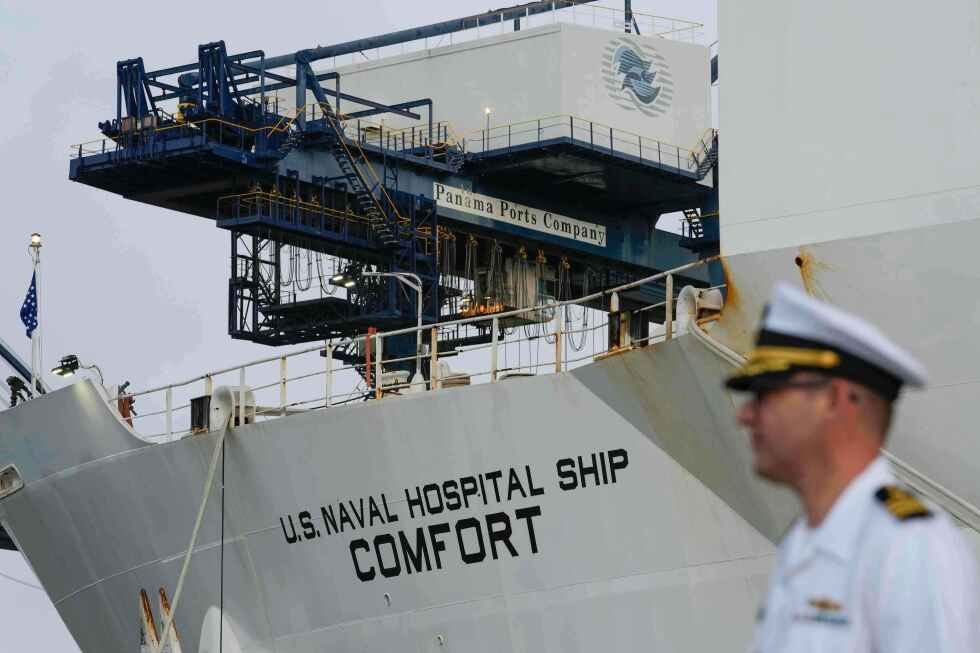
U.S. President Donald Trump said in a Truth Social post Saturday that he was sending a hospital ship to Greenland, alleging many people there are sick and not receiving care, even though both of the U.S. Navy’s hospital ships were undergoing maintenance at a shipyard in Alabama at the time he posted.
Publicly available ship tracking data shows that one of the ships, the USNS Mercy, went out to sea Tuesday. It is not clear from the public data where the ship is headed, and Pentagon officials did not comment when asked about its destination.
Trump’s post prompted a defense of Greenland’s health care system from its prime minister in the latest point of friction with Trump, who has frequently talked about seizing Greenland, which is a semiautonomous territory of NATO ally Denmark.
Here is a closer look at the facts:
Referring to his special envoy to the Arctic territory, Trump said, “Working with the fantastic Governor of Louisiana, Jeff Landry, we are going to send a great hospital boat to Greenland to take care of the many people who are sick, and not being taken care of there.”
THE FACTS: There have been no reports of major illnesses in Greenland lately and it was not clear which sickness Trump was referring to.
All of Greenland, which has a population of around 57,000 people, is served by the Queen Ingrid Hospital in the capital Nuuk, according to the Danish Medical Journal. The territory also has several regional health centers.
Most health care services in Greenland are free for citizens and permanent residents. This includes treatment by general practitioners, medical specialists and hospitals, health centers, prescription medicine, public dental care and home nursing care, according to the website of the Nordic Council of Ministers, which is the official body for intergovernmental cooperation in the Nordic Region.
In response to Trump’s post, Greenlandic Prime Minister Jens-Frederik Nielsen stressed the region’s free health care system and pointed out the differences in a jibe at the U.S. system.
“We have a public health care system where treatment is free for citizens. That is a deliberate choice — and a fundamental part of our society,” Nielsen said. “That is not how it works in the USA, where it costs money to see a doctor.”
Despite free health service, there are “major public health challenges” on the vast island, according to the Center for Public Health in Greenland.
Many of those challenges are related to undergoing “profound changes from a hunting society to a modern industrial and knowledge society” within a short period of time. Increasingly, people suffer from illnesses such as obesity, diabetes and cardiovascular disease.
Anna Wangenheim, Greenland’s minister for health and persons with disabilities, recently posted an “urgent” request on her Facebook page saying the “national health service currently needs dentists for 3 different towns: Aasiaat, Paamiut, and Nanortalik.”
Despite difficult access to medical services in remote areas and a shortage of staff, notable improvements have been achieved in Greenland, which only assumed political responsibility for its own healthcare system in 1992, said Lene Seibæk, a professor at the Institute of Health and Nature at the University of Greenland.
