
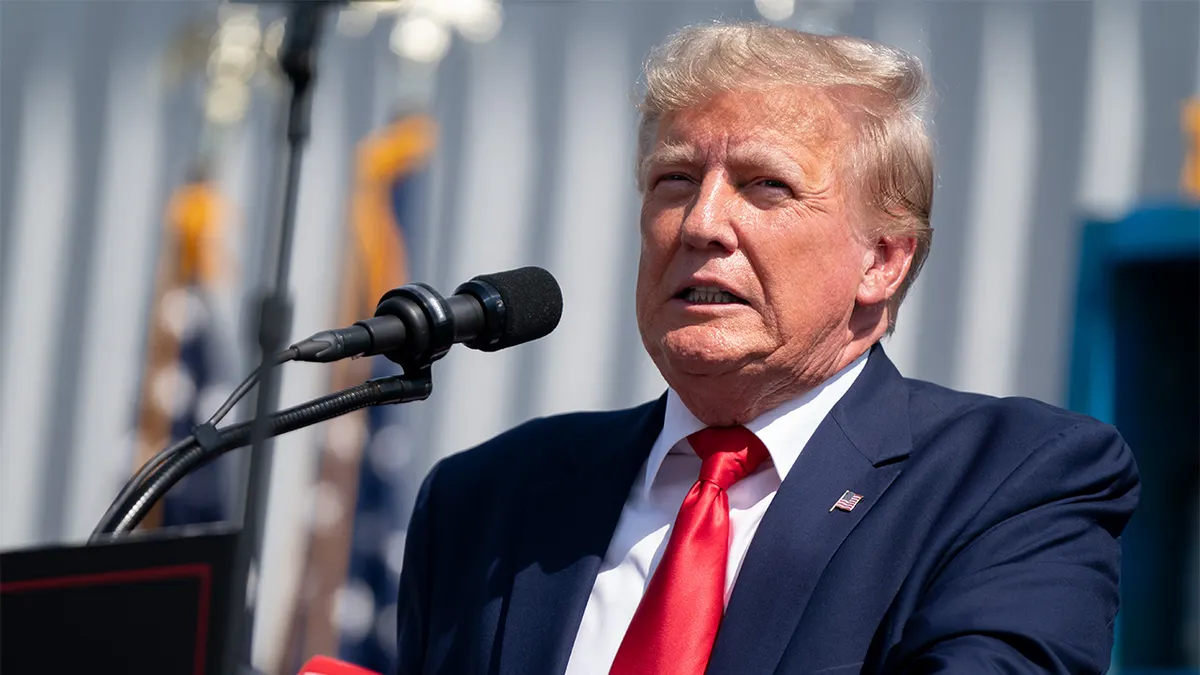
President to address nation as White House signals shifting ceasefire stance; Iran threatens US firms as regional fighting intensifies and civilian toll mounts.
WASHINGTON/SHARJAH — President Donald Trump said the United States could end its military operations against Iran within two to three weeks and that Tehran does not need to agree to a ceasefire deal for the conflict to conclude.
Speaking to reporters at the White House on Tuesday, Trump described a swift exit from what the Pentagon has dubbed “Operation Epic Fury,” saying the US “will be leaving very soon” and that the withdrawal timeline was “within two weeks, maybe two weeks, maybe three.”
When asked whether successful diplomacy with Iran was a prerequisite for ending the war, now in its fifth week, Trump said it was not. “Iran doesn’t have to make a deal, no,” he said. “No, they don’t have to make a deal with me.”
The White House later announced that Trump will deliver a national address at 9 p.m. EDT on Wednesday (0100 GMT Thursday) to “provide an important update on Iran.”
The remarks mark a notable shift from Washington’s earlier posture. US officials had previously threatened to intensify military operations if Tehran failed to accept a 15-point ceasefire framework, which included demands that Iran forgo nuclear weapons, halt uranium enrichment, and fully reopen the Strait of Hormuz.
Just a day earlier, Defence Secretary Pete Hegseth had said Trump remained open to a deal with Iran to end a war that has killed thousands, spread across the region, disrupted global energy supplies, and threatened to destabilize the world economy.
Mixed Signals on Diplomacy
While US officials have described ongoing talks with Tehran, Iranian Foreign Minister Abbas Araqchi said Tuesday that direct messages from US special envoy Steve Witkoff do not amount to formal negotiations. Speaking to Al Jazeera, Araqchi said the communications—including threats and messages conveyed through intermediaries—fell short of diplomatic talks.
Iran Threatens US Companies
In a sharp escalation, Iran’s Revolutionary Guards issued a threat against 18 US companies operating in the region, including Microsoft, Google, Apple, Intel, IBM, Tesla, and Boeing. The threats take effect from 8 p.m. Tehran time (1630 GMT) on Wednesday. When asked if he was concerned, Trump responded simply: “No.”
Trump Criticizes NATO Allies
Trump also criticized NATO allies, including Britain, for what he said was insufficient support for the US war effort. Secretary of State Marco Rubio echoed the sentiment on Fox News, calling NATO “a one-way street” and suggesting the alliance’s structure would need to be reexamined after the conflict. Rubio added, however, that Washington “could see the finish line.”
Conflict Shows No Signs of Abating
On the ground, the war continues to widen. At least seven people were killed and 24 wounded in two Israeli strikes in the Beirut area on Wednesday, according to Lebanon’s health ministry. Israel’s military said it had targeted a senior Hezbollah commander and another senior member of the Iran-aligned group. Hezbollah has not yet commented.
Meanwhile, Pakistan has offered to mediate in the conflict. The foreign ministers of China and Pakistan met in Beijing on Tuesday and jointly called for an immediate ceasefire, urging peace talks to begin as soon as possible.
Iran remains defiant despite sustained US and Israeli attacks. Syrian state television reported that explosions heard in Damascus resulted from Israeli air defences intercepting Iranian missiles. Iranian state media also reported damage to a radar facility in Bushehr and a steel plant in Isfahan following recent strikes.
Economic Toll at Home
The war’s economic impact is now being felt more acutely in the United States. The national average retail price of gasoline crossed $4 a gallon on Monday for the first time in more than three years, according to GasBuddy. A Reuters/Ipsos poll released Tuesday found that two-thirds of Americans believe the US should move quickly to end its involvement in the Iran war, even if it means not achieving the administration’s stated goals.
