
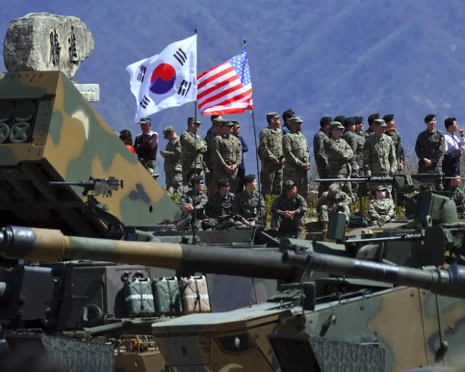
Pentagon’s new defense blueprint envisions Seoul assuming primary responsibility with “more limited” American support, potentially reshaping US troop presence and Indo-Pacific priorities.
WASHINGTON — The Pentagon’s newly released National Defense Strategy outlines a significant recalibration of America’s military role in Northeast Asia, declaring that South Korea should take “primary responsibility” for deterring North Korea with “critical but more limited US support.”
The policy document, published Friday, signals a potential future reduction or restructuring of the 28,500 US troops stationed in South Korea. It frames the shift as aligning with US interests to “update US force posture on the Korean Peninsula.”
“South Korea is capable of taking primary responsibility for deterring North Korea,” the strategy states, endorsing a change in the “balance of responsibility.” This follows years of US officials signaling a desire to make forces in South Korea more flexible for regional contingencies beyond the peninsula, such as supporting Taiwan or countering China’s expanding military reach.
While Seoul has historically resisted any dilution of the US mission, it has concurrently bolstered its own defenses—increasing its military budget by 7.5% this year and maintaining a 450,000-strong standing army with the goal of eventually leading wartime command of combined forces.
The strategy identifies China as the “pacing challenge” for the US in the Indo-Pacific, with a core goal of preventing Chinese dominance over America or its allies. It cautiously envisions a “decent peace” acceptable to both Washington and Beijing, without explicitly naming Taiwan—a flashpoint Beijing claims as its own territory.
Beyond Asia, the document addresses other global theaters:
- Iran: Described as seeking to rebuild its military and retaining the option to pursue nuclear weapons, amid heightened US military deployments to the Middle East.
- Europe: Commits to ongoing engagement but subordinates it to homeland defense and countering China. Russia is labeled a “persistent but manageable” threat to NATO’s east.
- Strategic Access: Notes efforts to secure permanent US military and commercial access to key regions like Greenland, countering Russian and Chinese Arctic ambitions.
The Pentagon’s top policy official, Elbridge Colby, is scheduled to visit South Korea and Asia next week, likely to discuss the strategic transition outlined in the document.
The strategy crystallizes the Trump administration’s focus on shifting greater defense burdens to allies and reorienting US global posture toward great-power competition, primarily with China.
