
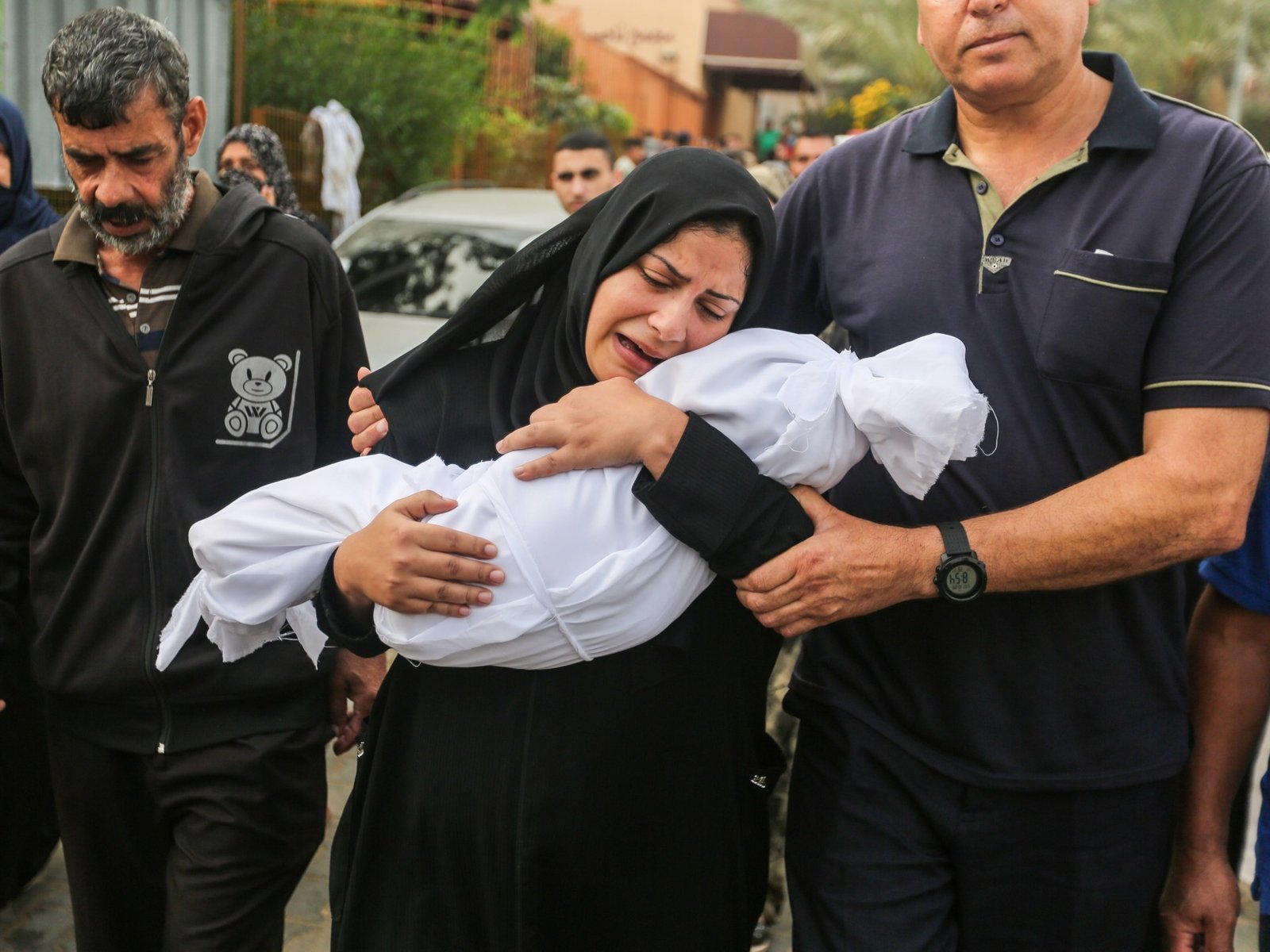
The US pundit’s ‘dead Gaza baby’ joke was not a slip of the tongue but a window into a media culture that trivialises Palestinian suffering and deflects responsibility.
Last Friday, during an appearance on Real Time with Bill Maher on HBO, CNN commentator and former Obama adviser Van Jones claimed that Iran and Qatar are running a disinformation campaign to manipulate young Americans into caring about Gaza. To make his point, he crudely imitated what he said appears on their social media feeds: “Dead Gaza baby, dead Gaza baby, dead Gaza baby, Diddy, dead Gaza baby, dead Gaza baby.” The audience laughed.
The remark, a crass attempt at humour that juxtaposed mass death with celebrity scandal, laid bare the moral drift that has infected American commentary on Palestine. What should have prompted grief instead provoked laughter. A reality steeped in blood became a punchline. It was not merely a gaffe but a revelation of how far the conversation has strayed from moral awareness.
Jones’s apology came swiftly. He admitted the remark was “insensitive and hurtful”, insisting that his intent had been to highlight how foreign adversaries manipulate social media. Yet intent does not erase consequence. To repeat “dead Gaza baby” for rhetorical effect and to attribute the flood of such images to foreign manipulation campaigns is to trivialise authentic suffering. It transforms the murdered children of Gaza into props in a morality play about disinformation.
A true apology would have confronted the deeper problem: the instinct, common in US media, to distrust evidence of Palestinian pain unless it is filtered through Western validation. It is an impulse rooted in hierarchy, the same hierarchy that divides the grievable from the disposable, the innocent from the suspect.
The issue was not merely one of tone but of substance. Jones’s remarks, met with neither objection nor discomfort from his fellow panellists — Thomas Friedman of The New York Times and host Maher — stand as a textbook illustration of how Western commentators, when confronted with the documented suffering of Palestinians, reach for the well-worn inversion that recasts truth as propaganda. It is an instinct that trivialises atrocity and, in this instance, by turning the deaths of Palestinian children into a punchline, completes their dehumanisation.
Jones’s claim is absurd on its face. The world’s horror at Gaza’s devastation is not the product of Qatari or Iranian disinformation; it is the natural response of any conscience not yet cauterised. To those possessed of moral fortitude, the images need no narration; they speak a universal language of grief. Tens of thousands of children have been killed in verified strikes, their names catalogued by humanitarian organisations, their bodies pulled from the ruins by foreign doctors and reporters who bear witness with weary precision. To suggest that these images are fabrications of manipulation rather than evidence of atrocity is not analysis but moral cowardice. It is to participate in the very propaganda one claims to expose.
Jones’s remark reflects a deeper pathology. For decades, much of the US media establishment has treated Palestinian death as a matter of optics rather than ethics. It prefers to interrogate imagery rather than investigate accountability. When confronted with the question of whether Israel’s actions meet the legal threshold for genocide — a conclusion reached by leading human rights organisations, including Human Rights Watch, Amnesty International, B’Tselem, and Al-Haq, as well as by the United Nations Human Rights Council, its Independent Commission of Inquiry, and the UN special rapporteur on the situation of human rights in the Palestinian territory — it looks away. Instead of examining evidence, it frets about “misinformation” and “narrative control”. The effect is to replace moral analysis with moral evasion. The question of genocide becomes not a crime to expose and punish but a branding problem to manage.
The obsession with disinformation also betrays a certain arrogance. It assumes that young people who recoil at the carnage must have been duped by malignant foreign actors. They could not possibly have arrived at outrage through independent moral reasoning. Their compassion must be manufactured, their empathy the product of an algorithm. Such condescension mirrors the colonial logic that denies agency to the colonised and authenticity to those who stand with them.
To be fair, disinformation is real. Every conflict spawns its share of fabrications. But recognising that fact does not license scepticism towards verified atrocity. When the evidence of suffering is so overwhelming, the burden shifts: those who doubt it must prove their case. The reflex to reach for Iran and Qatar as explanatory villains is not analysis; it is evasion. It comforts the conscience by projecting moral disorder elsewhere.
There was a time when Jones embodied a different spirit, one animated by moral urgency. His work on criminal justice reform and racial equity once lent him the credibility of a voice of conscience. That credibility was not lost through mere carelessness, but through the craven instinct to conform and a readiness to be co-opted by the rhetoric of empire. Yet the failure is not his alone. It reflects the ecosystem that produced him: a media culture that rewards deference to power, values fluency in the slogans of empire over fidelity to truth, and exalts the cadence of talking points above the substance of justice.
The laughter in Maher’s studio was telling. It revealed a desensitised audience that could chuckle at the invocation of dead children because those children belonged to the wrong geography. Substitute “Ukrainian baby” or “Israeli baby”, and the same crass joke would have drawn gasps, not laughter. The double standard is the moral disease of our age: empathy rationed by passport.
In the end, this controversy is not about speech but about sight. The task is not to police what people say about Gaza but to compel them to see Gaza: to see the mass graves, the skeletal survivors, the bombed schools, the hospitals reduced to ash. To see is to know, and to know is to judge. The effort to obscure that reality behind the fog of “disinformation” is nothing less than a refusal to see.
Jones’s apology does not close the wound it exposed. Until the US media can name and confront suffering without qualification, its moral authority will remain threadbare. The children of Gaza are not dying from disinformation; they are dying from Israeli bombs, and from the US’s wilful blindness.
The views expressed in this article are the author’s own and do not necessarily reflect media’s editorial stance.
