
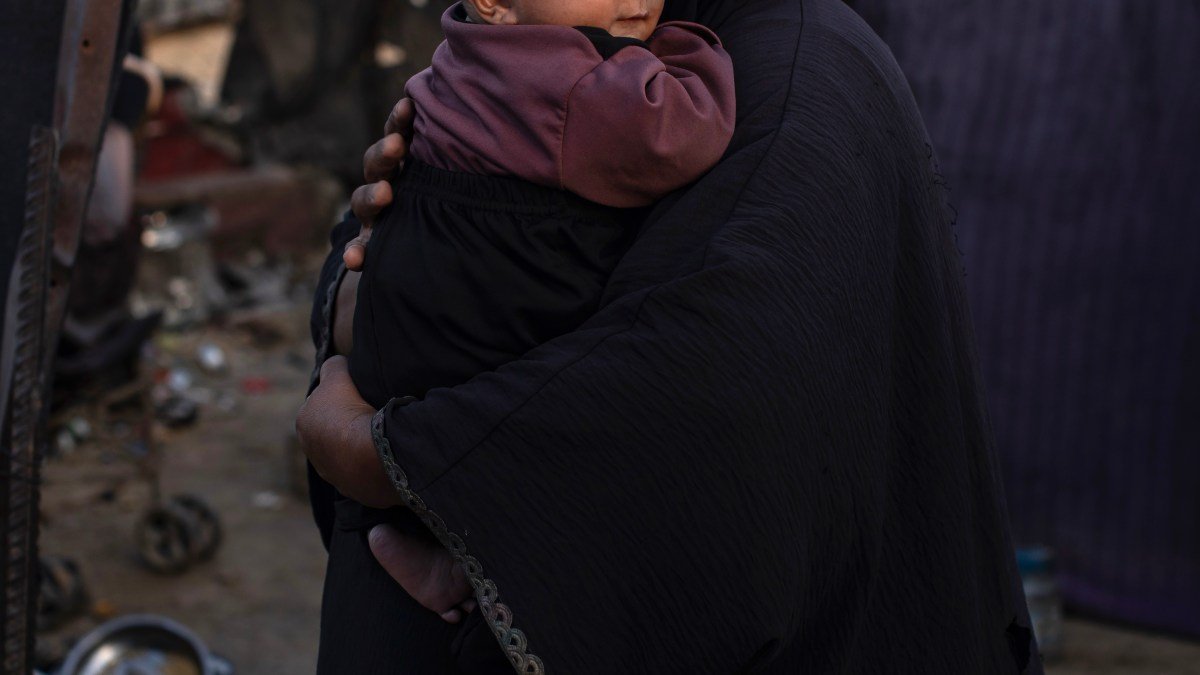
Mothers erasing themselves to feed their children, surgeries performed without anaesthesia and the total loss of privacy define the female experience in Gaza as the war enters another winter.
Women in Gaza are surviving the unsurvivable.
They are managing daily food scarcity while caring for their children under conditions of absolute deprivation; although a ceasefire stipulation, Israel continues to block tents and caravans, among other critical winter aid.
Women in Gaza continue to navigate repeated displacement, packing and unpacking their families’ lives over and over again under heavy bombardment.
They are caring not only for their own children, but also for the injured, the elderly, and the orphaned.
Above all, they carry the invisible but crushing emotional labour of holding families together through grief, terror, uncertainty and unrelenting loss amid unprecedented destruction.
Women are erasing themselves so others can survive
As a woman, I carry the burden of reporting the horrors that I, too, am faced with.
I have reported, daily, on the Israeli genocide in Gaza, and there has not been a single day without a mother breaking my heart. Not one.
Every day, I meet women who are exhausted beyond words, whose bodies starve while their hearts refuse to give up. In Gaza, a mother’s love has become an act of resistance against Israeli oppression.
“I hold my baby close all night long, fearing the cold will take my child away from me, or the rain will sweep him away. I can’t sleep,” Suzan told me. She was displaced in the Zeitoun neighbourhood, surviving in a fragile tent for more than two years.
“We only have three blankets,” she continued. “We share them. It’s OK if I can’t warm myself. My children can’t survive this cold without them.”
I hear versions of this sentence everywhere I go. Mothers who erase themselves so their children can survive.
During the height of the famine, I witnessed unconditional love in the rawest of forms.
I will never forget how, without exception, every mother told me she deprived herself of food so her children could eat.
“I cut one flatbread into pieces for my sons and daughters,” Maysoun told me. “When they eat, it’s as if I ate.”
Maysoun is representative of the mothers of Gaza. Different faces, different stories, but the same sacrifice.
Every cycle a nightmare
For more than two years, displaced women have not been able to access toilets or privacy, deprived of safety and dignity. These women grew up sheltered, with safe spaces to pray, eat and wash. Sharing a toilet with 1,000 people is something you never become accustomed to.
They have to manage menstruation, pregnancy, childbirth and illness while living in overcrowded shelters, tents, or the open air, without the basic necessities needed to sustain life.
I was not spared from this reality. I, too, couldn’t find sanitary pads or painkillers post-surgery.
Every menstrual cycle is a nightmare – a monthly reminder of how fragile dignity becomes in war. How pain becomes something we are expected to endure silently.
Thousands were widowed during the war
Living without a husband adds another layer of vulnerability for many. Many women have told me how empty they feel after losing the love of their lives. Others describe the struggle of managing their families under relentless bombardment and displacement.
Widowhood in Gaza is not just loss – it is exposure, fear and isolation.
While the Israeli-US aid distribution point, GHF, was in operation, thousands of Palestinians were either shot or killed while waiting for aid.
The Israeli policy of preventing aid or commercial supplies from entry forced women to risk death while trying to secure food rations for their families.
Israeli-inflicted hunger pushed these women into kill zones. Many who went were injured. Many were killed.
Nearly everyone in Gaza is malnourished, including new mothers who struggle to breastfeed their newborns, despite their own bodies weakened after months of prolonged hunger.
Many are physically unable to produce milk, and with infant formula unavailable or unaffordable, mothers are forced to feed their babies with whatever they can find – choices no mother in Gaza had to make before the war began.
At Al-Aqsa Hospital, I met a woman with a bullet lodged in her stomach; she was shot at a GHF distribution point. While holding my gaze, she lifted her shirt and showed me her wound, asking if I thought the scar would disfigure her body. She continued to tell me of the pain of being stitched up without anaesthesia.
I was jerked back to my own memory of waking up after gall bladder surgery without painkillers.
I cried. I screamed. All I wanted was something to numb the pain, something to make it stop.
I thought of the many pregnant women I reported on, giving birth without anaesthesia, without pain relief, without even a clean room to give birth in.
Women screaming into the void, bringing life into the world while surrounded by death and destruction. And to think, if there were enough political will among Israel’s Western allies, none of this would be happening.
There are more untold stories that must be told. Rasha, a breast cancer patient waiting endlessly for the Rafah crossing to open so she could leave Gaza for treatment, told me she believed she had developed cancer after being trapped under the rubble of her bombed-out home for hours.
“I inhaled all the toxins, all the dust,” she said, tears streaming down her sunken face. “This is why I think I have breast cancer now. I was healthy before this war.”
And while I continue to report on the horrors faced by the women of Gaza, I, too, feel like my own erasure. I try to provide whatever solace I can, but I know my words cannot provide the comfort these women need, the relief they deserve.
How do you respond to that as a reporter?
Another woman who will never leave my mind is Hala, who miscarried while being forcibly displaced from the north to the south.
“I was pregnant with twins,” she told me. “I miscarried one and saved the other.”
She paused. “I was bleeding the whole way, while carrying my belongings. I was forced to pack up whatever I could from our home and flee or risk death by bombardment.”
I remember her voice – how it trembled but did not break.
I remember how helpless I felt standing in front of her, my only weapon my notebook, my camera, my voice.
Everywhere I go, I carry the voices of these women with me.
They echo in my head and my heart. I hear them when I try to sleep, and when I report on air. I hear them when I am silent.
Every woman I met entrusted me with her pain, her story, her truth. And none of them will ever leave my mind. I will carry them with me for the rest of my days.
Because to be a woman in Gaza is to endure the unendurable – and to keep loving anyway.
