
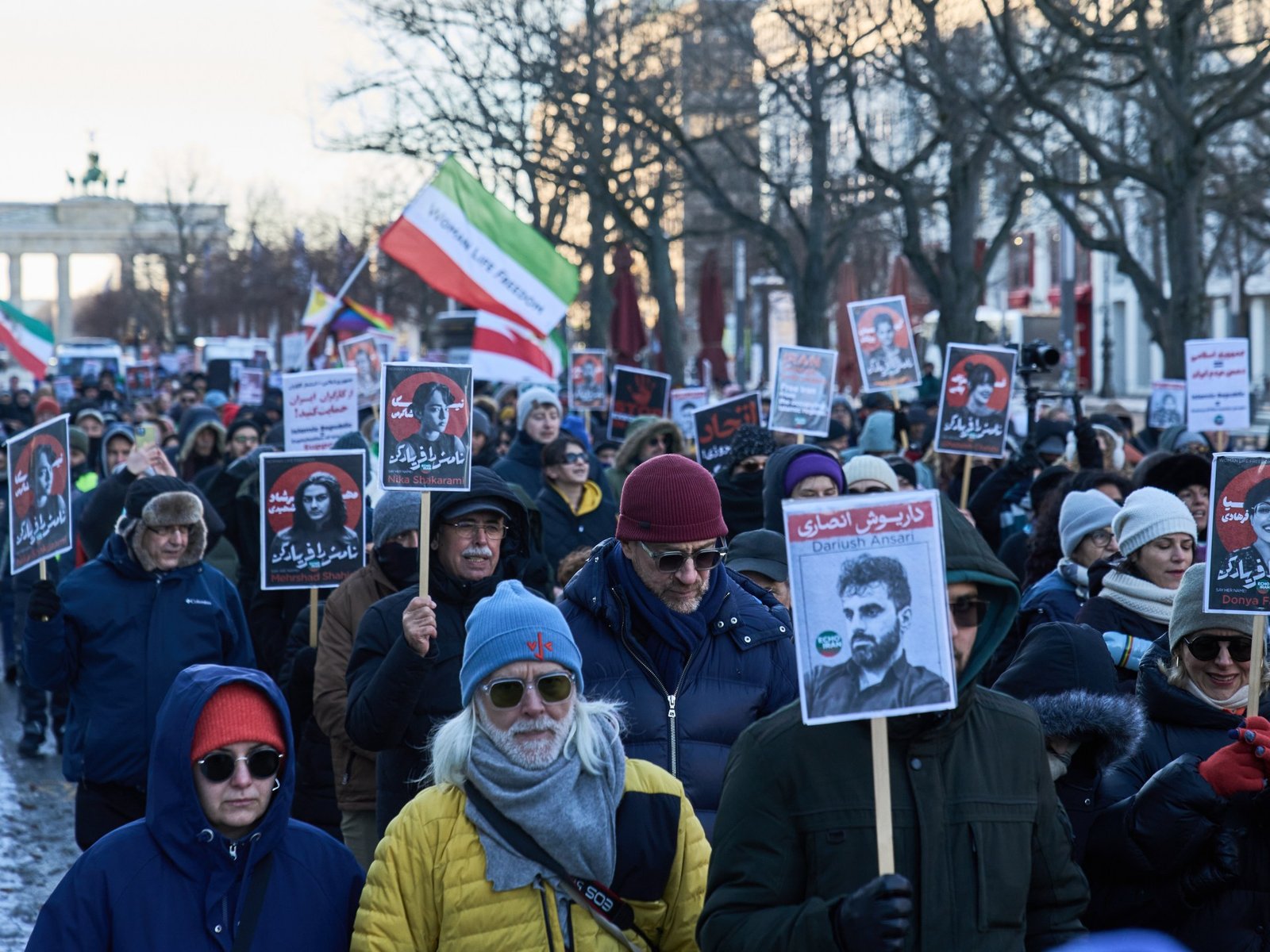
Iran’s fragmented opposition includes figures living abroad, such as Reza Pahlavi, the heir of the former monarch.
Protests in Iran that began in late December over soaring prices have evolved into a broader challenge to its religious rulers, who have governed Iran since the 1979 revolution.
More than 100 security personnel have been killed in recent days, state media reported, while opposition activists said the death toll is higher and includes dozens of protesters. media cannot independently verify either figure.
Recommended Stories
list of 4 items
- list 1 of 4Who is Reza Pahlavi? The exiled ‘prince’ urging Iranians to ‘seize cities’
- list 2 of 4Trump warns of “very strong options” amid Iran unrest
- list 3 of 4Iran’s FM says protests became ‘bloody’ to give Trump intervention excuse
- list 4 of 4Man detained after driving truck through anti-Iran protest in Los Angeles
end of list
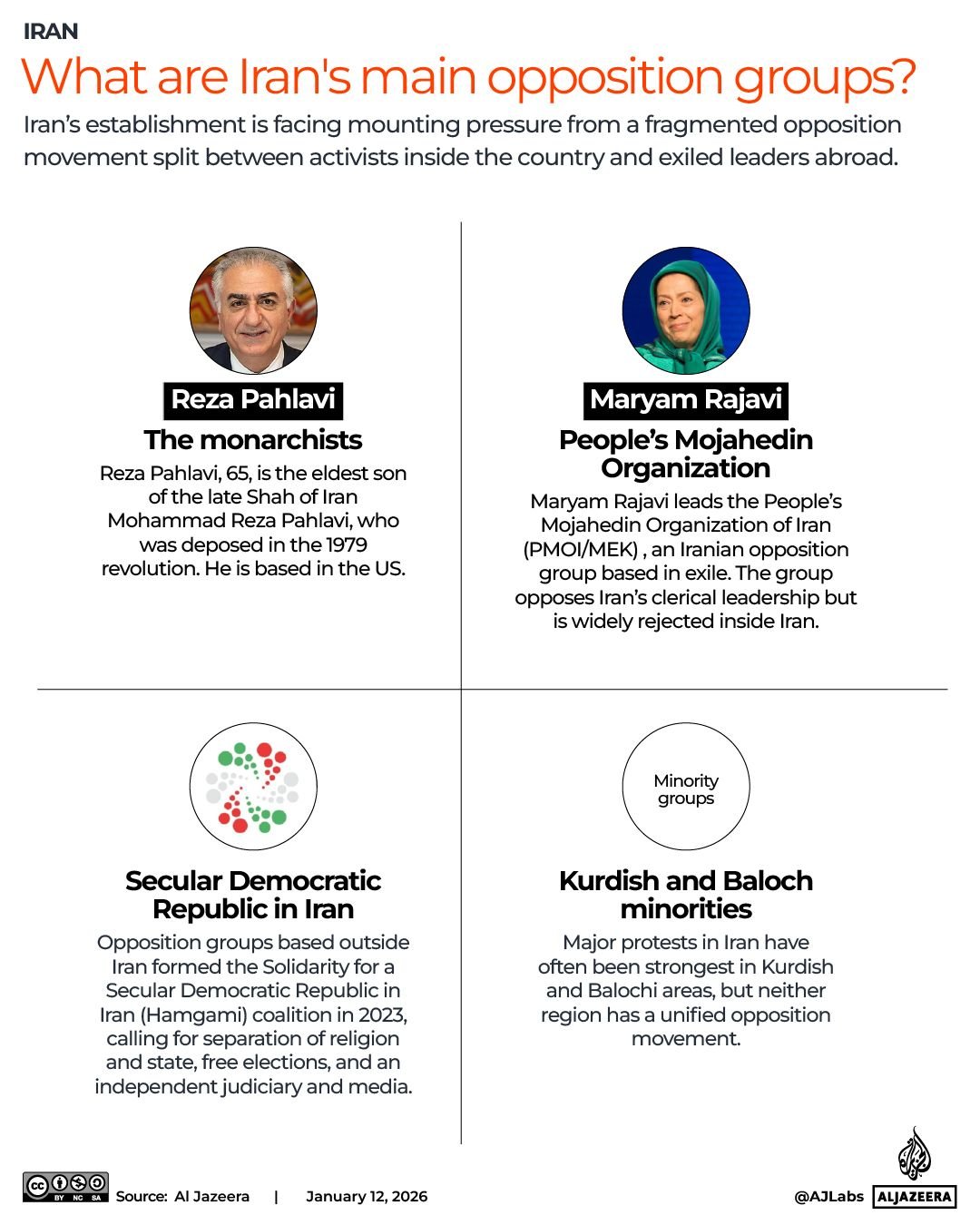
We take a look at Iran’s main opposition groups:
What shape are Iran’s opposition groups in?
The establishment in Iran is facing mounting pressure from a fragmented opposition movement.
While some groups and individuals in the movement are inside Iran, others are voicing opposition to the rulers from outside the country. They are mainly leaders who are living in exile or members of the Iranian diaspora.
Groups in other countries, including the United Kingdom and Germany, have started to rally on the streets in solidarity with the protesters in Iran.
Why don’t the protests have clear leaders?
Iran currently lacks a uniform opposition group which could form a government, Shahram Akbarzadeh, a professor in Middle East and Central Asian politics at Australia’s Deakin University, told media.
Opposition groups in Iran and outside are disjointed and have different aims. Some have clear leaders while others do not. No individual inside Iran, however, has emerged as a clear opposition leader in the ongoing protest movement.
A possible reason for this is that opposition members are fearful of reprisals if they have identifiable leaders.
Iran’s “Green Movement” in June 2009 was a spontaneous mass demonstration by white collar workers, women’s rights activists and civil society activists against the officially declared victory of Mahmoud Ahmadinejad in perhaps the most publicly contested presidential election in the history of the country. The day after these protests began, Ahmadinejad and his supporters staged an official demonstration in support of his declared victory. He served as president until 2013.
Ahmadinejad had been president since 2005. He was a hardline conservative, controversial for some of his opinions, including repeatedly denying the Holocaust.
The 2009 presidential election was also contested by former Prime Minister Mir‑Hossein Mousavi, who became a symbolic leader of the Green Movement. Since February 2011, however, he has been held under strict house arrest for rejecting the official election results.
Another candidate, Mehdi Karroubi, a reformist Muslim scholar and former parliament speaker, also took a leading role in challenging the election results and supporting the protests. He was placed under house arrest in 2011.
In March last year, the Iranian authorities officially lifted Karroubi’s house arrest.
Neither man is thought to be a focus of the current protests, but as a result of their examples, Iranian protesters inside the country tend not to organise themselves around a single, identifiable leader.
In line with other protest movements around the world, protesters inside Iran increasingly rely on networked organising. Mobilisation through student groups, social media platforms such as Discord and neighbourhood networks has resulted in the creation of numerous local groups and local leaders rather than just one or two central figureheads.
This was recently seen in the “Gen Z” youth protests in Nepal, which took place in September, and the youth protests in Bangladesh, which took place in July 2024 and resulted in the overthrow of Prime Minister Sheikh Hasina.
“[The] Iranian government has actively and effectively suppressed any attempt for organised opposition at home over the past decades and arrested and silenced its leaders,” Maryam Alemzadeh, an associate professor in the history and politics of Iran at the University of Oxford, told media. “Even nonpolitical NGOs, unions, student groups and anything that could resemble a bottom-up order has been quashed.
“As a result, neither leadership nor grassroots organisation can be expected, and protests are left contingent on ad hoc individual or collective decisions of the protesters.”
Which are the different groups among the opposition?
Besides the mass-organised movements going on inside Iran now, there are some other opposition groups based both inside and outside the country.
Reza Pahlavi and the monarchists
Pahlavi, 65, is the son of the deposed shah of Iran, Mohammad Reza Pahlavi, and the heir of the former Pahlavi monarchy.
After Mohammad Mosaddegh, Iran’s prime minister who was democratically elected in 1951, nationalised the British-controlled oil industry in Iran, he was overthrown in a 1953 coup backed by the United States and UK to reverse that move and secure Western oil interests. A repressive royal rule was reinstated until 1979 when the last shah fled the country as the Iranian Revolution took hold. He died in Egypt in 1980.
Living in exile in the US, his son now leads a prominent monarchist movement known as the Iran National Council but claims not to be insisting on a return to a monarchy. Instead, he says he advocates for a secular, democratic system to be decided by a referendum.
However, Pahlavi is supported by members of the Iranian diaspora and groups that do support the return of a monarchy. He is strongly opposed by other opposition groups, including republicans and leftists, so Iran’s opposition remains fragmented.
Many people who currently live in Iran do not remember the era of the monarchy. While some Iranians who do view the pre-revolutionary era with nostalgia, many others remember it for its inequality and repression.
Alemzadeh said Pahlavi emerged as the most prominent opposition leader in the aftermath of the Woman, Life, Freedom protest movement, which began in 2022.
“He enjoys support within [the] Iranian diaspora, especially the generation that left Iran with the 1979 revolution, like himself, but in parts of the younger generation as well. He does have some appeal in Iran as well, as there were chants in his support on the streets of Iran among other chants in this round of protests, but the extent of it is debated.”
Pahlavi’s appeal, she added, stems less from any credible plan or leadership of the protests than from years of nostalgic promotion by diaspora media and social media campaigns that have elevated him as the “loudest available alternative” amid widespread frustration and a lack of other visible leaders.
“Aided by an online campaign on social media, which was also assisted by Israel, according to Haaretz, Reza Pahlavi was then highlighted as the key to return to that ideal past,” Alemzadeh said.
She added that although Pahlavi is the best‑known opposition figure, there is little evidence he has a realistic plan or organisational base to manage the security apparatus, entrenched corruption, remaining government supporters and basic state functions in a post-Islamic Republic Iran.
“Calling for Pahlavi’s return is a nostalgic reaction to the economic and diplomatic deadlock created by the Islamic regime. It is more about rejecting the rule of the clergy, than calling for the restoration of the monarchy,” Akbarzadeh from Deakin University told media.
Maryam Rajavi and the People’s Mujahideen Organisation
The Mujahideen was a powerful leftist group that carried out bombing campaigns against the shah’s government and US targets in the 1970s but eventually fell out with other groups.
It is often known by its Persian name, the Mujahideen-e Khalq Organisation, or by the acronyms MEK or MKO.
Many Iranians, including sworn enemies of the Islamic Republic, say they cannot forgive the group for siding with Iraq against Iran during the 1980-1988 war.
The group was the first to publicly reveal in 2002 that Iran had a secret uranium-enrichment programme.
However, the Mujahideen has shown little sign of any active presence inside Iran for years.
In exile, first in France and later in Iraq, its leader, Massoud Rajavi, has not been seen for more than 20 years and his wife, Maryam Rajavi, has taken control. Rights groups have criticised the group for what they call cult-like behaviour and abuses of its followers, which the group denies.
The group is the main force behind the National Council of Resistance of Iran, led by Maryam Rajavi, which has an active presence in many Western countries, including France and Albania.
Solidarity for a Secular Democratic Republic in Iran
A number of groups based outside Iran and calling for a democratic republic joined together in 2023 to form the Solidarity for a Secular Democratic Republic in Iran (Hamgami) political coalition.
It gained some popularity among the Iranian diaspora in the wake of the 2022 protests over the killing of Mahsa Amini, 22, who died in police custody after being arrested by Iran’s so-called morality police for not wearing her hijab correctly – part of the strict dress code that was made obligatory shortly after the 1979 revolution.
The coalition advocates for the separation of religion and state, free elections and the establishment of an independent judiciary and media.
However, it has not gained much traction within Iran itself. “I don’t think it has any weight in the public sphere,” Alemzadeh said.
Kurdish and Baluch minorities
Persians make up about 61 percent of Iran’s 92 million people while significant minority groups include Azerbaijanis (16 percent) and Kurds (10 percent). Other minorities are Lurs (6 percent), Arabs (2 percent), Baluchis (2 percent) and Turkic groups (2 percent).
Iran is predominantly Shia Muslim, making up about 90 percent of the population, while Sunni Muslims and other Muslim sects account for roughly 9 percent. The remaining 1 percent includes roughly 300,000 Baha’i, 300,000 Christians, 35,000 Zoroastrians, 20,000 Jews and 10,000 Sabean Mandeans, according to the Minority Rights Group.
Iran’s mostly Sunni Muslim Kurdish and Baluch minorities have often clashed with the Persian-speaking, Shia Muslim government in Tehran.
Several Kurdish groups have long opposed the government in western Iran, where they form a majority, and there have been periods of active rebellion against government forces in those areas.
In Sistan-Baluchestan, along Iran’s eastern border with Pakistan, opposition to Tehran includes supporters of Sunni leaders seeking better representation within the country and armed groups with links to al-Qaeda.
When major protests have spread across Iran, they have often been strongest in Kurdish and Baluch areas, but neither region has a single, unified opposition movement.
