
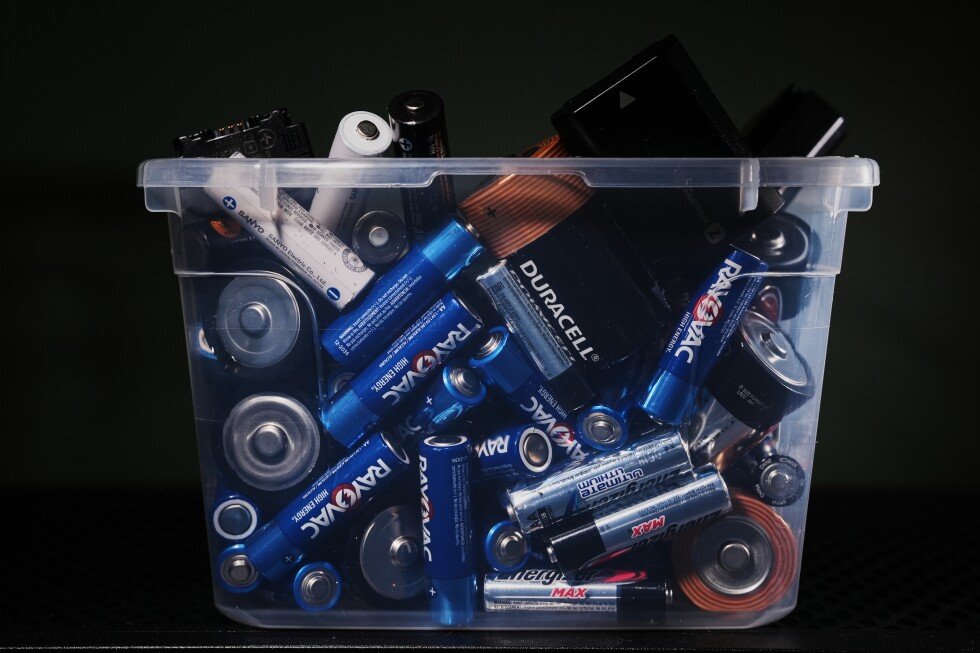
NEW YORK (news agencies) — When household batteries die, it’s hard to know what to do with them. So they get shoved into a junk drawer or sheepishly thrown into the trash.
But dead batteries aren’t quite finished. They can leak heavy metals like cadmium and nickel into soil and water once they reach the landfill. Some of them can also overheat and cause fires in garbage trucks and recycling centers.
The good news is, safely disposing of your batteries takes just a few steps. They’ll get shipped to recycling centers that break down their contents to make new things.
Battery recycling processes could use some fine-tuning, but it’s still a simple and responsible way to get rid of them.
Recycling old batteries “keeps you safe, keeps the waste industry safe, keeps the first responders safe and responsibly sees that battery reach a proper end of life,” said Michael Hoffman, president of the National Waste and Recycling Association.
Batteries keep things running in our homes, powering everything from alarm clocks and TV remotes to gaming controllers. Millions are bought and used every year in the U.S., according to the Environmental Protection Agency.
They leave their stamp on the environment at nearly every stage of their life span.
Many of the materials used to make batteries — elements like lithium and nickel — are mined. Over half the world’s cobalt reserves are in Congo.
Once mined, those materials are shipped around to be refined, fashioned into a battery and packaged for sale. All the ships, trucks and planes moving them add to batteries’ carbon footprint. Making the batteries can release carbon emissions and pollution into the air and atmosphere, too.
Though household batteries are far smaller than the big ones that power EVs and electric bicycles, there are a lot more of them and it’s worth figuring out how to get rid of them.
“One person’s single battery is not necessarily a lot,” said environmental scientist Jennifer Sun with Harvard University. “But everyone uses many batteries.”
To begin, wrangle your old batteries and figure out what kind they are. Batteries “come in all shapes and sizes, but what’s inside differs,” said materials scientist Matthew Bergschneider of the University of Texas at Dallas.
Alkaline and zinc-carbon batteries are generally single-use and come in AA, AAA and more. These can be safely thrown in the household trash in most places, but the EPA still recommends recycling them so that their materials can be made into something new.
Lithium-ion batteries — commonly found in things like power tools and cordless vacuums — are a risk to cause fires and leak toxic gases in garbage trucks and landfills. A lot of rechargeable batteries are lithium-ion, but more single-use batteries are being made this way too.
Be sure to look up battery disposal laws for your area: Places like New York, Vermont and Washington, D.C. have special rules about throwing away household or rechargeable batteries.
