
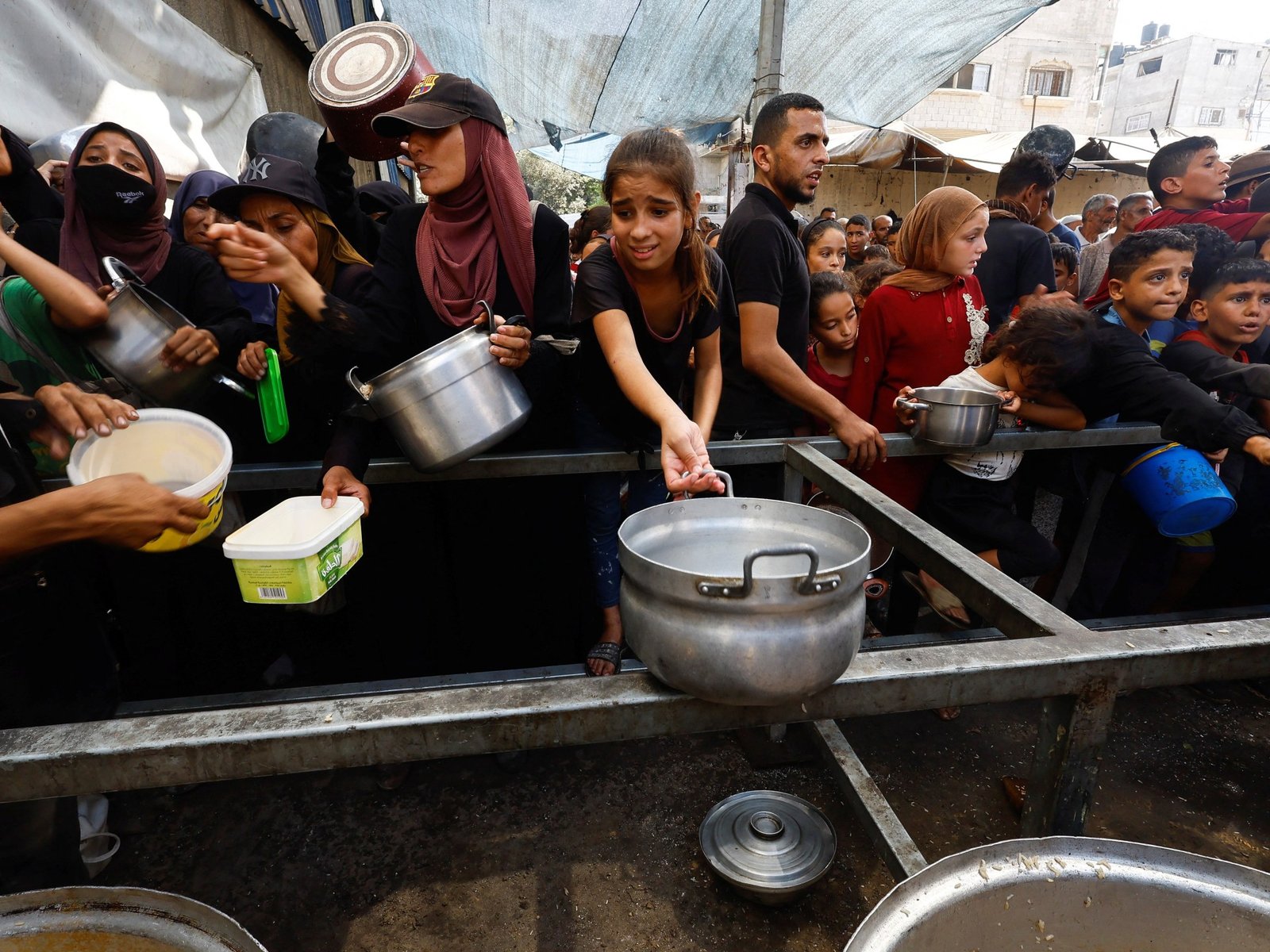
Despite being one of the most frequently used weapons of war, hunger is still treated as inevitable suffering rather than deliberate violence.
“In the week ending September 18 there were 1,319 deaths … Since August 16, 4,338 sufferers from starvation have been admitted to the city’s hospitals of whom 972 have died. Corpses of starved people removed from the streets and hospitals by the police Corpse Disposal Squad and the two non-official agencies since August 1 have been 2,527.”
– September 23, 1943, The Statesman
In September 1943, Bengal was in the grip of a man-made famine that claimed thousands of lives each week. India, still under British colonial rule, had entered World War II in 1939 as a supplier of troops, exports and credit, and as a strategic theatre in the Allied campaign against Japan. In 1942, the colonial authorities imposed a modified “scorched earth” policy across Assam, Bengal, Bihar, Orissa and parts of Madras, ordering the army to destroy or remove food stocks and disable transport routes by road, rail, river and sea. Ostensibly intended to block Japanese access to resources, the policy left millions of civilians without food.
More than 5,000 miles away in London, Secretary of State for India Leo Amery urged Prime Minister Winston Churchill’s war cabinet to send 500,000 tons of grain to Bengal to save the starving. The cabinet rejected the appeal, allocating less than a quarter of the request. Amery later noted that “the Cabinet generally treated the matter as a bluff on India’s part”. The death toll from starvation and famine-induced epidemics would climb to three million within a few years.
The Statesman, an English-language newspaper in India, published the above-quoted editorial despite censorship instructions forbidding “casual references to incidents calculated to arouse horror or alarm”. The colonial government was instead encouraging stories that stressed relief efforts and promoted the idea of a longstanding “beggar problem”. This narrative naturalised hunger as an inevitable feature of poverty while concealing the scale of famine and casting British rule as benevolent. The then-editor of The Statesman, Ian Stephens, later recalled that officials even replaced “starvation” with “sick destitutes” in reports on Bengal fatalities. The difference was more than semantics: “sick destitute” suggested misfortune and forces beyond human control, while starvation implied a perpetrator and intent.
Although some press outlets, such as The Statesman, defied authorities to report accurately on the famine both in India and in Britain, their efforts did not lead to any serious legal consequences for those responsible. This was not incidental: the architects of post-war international law had themselves relied on food blockades and deprivation as tools of warfare and colonial domination. As such, they were unwilling to criminalise a weapon they themselves had wielded. As scholars Nicholas Mulder and Boyd van Dijk explain, Britain and France favoured blockades in the 20th century as “an essentially negative material intervention, with low public visibility and high pay-off as a war-fighting strategy”. That reluctance to confront starvation as an instrument of violence has left deep traces in international law, shaping how the crime is treated even today.
Although international law clearly prohibits the deliberate starvation of civilians as a method of warfare, it remains difficult to prosecute. The 1977 Additional Protocols to the Geneva Conventions prohibit using starvation of civilians as a method of warfare. The Rome Statute of the International Criminal Court (ICC) goes further, codifying it as a prosecutable war crime. Despite this clarity, why does starvation as a crime remain so difficult to try?
Starvation cases present unique evidentiary hurdles. Starvation operates differently from bombs or massacres. It is slow, diffuse, and often hidden behind policy. Prosecutors must prove intent: that leaders sought to deprive civilians of food, rather than mismanaging shortages or failing to protect supply chains. Sieges, sanctions and blockades muddy the picture, defended as “legitimate” military measures. Establishing individual criminal responsibility for such structural violence is notoriously difficult.
But difficulty is no excuse. Starvation inflicts devastation on a scale comparable to conventional weapons, as the current situation in Gaza makes clear. It dismantles societies, leaving lasting physical, psychological and economic scars. Its structural nature — its ability to work invisibly, over time and under the cover of policy — is precisely why it must be prosecuted, not overlooked.
For too long, starvation has been treated as an inevitable by-product of war. In reality, it is a deliberate strategy, outlawed for decades but rarely enforced. As long as courts and prosecutors fail to treat starvation as the crime it is, powerful actors will continue to wield hunger as a weapon against civilians with impunity.
Naming it correctly is the first step; prosecuting it is the next.
The views expressed in this article are the author’s own and do not necessarily reflect media’s editorial stance.
