
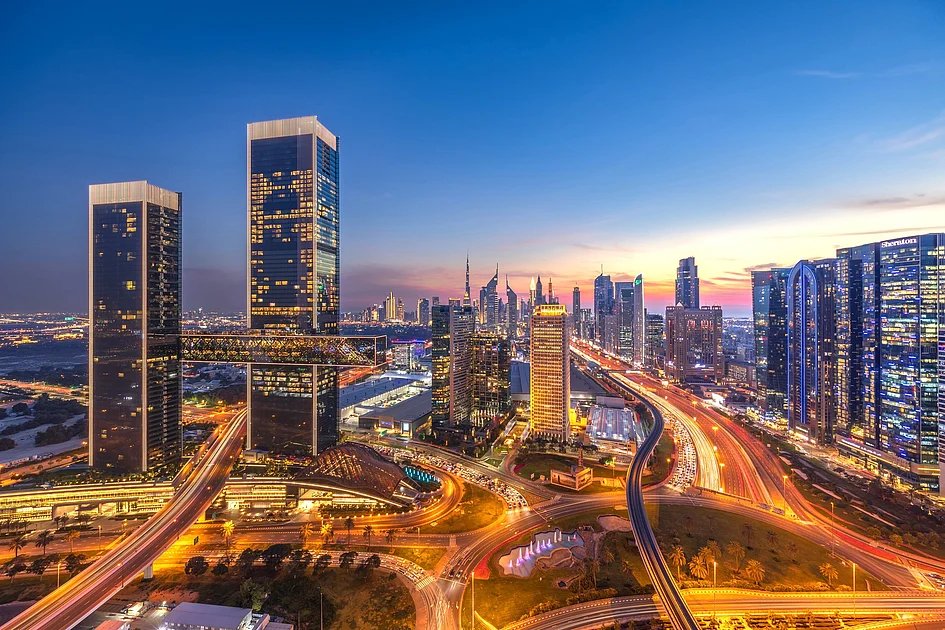
The UAE is emerging as a standout performer in the Gulf, transforming lower oil prices into a catalyst for innovation, trade expansion, and sustainable growth.
As Opec+ increases production and crude prices hover near $60 per barrel — the lowest since 2020 — the UAE’s diversified economy is proving remarkably resilient, outpacing regional peers and reinforcing its position as a global business hub.
Analysts argue that although evolving Opec+ production and soft crude prices pose clear challenges across the region, the UAE is emerging as an outlier. As the International Monetary Fund (IMF) noted after its October 2025 visit, the country “has shown strong resilience to global uncertainty, regional tensions, and oil price fluctuations.” The IMF now projects the UAE’s GDP to grow by about 4.8 per cent in 2025 and 5.0 per cent in 2026 — significantly ahead of many of its peers.
Behind the UAE’s strong performance lies the government’s decade-long diversification agenda. Non-oil sectors now contribute more than 73 per cent of GDP, according to the Central Bank of the UAE, driven by tourism, logistics, manufacturing, and the digital economy. Non-oil trade surpassed Dh2.8 trillion ($762 billion) in 2024 — a 13.6 per cent year-on-year rise — while inflation remained low at 1.4 per cent in early 2025, helping sustain consumer spending and investor confidence.
The IMF noted that the UAE continues to post fiscal and external surpluses, providing “ample buffers that can be deployed to respond to adverse shocks.” This contrasts sharply with some Gulf neighbours: Saudi Arabia and Bahrain are projected to run fiscal deficits of –3.7 per cent and –9.9 per cent of GDP respectively in 2026, as per PwC Middle East’s latest Middle East Economy Watch.
Stephen Anderson, chief strategy & technology officer at PwC Middle East, “The GCC’s trade and diversification strategy reflects a region taking control of its economic future. The UAE, in particular, is redefining its role — from an energy supplier to a global leader shaping the next phase of trade and investment.”
Still, the region’s overall growth picture remains positive. Saudi Arabia’s economy — the largest in the GCC — is demonstrating resilience through its Vision 2030 reforms. The Kingdom’s non-oil sector grew 4.2 per cent in the first half of 2025, supported by large-scale investment in manufacturing, tourism and infrastructure. The Riyadh Metro, Neom and Diriyah projects are anchoring domestic demand and job creation. Despite a temporary slowdown in oil income, the IMF expects Saudi GDP to expand by around 3.5 per cent in 2025, maintaining its regional leadership in diversification spending.
Qatar, too, continues to gain momentum. Non-oil GDP expanded 5.3 per cent in the first half of 2025, buoyed by the post–World Cup tourism boom and rapid growth in financial services and technology. The country’s fiscal position remains solid thanks to strong liquefied natural gas (LNG) exports, with the IMF projecting real GDP growth of around 4 per cent next year. Continued LNG expansion under the North Field project — expected to raise capacity by nearly 60 per cent by 2027 — is cementing Qatar’s long-term energy advantage even amid lower oil prices.
Across the GCC, the diversification drive is clearly paying off. PwC Middle East projects overall regional growth of 3.9 per cent in 2025 and 4.4 per cent in 2026, supported by low inflation, robust domestic demand, and rising non-oil investment. Abu Dhabi led the way with 6.4 per cent non-oil growth in the first half of 2025, underlining how new industries are now powering the region’s expansion.
Trade is emerging as another defining strength. The UAE has spearheaded the GCC’s global trade strategy through a wave of Comprehensive Economic Partnership Agreements (Cepas) and Free Trade Agreements (FTAs). It has already concluded deals with India, Indonesia, Malaysia and Australia, while negotiations continue with Japan, Pakistan and the UK. In 2024, UAE non-oil trade rose nearly 15 per cent to about Dh3 trillion ($817 billion), reinforcing its role as a central hub between Asia, Africa and Europe.
The GCC as a whole is now broadening its trade footprint beyond hydrocarbons. Regional investment in Africa surpassed $53 billion in 2023, while deeper ties with Asia are reshaping global commerce flows.
PwC’s Chief Economist, Richard Boxshall, observed that “fiscal resilience today means adaptability. Lower oil prices are testing buffers but reinforcing the region’s commitment to reform.”
The IMF echoed that view, emphasising that “the UAE’s economic transformation shows how disciplined fiscal policy, strong governance and openness to trade can insulate an economy from commodity price shocks.”
While oil revenue remains a key component of Gulf budgets, the message from recent data is clear: non-oil activity is now the real engine of regional growth. With the UAE leading the charge, the Gulf is demonstrating that a post-oil economy is not a distant vision but a present reality.
