
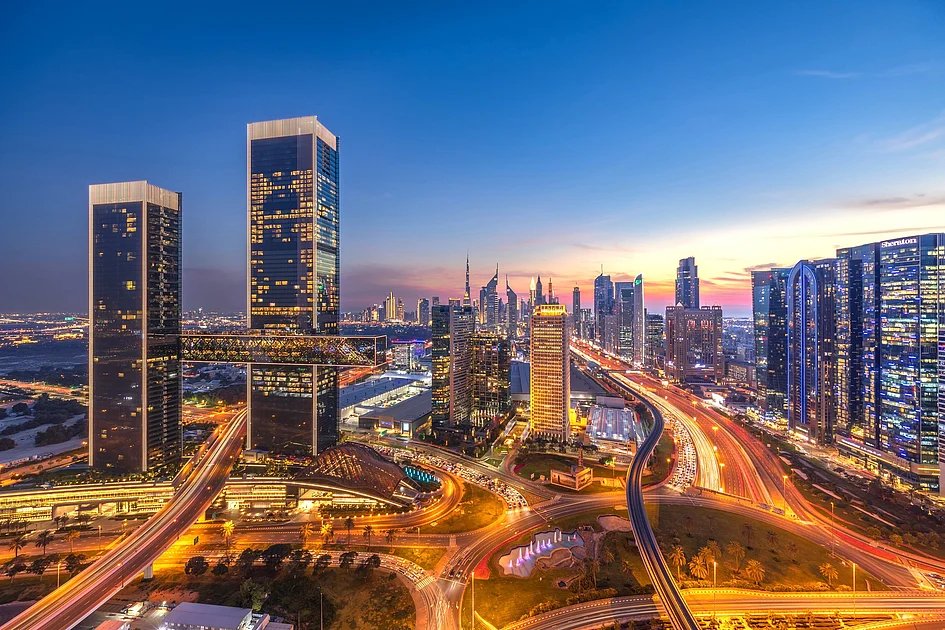
Dubai’s off-plan offices emerged as the city’s newest investment engine, reshaping the profile of corporate real estate demand and marking one of its most dynamic phases in a decade.
In October, commercial transactions surged to Dh12.3 billion across 1,274 deals, up 21.4 per cent year-on-year, according to Engel & Völkers Middle East. The value of activity rose 9.9 per cent compared with the same month in 2024, marking one of the strongest monthly performances on record.
The standout driver is the office segment, where transaction volumes jumped 64 per cent and values climbed 98 per cent. The momentum is supported by Dubai’s near-record prime office occupancy levels — consistently above 90 per cent — and by structural shifts in corporate behaviour as global firms consolidate regional operations in the emirate. Grade A districts such as Business Bay and Jumeirah Lakes Towers remain in high demand, with limited ready supply pushing investors toward the fast-growing off-plan segment.
This shift is dramatic. Off-plan office sales have expanded from 69 transactions in Q3 2024 to 389 in Q3 2025, a surge of 464 per cent. October alone saw 225 off-plan office deals completed, compared with just 33 a year earlier. Developments such as Lumena, Lumena Alta, AHS Tower, Samana Barari Avenue, 31 Above and Aspirz Tower are at the centre of this wave, attracting investors seeking modern, efficient workplaces built around sustainability standards, wellness features and high-spec digital infrastructure.
“The off-plan office segment has become one of Dubai’s most dynamic investment stories this year,” said Alex Lourenço, head of Commercial at Engel & Völkers Middle East. “Grade A supply is extremely tight, and corporates are demanding buildings that meet global benchmarks for design, technology and energy performance. Investors have responded to that gap with confidence, and pre-sales are reflecting this shift.”
Dubai’s broader economic conditions are reinforcing the trend. New business registrations reached record levels in 2025, while global corporates increasingly choose the UAE as their regional base. According to data from the Dubai International Financial Centre, the number of active companies in the financial hub has grown by more than half over the past three years. Meanwhile, CBRE and JLL have both reported strong upward pressure on prime office rents, driven by expanding multinational demand and sustained inflows of professional talent.
Retail properties also remain buoyant. Sales volumes rose 29 per cent in October and the value of transactions doubled year-on-year, supported by population growth, tourism spending and continued expansion of international brands. Developers are increasingly incorporating retail space into mixed-use commercial and residential projects as footfall expectations climb.
Against this backdrop, the residential sector is entering a steadier growth cycle after two years of exceptional acceleration. October recorded 18,530 residential sales, with off-plan activity accounting for 68.3 per cent. Secondary sales rose 14.4 per cent month-on-month, reflecting renewed interest in ready homes. Apartments commanded 85.8 per cent of transactions, supported by rental yields averaging 6.8 per cent. Prices remain resilient, rising between 5 and 10 per cent across many apartment communities and 10 to 20 per cent in villa districts.
Beyond property-specific dynamics, macroeconomic trends are deepening Dubai’s appeal as a headquarters destination. Standard Chartered’s “Future of Trade: Resilience” report identifies the UAE as one of six global markets shaping the future of international trade. Twenty per cent of corporates worldwide are reassessing their supply chains through the UAE, signalling its growing role as a resilient logistics and commercial hub with strong connectivity to Mainland China, Asean, Africa and the United States.
Half of corporates surveyed in Saudi Arabia, Egypt and India intend to expand trade with the UAE. “The UAE’s rise as a global trade hub reflects the country’s vision to diversify its economy and invest in world-class infrastructure,” said an analyst at a leading bank. “It is increasingly positioned at the centre of tomorrow’s trade corridors.”
Government-led industrial programmes such as Operation 300bn, which targets raising the industrial sector’s contribution to Dh300 billion by 2031, continue to support diversification. Investment in data centres, cloud infrastructure, advanced logistics and renewable energy is also drawing new industries to the UAE, contributing to the rise in demand for future-ready commercial spaces.
Engel & Völkers forecasts continued momentum in Dubai’s commercial property market through 2026 in the backdrop of prime office supply shortage, strong investor appetite and rising multinational demand rising, The surge in off-plan offices marks the start of a new growth cycle — one that is steadily shifting Dubai’s commercial real estate market from a stable performer into a strategic driver of the UAE’s evolving global trade and business ecosystem
