
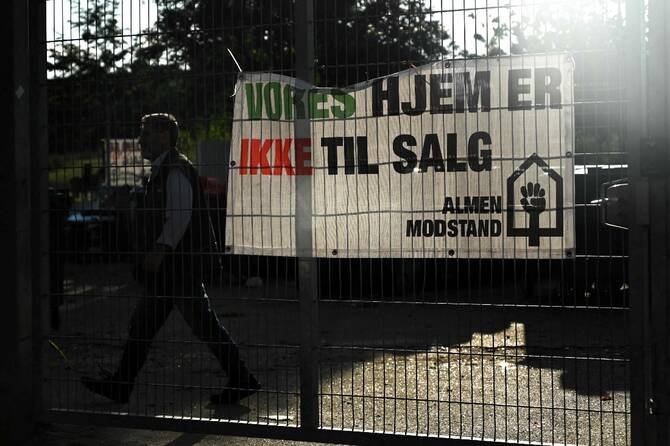
Residents of a Copenhagen estate challenge Denmark’s “ghetto” policy, arguing it illegally targets “non-Western” communities and forces displacement.
COPENHAGEN — The European Court of Justice is set to rule Thursday on whether Denmark’s controversial “ghetto” redevelopment law constitutes unlawful discrimination against immigrant communities. The legislation requires social housing estates with a majority of “non-Western immigrants and their descendants” to renovate and convert at least 60% of units to market-rate rentals by 2030.
Danish authorities say the policy aims to reduce segregation and dismantle “parallel societies” in high-crime neighborhoods. But residents of Copenhagen’s Mjolnerparken estate, who brought the case in 2020, argue it explicitly discriminates based on ethnicity.
“Using our ethnicity to decide where we can live is discriminatory and illegal,” said Muhammad Aslam, head of the tenants’ association at Mjolnerparken, where 80% of residents were classified as “non-Western” in 2020.
The plaintiffs gained hope in February when the European Court of Justice’s advocate general issued a preliminary opinion calling the policy “direct discrimination,” stating it places “an already disadvantaged ethnic group in a less favorable position.”
Under the law, thousands of residents across Denmark could be displaced. At Mjolnerparken, renovations have stretched over three years—far beyond the planned four months—with many apartments permanently converted to higher-cost rentals.
“If the ruling follows the advocate general’s opinion, we will be completely satisfied,” Aslam said. “Otherwise, it gives Denmark carte blanche to adopt more discriminatory laws,” added Lamies Nassri of the Center for Muslims’ Rights in Denmark.
The ruling could set a significant precedent for housing and integration policies within the European Union.
