
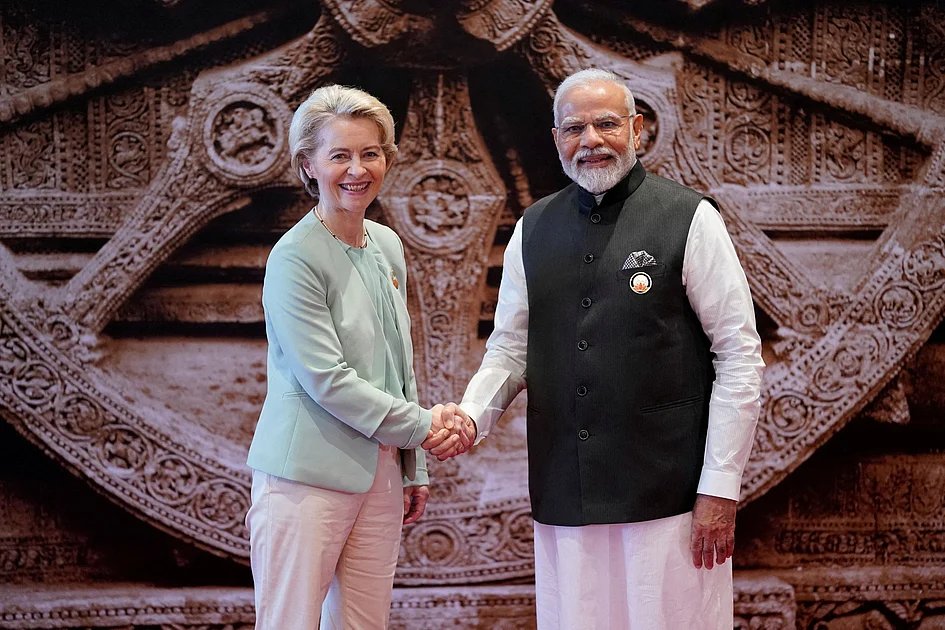
India and the European Union are closing in on a long-elusive free trade agreement that leaders on both sides have branded the “mother of all deals”, a mega-pact they hope will anchor market access and strategic trust as President Donald Trump’s tariff threats inject fresh volatility into global commerce.
European Commission President Ursula von der Leyen and European Council President António Costa are in New Delhi ahead of the 16th EU-India Summit on January 27, when officials expect an announcement that negotiations are being concluded — even if signatures come later.
EU officials have said the objective is to complete talks, but not to sign in Delhi, as negotiators finish bridging gaps that have kept the agreement stuck for nearly two decades. The timing is no accident, trade experts and economists say.
India has faced tariffs as high as 50 per cent on some exports to the US, and Europe is bracing for renewed tariff brinkmanship and trade disruptions. That pressure has turned the India-EU negotiation from a slow-moving economic project into a strategic hedge — a way to lock in predictable rules, diversify demand and reduce vulnerability to abrupt policy swings from Washington. To underline the scale, the EU is already India’s largest goods trading partner.
Two-way goods trade in FY2024/25 stood at just over $136 billion, according to figures cited by Indian and European sources in the run-up to the summit. The proposed FTA would expand that corridor across sectors, from industrial goods to services, while aiming to address chronic irritants such as non-tariff barriers and regulatory friction.
The contrast with India’s US trade relationship is stark — and helps explain why New Delhi wants options. US goods and services trade with India totalled an estimated $212.3 billion in 2024, with goods trade alone at $128.9 billion, according to the US Trade Representative.
That makes the US a larger overall two-way partner when services are included, but it is also the relationship now carrying the highest tariff uncertainty. The EU deal, Indian officials argue privately, is about building a second engine: if US tariff headwinds intensify, deeper access to Europe can soften the blow to exporters and investment sentiment.
New Delhi has been pursuing that “portfolio” approach aggressively, stitching together a run of bilateral agreements to broaden market access and attract capital. The most geopolitically resonant example came this month with the UAE. India and the UAE agreed to aim to double bilateral trade to $200 billion within six years/around 2032, after trade crossed $100.06 billion in FY2024/25 under the Cepa framework.
The message is clear: even as the US becomes more unpredictable, India is expanding trade corridors with partners willing to commit to long-term targets and institutional mechanisms. Economists say this is less about replacing the US market than about reducing single-market exposure. With India now the world’s fourth-largest economy and still one of the fastest-growing major markets, its strategy is to keep export and investment pipelines open in multiple directions — Europe for scale and standards-based access, the Gulf for energy-investment-supply chain linkages, and other FTAs to keep tariffs and compliance costs manageable when global trade becomes more fragmented.
Still, the India-EU pact faces sensitive last-mile hurdles. Agriculture remains politically explosive, and Indian officials have indicated that the most sensitive agricultural issues are effectively being kept off the table for now. Another major fault line is Europe’s Carbon Border Adjustment Mechanism (CBAM), which Indian industry fears could function as a new border charge on carbon-intensive exports, even as traditional tariffs fall.
Europe, for its part, has pushed for stronger intellectual property protections and data governance assurances. Beyond trade, the summit is designed to deliver a broader strategic package: a defence and security partnership, an information security agreement and a mobility framework covering categories such as highly skilled workers, students, researchers and seasonal workers.
That wider agenda reflects how both sides increasingly frame the relationship as a resilience partnership — spanning supply chains, critical minerals, connectivity and cooperation in multilateral forums — rather than a narrow tariff bargain. If announced as expected, the deal would be more than a headline: it would be India’s clearest signal yet that it intends to cushion tariff shocks by building overlapping trade alliances, turning market diversification into an economic shock absorber, trade analysts said.
“In a world of tariff threats and shifting blocs, New Delhi and Brussels appear determined to treat this as their moment to lock in a historic corridor — before the next round of trade turbulence hits.”
- India
