
Lawyers for Brenton Tarrant, who killed 51 in New Zealand’s 2019 mosque attacks, say he was determined to admit guilt—contradicting his current claim of being mentally unfit to plead.
WELLINGTON — Brenton Tarrant, the Australian white supremacist who murdered 51 worshippers in New Zealand’s 2019 Christchurch mosque attacks, was “pleased” to be charged with terrorism and insisted on pleading guilty to that charge, his former lawyers told an appeals court on Tuesday.
The testimony directly contradicted Tarrant’s current claim that he was mentally unfit when he admitted to the crimes, which he now seeks to withdraw.
Tarrant, 35, was sentenced to life imprisonment without parole in 2020 after pleading guilty to 51 murders, 40 attempted murders, and one charge of engaging in a terrorist act. He is now appealing those guilty pleas, arguing that harsh prison conditions—including prolonged solitary confinement—left him in a state of “nervous exhaustion” and impaired his judgment.
But his former legal team told the Court of Appeal that Tarrant was clear-headed and deliberate in his decision to plead guilty, and that he specifically wanted to be convicted as a terrorist.
“He wanted to be described as a terrorist,” said Jonathan Hudson, one of Tarrant’s former lawyers.
Shane Tait, another former lawyer, said Tarrant had initially floated the idea of arguing at trial that he was “defending” New Zealand—a claim Tait told him had no legal basis. When Tait pressed him on what defense he would present, Tarrant replied, “Don’t worry, it won’t get that far,” indicating his intent to plead guilty.
Both lawyers said Tarrant refused to let them negotiate the terrorism charge away, despite the overwhelming evidence against him, which included a livestream of the attack and a racist manifesto.
Crown lawyers have argued Tarrant had multiple opportunities to raise mental health concerns before pleading guilty but never did. No witness has yet supported his claim that he was unfit to enter a plea.
The appeal hearing, which began Monday, marks the first time Tarrant has been seen in court in years. Appearing via video link from prison, he appeared pale and thin, with a shaved head and glasses.
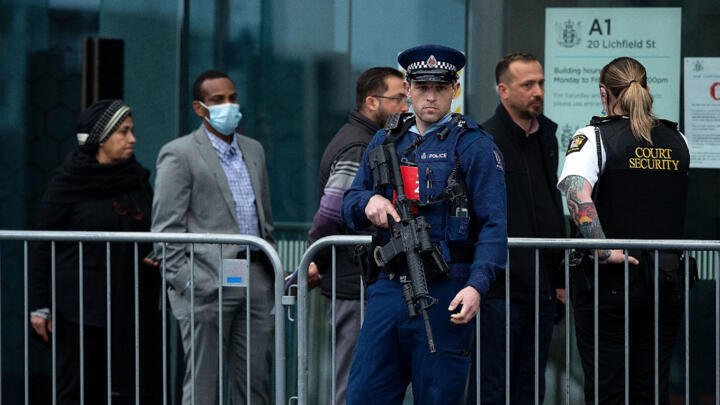
In Christchurch, families of the victims watched the proceedings via livestream. Many expressed anger and exhaustion that the gunman was able to reopen his case.
“There’s definitely no remorse at all,” said Rashid Omar, whose son Tariq was killed. “We are very, very strong. We’re not going to be bullied by him.”
The Court of Appeal’s decision is expected at a later date. If Tarrant’s bid to withdraw his guilty pleas fails, a separate hearing will consider his appeal against his life-without-parole sentence.
