
As West Asia conflict disrupts fuel supplies, neighbours from Sri Lanka to Nepal turn to New Delhi—not just for oil, but for strategic stability and trust.
NEW DELHI — When global supply chains seize up and energy markets spiral into chaos, a familiar dynamic takes hold in South Asia: neighbours look to India.
The latest disruption—sparked by escalating military confrontation in West Asia and threats to shipping through the strategic Strait of Hormuz—has once again underscored New Delhi’s emerging role as the region’s stabiliser. With fuel prices soaring and supplies tightening, Bangladesh, Sri Lanka, the Maldives, and Nepal have all approached India for urgent assistance in securing petroleum products and LPG.
These requests are more than diplomatic formalities. They reflect the severity of the current energy crunch and mark a quiet but significant shift in India’s standing—from a regional power to an indispensable economic partner.
A Region Exposed to Global Shocks
The Strait of Hormuz, through which a substantial portion of the world’s oil and liquefied natural gas flows, has become a flashpoint. For energy-importing regions like South Asia, the ripple effects are immediate and severe.
Nations with limited refining capacity and fragile storage infrastructure are the most vulnerable. Bangladesh, for instance, has been forced into the costly spot LNG market after long-term contracts unraveled. The government has imposed fuel rationing and cut energy consumption to keep the economy afloat. In such a landscape, securing refined products from a proximate and reliable supplier is no longer just convenient—it is existential.
India’s Refining Muscle
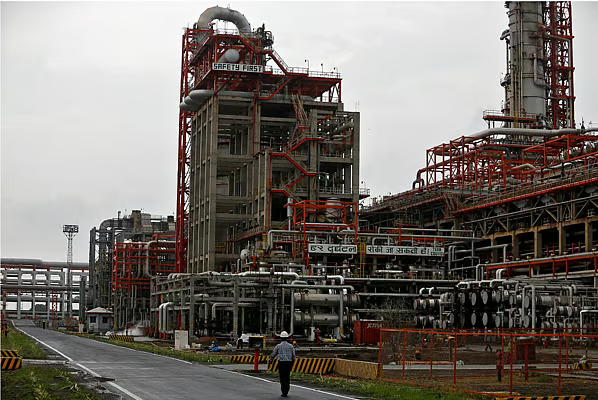
India’s capacity to respond is rooted in a decades-long industrial strategy. It has transformed itself into one of the world’s largest refining hubs, capable of processing crude into diesel, petrol, and aviation fuel for export to Asia and Africa.
This evolution has quietly redefined India’s regional footprint. No longer merely a consumer of crude, India now functions as a critical processor and supplier for its neighbours. When shortages hit, New Delhi is often the closest and most dependable source of refined fuel.
Currently, Indian policymakers are reviewing requests for additional supplies, carefully balancing regional commitments with domestic energy requirements—a complex equation for a nation of 1.4 billion people with a rapidly expanding economy.
A Legacy of Standing by Neighbours
India’s instinct to help during crises is not new. Over the decades, New Delhi has consistently extended a hand to neighbouring countries facing natural disasters, economic distress, or supply disruptions.
During Sri Lanka’s catastrophic economic collapse in 2022, India provided over $4 billion in assistance through credit lines, currency swaps, and shipments of fuel and food. The aid helped keep essential services running in a nation on the brink.
Similar patterns hold elsewhere. The Bangladesh-India Friendship Pipeline, linking Numaligarh refinery to Parbatipur, has institutionalised long-term fuel cooperation. In Nepal, the Motihari-Amlekhganj petroleum pipeline ensures a steady flow of supplies, minimizing logistical disruptions along the porous border.
These are not just emergency measures; they are the building blocks of long-term infrastructure partnerships designed to strengthen regional resilience.
From Energy Trade to Strategic Trust
Energy cooperation carries weight beyond economics. When nations turn to India for help, it signals a deepening of trust and interdependence.
In times of crisis, New Delhi has responded with financial support, fuel shipments, and logistical aid. Such actions accumulate goodwill and reinforce India’s image as a dependable partner. For smaller South Asian economies facing urgent shortages, India’s geographical proximity, established logistics, and diplomatic familiarity make it the natural first call.
In this context, energy assistance becomes more than commerce. It acts as a buffer against political instability, preventing economic distress from spiraling into broader chaos.
The Domestic Balancing Act
Still, India must walk a tightrope. Its own energy security is paramount. Officials have made clear that any decision to boost exports will hinge on domestic supply levels and refining capacity.
Yet India’s diversified procurement strategy and massive refining base provide a cushion that many of its neighbours lack. This margin of flexibility allows New Delhi to extend support during periods of global stress without compromising its own needs.
Toward a Regional Energy Future
The current crisis also illuminates a deeper truth: South Asia’s long-term energy security depends on cooperation, not isolation.
Shared pipelines, cross-border electricity grids, and coordinated emergency reserves could revolutionise how the region manages disruptions. Initiatives like the BBIN (Bangladesh, Bhutan, India, Nepal) framework are already laying the groundwork for greater integration in infrastructure and energy.
If these efforts gain momentum, South Asia could evolve from a collection of vulnerable energy markets into a resilient, interconnected system capable of weathering global shocks.
India’s Evolving Role
The requests from Dhaka, Colombo, and Malé are ultimately about more than fuel shipments. They illustrate how India’s economic scale, industrial capacity, and geographic position are reshaping its role in the region.
In moments of global upheaval, countries gravitate toward the power that is closest, most capable, and most trusted. For South Asia, that power increasingly appears to be India.
Decades of standing by its neighbours have built a reservoir of trust that now underpins regional cooperation. In an uncertain world, that spirit of partnership may prove to be South Asia’s greatest asset.
