
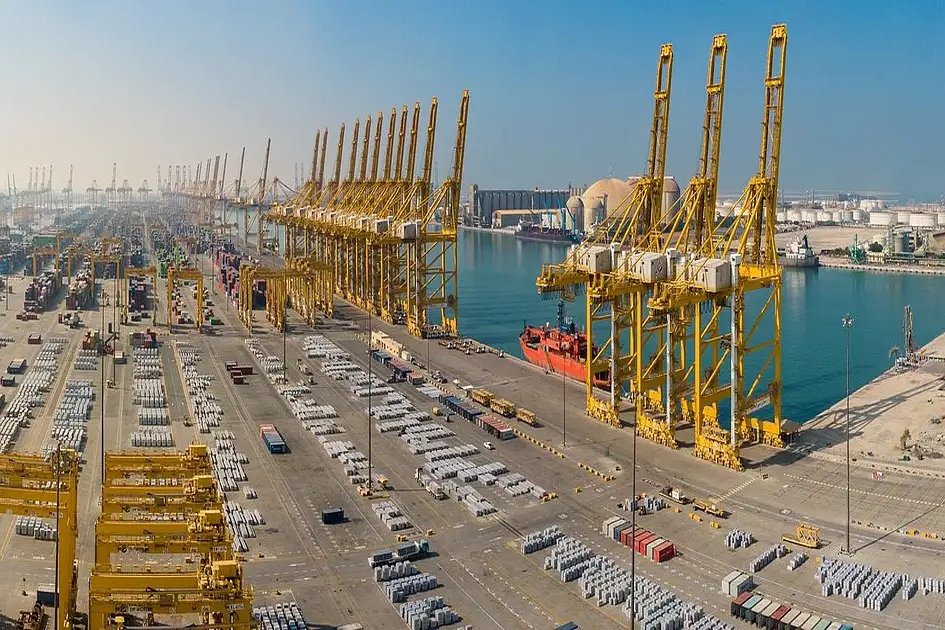
The UAE is positioning itself to become one of the world’s top five exporting nations within five years, building on its historic entry into the global top 10 exporters after total trade in goods and services surged to $1.637 trillion (Dh6 trillion) in 2025, according to the latest World Trade Organisation data released this week.
The country ranked ninth globally in goods exports, marking a rapid climb from 17th place just five years ago and underscoring a structural shift from a regional re-export hub to a diversified global trade platform spanning hydrocarbons, aluminium, gold, machinery, electronics and high-value services.
“The UAE’s rise into the world’s top 10 exporters marks a structural shift from a regional re-export hub to a globally competitive trade power,” said Dr Raymond Khoury, partner and Public Sector Practice Lead at Arthur D. Little Middle East. “With continued expansion of trade agreements, advanced logistics and digital trade capabilities, the UAE is well positioned to move further up the rankings — potentially toward the top five.”
A central pillar of this momentum is the UAE’s accelerating non-oil trade expansion, which crossed Dh4 trillion ($1.09 trillion) in 2025 — six years ahead of the country’s 2031 target. The milestone highlights the success of diversification policies that have strengthened exports across logistics, financial services, manufacturing, precious metals, aviation and digital trade.
The rapid rollout of Comprehensive Economic Partnership Agreements (Cepas) has emerged as one of the most decisive drivers of export growth. The UAE has concluded Cepas with major partners including India, Turkey, Indonesia, Israel, Serbia, Jordan and Vietnam, while negotiations continue with several African and Asian economies. Non-oil exports to the 14 Cepa partner countries in force by the end of 2025 reached Dh175.5 billion, rising 18.2 per cent year-on-year and accounting for more than one-fifth of total exports.
Among these agreements, the UAE–India Cepa stands out as the single most transformative corridor supporting the UAE’s export ambitions. Bilateral trade between the UAE and India reached about $100 billion in the 2024-25 financial year, nearly doubling within three years of the agreement’s implementation in 2022 — five years ahead of target.
The Cepa has lowered tariffs across sectors such as gems and jewellery, aluminium, petrochemicals, food products and engineering goods while accelerating investment flows and supply-chain integration between the Gulf and South Asia. During President Sheikh Mohamed bin Zayed Al Nahyan’s visit to India earlier this year, both countries committed to doubling bilateral trade again to $200 billion by 2032, reinforcing India’s role as a cornerstone of the UAE’s export expansion strategy.
According to trade watchers, agreements like Cepa are designed not only to facilitate trade but to actively encourage investment flows between partner economies. Lower tariffs improve competitiveness for UAE exporters and expand access to supplier networks and new markets.
Beyond merchandise exports, services trade is emerging as another powerful engine supporting the UAE’s climb in global rankings. Services trade exceeded $310 billion in 2025, with exports accounting for more than 60 per cent, reflecting strong growth in aviation, logistics, tourism, fintech and professional services. Digital services exports alone reached $33 billion, highlighting the country’s growing strength in knowledge-based trade sectors.
The UAE is also strengthening export competitiveness through technology. The Ministry of Foreign Trade’s partnership with Abu Dhabi-based artificial intelligence firm Presight to deploy a nationwide AI-powered trade platform is expected to enhance customs efficiency, supply-chain visibility and trade analytics.
Dr Thani Al Zeyoudi said the WTO ranking reflects strong global confidence in the UAE’s open economic model and long-term commitment to trade liberalisation despite geopolitical uncertainty and slowing global merchandise trade growth.
Economists at International Monetary Fund have also highlighted the UAE’s diversified non-oil growth strategy, logistics infrastructure and expanding trade partnerships as key factors strengthening its role as a global trade corridor linking Asia, Africa and Europe.
Analysts noted that with one of the world’s most extensive Cepa networks among emerging economies, world-class ports and logistics corridors, expanding digital trade platforms and deepening integration with fast-growing partners such as India, the UAE is increasingly evolving from a transit hub into a global trade orchestrator — a transformation that makes a top-five exporter ranking within reach before the end of the decade.
