
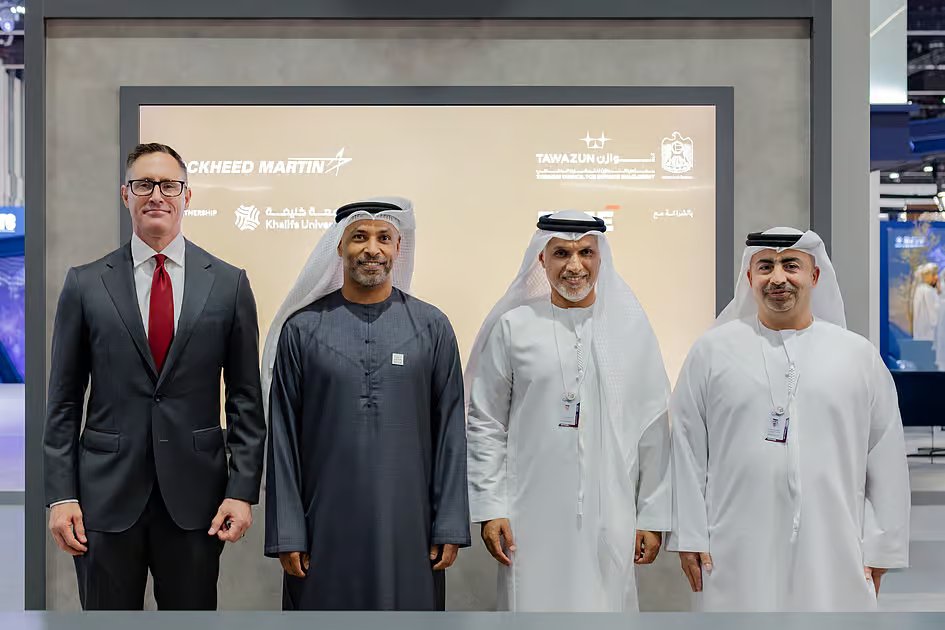
The UAE has taken a decisive step towards building a sovereign defence and advanced technology ecosystem after Lockheed Martin, the world’s largest defence contractor, signed a landmark agreement with the Tawazun Council to establish an advanced microelectronics design and assembly facility in the country.
The agreement, announced on the sidelines of “Make it in the Emirates 2926,” UAE’s flagship industrial platform, marks a significant milestone in Abu Dhabi’s strategy to localise critical defence technologies, deepen semiconductor capabilities and position the country as a regional hub for next-generation manufacturing.
The project will be developed in partnership with Edge Group and Khalifa University and will focus on advanced “chiplet”-based semiconductor technologies increasingly regarded as essential for aerospace, artificial intelligence, autonomous systems and modern defence platforms.
The move comes against the backdrop of a broader industrial transformation drive in the UAE, where policymakers are accelerating efforts to reduce reliance on imported strategic technologies while embedding the country deeper into global manufacturing and supply chains.
The significance of the announcement was amplified by a parallel initiative unveiled a day earlier, when Tawazun and AD Ports Group announced plans to establish the Al Selmiyyah Defence Industrial Free Zone in Abu Dhabi — a specialised ecosystem designed to attract leading global defence manufacturers and expand localised production.
Together, the two initiatives underscore how the UAE is moving beyond its traditional role as a major defence buyer towards becoming an integrated producer, developer and exporter of advanced technologies.
Lockheed Martin’s involvement adds considerable weight to the project. The US-based company, which generates annual revenues exceeding $65 billion, is widely regarded as the world’s leading defence equipment manufacturer, producing some of the most advanced military systems globally, including the F-35 fighter jet, missile defence platforms, radar systems, satellites and combat technologies.
Industry analysts say the partnership represents a major strategic gain for the UAE because it places the country inside a critical segment of the global semiconductor and defence technology value chain at a time when governments worldwide are scrambling to secure resilient access to advanced chips and critical components.
Chiplets — modular semiconductor units combined into powerful processors — are increasingly viewed as the future of high-performance computing because they improve scalability, reduce manufacturing costs and enable faster technological upgrades compared with traditional semiconductor designs.
Under the agreement, Halcon, a subsidiary of Edge Group, will integrate chiplet-based processors into advanced targeting and guidance systems to enhance onboard computing capabilities, target acquisition and precision engagement.
The initiative will also establish a dedicated research and development centre at Khalifa University focused on semiconductor design, microelectronics research and specialised talent development for UAE nationals.
Analysts say the project reflects the UAE’s determination to build long-term industrial resilience as geopolitical tensions, trade restrictions and supply-chain disruptions reshape global manufacturing priorities.
“The UAE is strategically positioning itself in technologies that will define future economic and defence competitiveness,” a regional defence analyst said. “This is no longer about assembling imported systems. It is about developing sovereign technological capability.”
The partnership also strengthens the UAE-US technology relationship through a co-development model linking Emirati industrial ambitions with American technological expertise and innovation networks.
Daniel Mouton, chief executive of Lockheed Martin Middle East, said the initiative would help establish the UAE’s role within the global microelectronics ecosystem.
“Chiplets are foundational to the next generation of aerospace, defence, AI and autonomous systems,” he said. “This initiative brings together UAE vision, Emirati talent and US technology partners to build capability that can serve both national priorities and wider industrial growth.”
The semiconductor project complements the newly announced Al Selmiyyah Defence Industrial Free Zone, which is expected to become one of the Middle East’s most advanced defence manufacturing clusters.
The free zone aims to attract leading global original equipment manufacturers, facilitate technology transfer and integrate UAE-based manufacturers into regional and international supply chains.
Under the framework agreement, Tawazun will oversee regulatory, licensing and industrial compliance systems, while AD Ports Group will lead infrastructure planning, logistics integration and industrial zone development.
The zone will also benefit from direct connectivity to regional and global trade networks, strengthening export readiness and supporting the UAE’s ambition to become a competitive global centre for defence manufacturing.
The initiatives align closely with the UAE’s broader “Make it in the Emirates” strategy, which seeks to expand industrial contribution to GDP, develop high-value manufacturing sectors and create advanced employment opportunities for Emiratis.
Over the past decade, the UAE has steadily expanded its defence industrial footprint through EDGE Group, Tawazun Industrial Park and a growing ecosystem of aerospace, autonomous systems and advanced manufacturing ventures.
However, analysts say the latest semiconductor and industrial free zone initiatives mark a more ambitious phase focused on securing control over critical technologies that underpin future defence and industrial competitiveness.
As global supply chains become increasingly fragmented and technology competition intensifies, the UAE appears determined to ensure it occupies a far more strategic position in the industries likely to shape the next phase of the global economy.
