
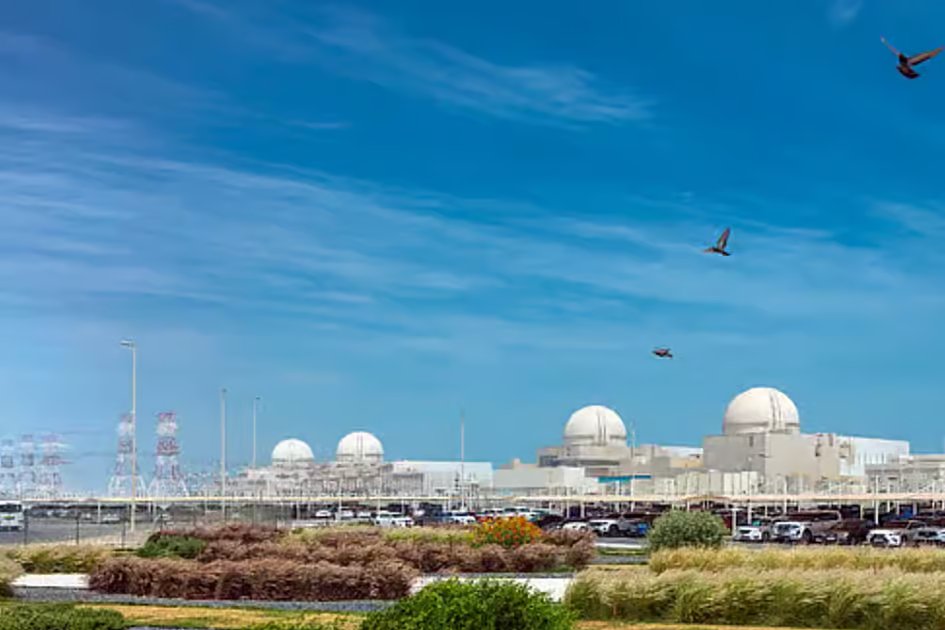
The UAE ministry said the country detected and engaged a total of six drones, over the past 48 hours
[Editor’s Note: Follow the media live blog for the latest regional developments with the US-Israel-Iran ceasefire now in effect.]
UAE has revealed the source of attacks near Barakah nuclear plant. The Ministry of Defence confirmed that the three drones on May 17, along with the drones intercepted subsequently, all originated from Iraqi territory.
The UAE ministry said the country detected and engaged a total of six drones, over the past 48 hours, which attempted to target civilian and vital areas in the country.
On the same day that the Barakah plant was targeted, Saudi Arabia also faced drone attacks coming from Iraqi airspace, which were intercepted and destroyed after entering the Kingdom’s airspace. The UAE condemned these attacks, and confirmed its full solidarity with Saudi Arabia.
Attack near Barakah plant
On May 17, UAE said a drone strike caused a fire at an electrical generator outside the inner perimeter of Abu Dhabi’s Barakah Nuclear Power Plant in the Al Dhafra region.
The ministry later confirmed that out of the three drones that were detected, two were intercepted, while the third struck the generator. Abu Dhabi Media Office confirmed that the blaze did not result in any injuries and had no impact on radiation safety levels at the facility.
On Sunday, the ministry added that it would undertake investigations to determine the source of the attacks.
IAEA confirms normal radiation levels
International Atomic Energy Agency said on Sunday that UAE informed the body that radiation levels remained normal after the drone strike, and that no injuries were reported. IAEA said on May 17 that emergency diesel generators were providing power to the plant’s unit 3.
IAEA was following the situation closely and was “in constant contact with the UAE authorities, ready to provide assistance if needed,” the UN watchdog said.
On May 18, IAEA cited the UAE as saying that off-site power was restored to Unit 3 of the Barakah plant earlier today. Rafael Grossi, the Director-General of the body, reiterated that “nuclear sites and other installations important for nuclear safety must never be targeted by military activity.”
What UAE said in response to the attack
Anwar Gargash, Diplomatic Adviser to UAE President, stressed the Emirates’ resolve: “No one will twist the UAE’s arm, nor will they succeed in undermining its vision, its success, and its inspiring message to the peoples of the region in security, stability, development, and prosperity.”
He added that the “terrorist” attack showed a “criminal disregard for the lives of civilians in the UAE”.
The country’s Ministry of Foreign Affairs (MoFA) said the attack is a “dangerous escalation,” posing a “direct threat” to the country’s security. UAE termed it an “unacceptable act of aggression”, stressing that targeting peaceful nuclear energy facilities is a flagrant violation of international law, the UN charter, and humanitarian law.
Gulf countries, other nations condemn attack
Saudi Arabia pointed out that such attacks threaten the security and stability of the entire region. Kuwait termed the attack as a “heinous act” and stressed that targeting vital and civilian sites is condemned and “rejected by all legal standards.”
Meanwhile, Bahrain pointed out that the attack is a violation of international law, along with a violation of the UN Charter, the principles of good neighbourliness, and UN Security Council Resolution 2817. Oman also condemned the attack, affirmed its solidarity with the UAE regarding the measures it is taking to preserve its security and the safety of its territories.
Read the media report for more countries’ statements denouncing the attack near Barakah plant.
