
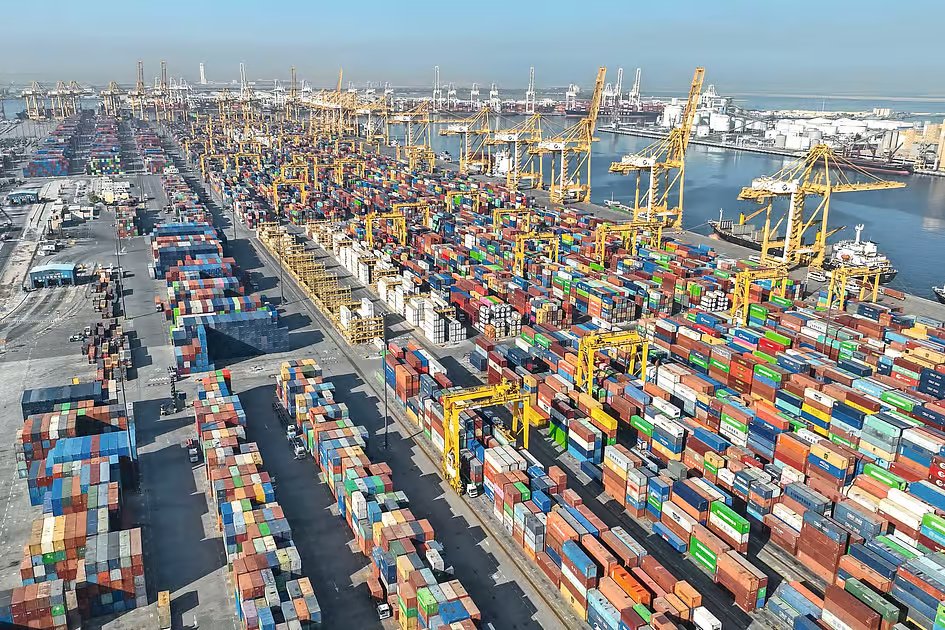
The UAE is accelerating its transformation into a global trade and logistics powerhouse as the Iran war redraws supply chains, disrupts traditional shipping routes and forces economies to rethink the architecture of international commerce.
Speaking at the GLOBSEC Forum 2026 in Prague, Thani bin Ahmed Al Zeyoudi said the regional conflict has not derailed the country’s long-term economic strategy but instead hastened the diversification of trade corridors and reinforced the UAE’s position as one of the world’s most resilient commercial hubs.
Participating in a high-level panel discussion titled “The Ripple Effect: How the Iran War is Shaping Global Economies and Politics,” Al Zeyoudi outlined a series of emergency and structural measures introduced by the UAE to ensure uninterrupted trade flows amid rising geopolitical instability in the Middle East.
These measures include the activation of alternative shipping and logistics corridors through the UAE’s eastern ports of Fujairah and Khorfakkan, expansion of air freight bridges for critical pharmaceutical and food supplies, the launch of a Green Corridor with Oman, and a new Sharjah-Dammam trade bridge linking the UAE more efficiently with Saudi Arabia and wider Gulf markets.
“The fundamental redesign of Gulf logistics that we were undertaking over a decade is now being compressed into years,” Al Zeyoudi said. “What this moment has done is accelerate the timelines of existing plans and underscore the wisdom of building an open, diversified and resilient trade architecture before it is needed.”
The minister said the UAE had also introduced a Dh1 billion economic support fund to ensure business continuity and targeted relief for small and medium enterprises, alongside a Five-Pillar Financial Institution Resilience Package unveiled by the Central Bank to maintain liquidity and sustain credit flows across the economy.
The latest initiatives come as the UAE consolidates its emergence as one of the world’s leading trade nations. According to the latest World Trade Organization data, the UAE climbed to become the world’s ninth-largest exporter of goods and the 13th-largest importer — a historic milestone reflecting the country’s rapid ascent in global commerce.
Al Zeyoudi described the achievement as a strong endorsement of the UAE’s competitiveness and investor confidence despite mounting geopolitical risks.
“Despite the current geopolitical challenges, we are determined to build on this success and strengthen our position on the global trade map,” he said.
The WTO report showed that the UAE’s non-oil foreign trade exceeded Dh3.78 trillion ($1.03 trillion) in 2025 for the first time, underlining the success of the country’s diversification drive and its aggressive trade expansion strategy.
The UAE’s contribution to global goods exports rose to 3.3 per cent, while its share of global goods imports reached 2.8 per cent. In services trade, the country accounted for 2 per cent of global exports and 1.4 per cent of global imports.
The country’s fast-growing services economy also crossed the Dh1 trillion mark for the first time, with total services trade reaching Dh1.14 trillion in 2025. Analysts say this reflects the growing strength of sectors such as logistics, finance, aviation, tourism, technology and digital services.
Particularly notable was the UAE’s rise in digital trade. The country ranked 25th globally in digital services exports, generating $33 billion (Dh121 billion), accounting for 17 per cent of the UAE’s total services exports.
Economists say the UAE’s ability to maintain trade momentum during regional turmoil stems from years of investment in ports, aviation infrastructure, customs digitisation, free zones and trade agreements.
The UAE’s Comprehensive Economic Partnership Agreement (Cepa) programme has emerged as a cornerstone of that strategy. Since signing its first Cepa with India in 2022, the UAE has expanded the initiative rapidly, reaching 36 agreements across six continents.
These agreements are designed to reduce tariffs, simplify customs procedures, improve market access and strengthen investment flows, positioning the UAE as a gateway connecting Asia, Africa, Europe and the Middle East.
“Nothing that we have achieved in the last five years has been undone or unwound,” Al Zeyoudi said. “The UAE is a bridge to high-growth markets across the Gulf, Africa and Asia, and a partner for trade, logistics, investment and technology. That role has not diminished. It has become more important.”
Trade experts say the current conflict is accelerating a broader structural shift already under way in the Gulf, where countries are seeking to reduce dependence on vulnerable chokepoints such as the Strait of Hormuz while building multimodal trade ecosystems integrating ports, railways, highways and air cargo networks.
The UAE’s eastern seaboard ports, particularly Fujairah, have gained strategic significance because they provide direct access to the Indian Ocean outside the Strait of Hormuz, allowing trade flows to continue even during periods of heightened maritime risk.
At the same time, the country’s logistics and aviation sectors are benefiting from businesses rerouting cargo through safer and more efficient regional hubs.
Despite the UAE’s strong performance, the WTO warned that the regional conflict could weigh heavily on global trade growth this year.
The organisation expects global goods trade growth to slow to 1.9 per cent in 2026 from 4.6 per cent in 2025, while services trade growth is projected to ease to 4.8 per cent before recovering in 2027. The WTO cautioned that a prolonged rise in energy prices could further weaken global trade momentum.
Analysts believe the UAE remains among the best-positioned economies in the region to navigate geopolitical volatility due to its diversified economic base, strong sovereign finances, advanced infrastructure and strategic geographic location connecting East and West.
