
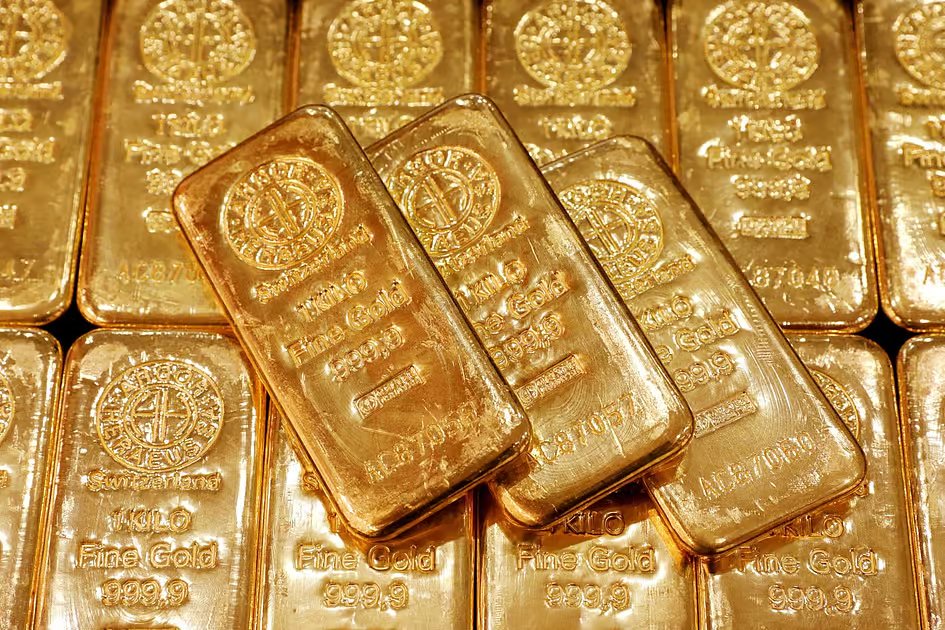
Gold prices slumped to their lowest level in nearly three months on Wednesday as a stronger US dollar, rising Treasury yields and renewed geopolitical uncertainty triggered a fresh wave of selling in precious metals, even as leading Wall Street banks maintained bullish long-term forecasts for the safe-haven asset.
Spot gold fell as much as 1.9 per cent to around $4,181 an ounce, breaching the key $4,200 support level and extending its decline to nearly 12 per cent from recent highs. The drop marks a sharp reversal from the record-breaking rally that saw gold surge above $5,500 an ounce earlier this year amid escalating Middle East tensions, central bank buying and concerns over global economic stability.
The latest weakness comes after Citigroup lowered its three-month gold price target to $4,000 an ounce from $4,300, citing mounting headwinds from higher-for-longer US interest rates and fading geopolitical risk premiums. However, the bank maintained its six- to 12-month target of $5,000 an ounce, signalling confidence that the structural drivers behind the gold bull market remain intact.
For UAE consumers, the global sell-off has translated into a sharp correction in local bullion prices. Dubai’s benchmark retail gold rate fell to Dh514.25 per gram for 24K gold and Dh476.25 per gram for 22K gold on Wednesday, down sharply from the record highs above Dh600 per gram seen during the peak of the Middle East conflict earlier this year. A 10-gram purchase of 22K gold now costs about Dh4,762 before making charges, offering some relief to buyers who had deferred purchases as prices surged to historic highs.
The sell-off gathered momentum after stronger-than-expected US economic data reinforced expectations that the Federal Reserve could keep interest rates elevated for longer. Investors are also grappling with renewed concerns over inflation as energy markets remain volatile, prompting traders to scale back expectations of imminent monetary easing.
Analysts said higher Treasury yields and a firmer dollar have become the dominant forces driving gold prices in recent weeks. Markets are now pricing in more than a 70 per cent probability of a US interest-rate increase by December. Higher rates increase the opportunity cost of holding non-yielding assets such as gold, while a stronger dollar makes bullion more expensive for international investors.
The correction has erased a significant portion of gold’s extraordinary gains over the past 18 months. Yet most major investment banks remain convinced that the longer-term outlook remains favourable.
Goldman Sachs continues to rank gold among its highest-conviction commodity trades and expects prices to reach between $4,900 and $5,400 an ounce by the end of 2026. Goldman analysts argue that persistent central-bank buying, ongoing reserve diversification away from the US dollar and eventual Federal Reserve rate cuts will continue to underpin demand.
The investment bank also believes concerns over rising sovereign debt burdens and fiscal sustainability in major economies will encourage both institutional and retail investors to maintain exposure to gold as a portfolio hedge. Goldman Sachs has repeatedly highlighted central-bank demand as the single most important structural support for bullion prices.
Morgan Stanley has similarly maintained a constructive outlook, forecasting gold could climb to $4,800 an ounce by the fourth quarter of 2026. The bank expects lower interest rates next year, continued central-bank accumulation and stronger inflows into exchange-traded funds backed by physical gold to support prices.
According to the World Gold Council, central banks have emerged as one of the most powerful drivers of gold demand over the past four years. Official-sector purchases have consistently exceeded historical averages as countries seek to diversify reserves and reduce dependence on the US dollar amid an increasingly fragmented geopolitical environment.
The World Gold Council estimates that central banks bought a net 244 tonnes of gold during the first quarter of 2026 alone, extending a trend that has transformed the structure of the global gold market. Analysts note that while speculative investment demand can fluctuate sharply in response to interest-rate expectations, central-bank purchases tend to be longer term and less sensitive to short-term price movements, providing a crucial floor for the market.
Kotak Securities said stronger-than-expected US economic data continues to strengthen the case for a tighter monetary policy stance, keeping pressure on precious metals. The brokerage identified key support levels for spot gold at $4,205, followed by the psychologically important $4,000 level. Resistance is seen around $4,367, $4,388 and $4,458 an ounce.
Technical analysts believe the break below the $4,300-$4,350 range has shifted momentum decisively lower in the near term. A sustained move below $4,200 could open the door to further declines towards Citi’s revised target of $4,000 an ounce.
Despite the correction, industry observers argue that the current pullback represents a consolidation following an unprecedented rally rather than the beginning of a prolonged bear market. Gold remains substantially higher than levels seen two years ago and continues to outperform many traditional asset classes during periods of market uncertainty.
For investors and jewellery buyers in the UAE, the correction is being closely watched after gold prices scaled unprecedented highs during the geopolitical turmoil of recent months. Dubai’s retail gold rate currently stands at Dh514.25 per gram for 24K, Dh476.25 for 22K, Dh456.75 for 21K and Dh391.50 for 18K gold. The decline has already begun to revive buying interest among residents and tourists, particularly from India, where consumers traditionally view price corrections as an opportunity to accumulate gold ahead of the festive and wedding seasons.
The pullback is particularly noteworthy because gold remains substantially higher than a year ago despite the recent decline. At current Dubai rates, 24K gold is still trading above Dh500 per gram, compared with levels below Dh300 per gram just two years ago. Analysts say this underscores a structural shift in the market driven by central-bank buying, reserve diversification away from the dollar and persistent geopolitical risks — factors that continue to support Wall Street’s bullish long-term projections.
Silver has also come under pressure amid the broader precious-metals sell-off. Spot silver slipped to around $67.5 an ounce after briefly trading near $69 earlier this week. Kotak Securities sees support at $67.18, followed by $66.43 and $64.01 an ounce, while resistance is placed at $69.60, $70.35 and $72.77.
However, Morgan Stanley remains optimistic about silver’s longer-term prospects, citing robust industrial demand from solar energy projects, electric vehicles, battery technologies and advanced electronics manufacturing. The bank expects the energy transition and expanding technology sector to provide a powerful long-term demand tailwind for the metal.
The emerging consensus among global investment banks is that gold may face additional turbulence in the coming months as markets navigate higher interest rates, resilient US economic growth and a stronger dollar. Yet the longer-term case for bullion remains firmly intact, supported by central-bank demand, geopolitical uncertainty, fiscal concerns and expectations that global monetary policy will eventually become more accommodative.
For now, gold’s journey back towards the $5,000 mark may be delayed, but few on Wall Street appear willing to bet against the precious metal’s enduring appeal as a store of value and hedge against uncertainty.
