Close Menu
    What's Hot

    The Himalayas are melting faster – and India's economy is 'at risk'A new report warns Himalayan glaciers are melting faster, threatening India’s water, economy and communities.3 hrs agoAsia

    September 14, 2026

    Why a fresh wave of North Korean soldiers may fight in Russia's war in UkraineNorth Korea will continue to send its soldiers to fight in Russia's war, but only for as long as it is profitable to do so, writes the BBC's Quentin Sommerville.2 hrs agoBBC InDepth

    September 14, 2026

    Zverev caps transformational year with US Open triumphAlexander Zverev lands his second Grand Slam title after ending Ben Shelton's hopes of becoming a rare home US Open men's champion.26 mins agoTennis

    September 14, 2026
    Facebook X (Twitter) Instagram
    • Politics
    • Economy
    Facebook X (Twitter) Instagram
    Gulf News Week
    Subscribe
    Monday, September 14
    • Home
    • Politics
      • Europe
      • Middle East
      • Russia
      • Social
      • Ukraine Conflict
      • US Politics
      • World
    • Region
      • Middle East News
    • World
    • Economy
      • Banking
      • Business
      • Markets
    • Real Estate
    • Science & Tech
      • AI & Tech
      • Climate
      • Computing
      • Science
      • Space Science
      • Tech
    • Sports

      Dominant PSG put Liverpool on the brink with 2-0 Champions League quarter-final first-leg win

      April 9, 2026

      Dubai Basketball U-18 Elite Crowned Basket Cup Sarajevo 2026 Champions in Historic Debut

      April 6, 2026

      Saudi boxing crowns 20 champions as Kingdom’s Elite Belt concludes in Riyadh

      April 4, 2026

      “He Signed for a Real Fight”: Pacquiao Contradicts Mayweather Over Rematch Status

      April 3, 2026

      Arsenal Hold Off Chelsea Fightback to Reach Women’s Champions League Semi-Finals

      April 2, 2026
    • Health
    • Travel
    • Contact
    Gulf News Week
    Home»Most Viewed News»The Himalayas are melting faster – and India's economy is 'at risk'A new report warns Himalayan glaciers are melting faster, threatening India’s water, economy and communities.3 hrs agoAsia
    Most Viewed News

    The Himalayas are melting faster – and India's economy is 'at risk'A new report warns Himalayan glaciers are melting faster, threatening India’s water, economy and communities.3 hrs agoAsia

    Gulf News WeekBy Gulf News WeekSeptember 14, 2026No Comments5 Mins Read
    Share Facebook Twitter Pinterest Copy Link LinkedIn Tumblr Email VKontakte Telegram
    The Himalayas are melting faster - and India's economy is 'at risk'A new report warns Himalayan glaciers are melting faster, threatening India’s water, economy and communities.3 hrs agoAsia
    Share
    Facebook Twitter Pinterest Email Copy Link
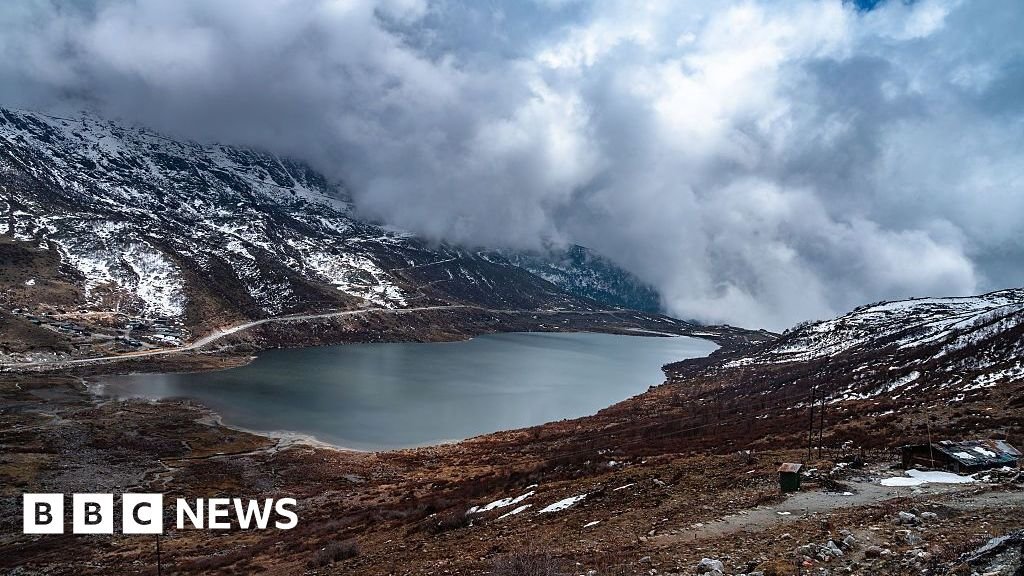
    Nur Photo via Getty Images Kupup Lake, also known as Bitan Cho or Elephant Lake, is a high-altitude glacial lake near Jelep La Pass in East Sikkim, India, on April 17, 2026. The lake, situated at approximately 13,066 feet, is part of the Old Silk Route loop near the India-China border and is often frozen from winter through mid-May. INur Photo via Getty Images
    India’s government says 56 glacial lakes had been classified as “very high risk”

    The Himalayas are approaching a dangerous threshold as glaciers melt faster, glacial lakes grow more unstable and the mountains face a widening gap in monitoring, according to new research.

    The findings come in the aftermath of devastating floods in Nepal and Tibet, which killed more than 1,300 people and caused widespread destruction, highlighting the growing risks from a rapidly changing Himalayan environment.

    Himalayan glaciers are now losing mass 65% faster than they were a decade ago, the report by global consultancy Systemiq, produced with the Integrated Mountain Initiative and with technical contributions from the International Centre for Integrated Mountain Development (ICIMOD) and GB Pant National Institute of Himalayan Environment, says.

    Yet only about 21 of the estimated 40,000 glaciers across the Himalaya-Karakoram region are being monitored in detail and on a sustained basis, according to the report.

    As glaciers retreat, they can leave behind expanding lakes held back by unstable deposits of rock and ice. At the same time, warming is destabilising permafrost – permanently frozen ground that can thaw as temperatures rise – and high mountain slopes, increasing the possibility of cascading hazards, the report says.

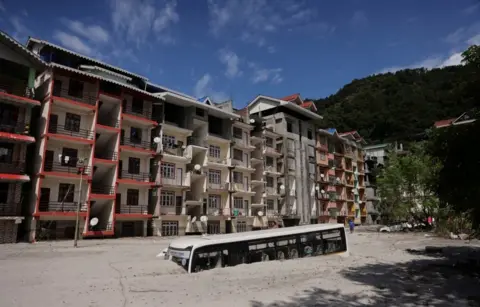
    Reuters A bus is covered in debris caused by flash floods after a lake burst in Rangpo, Sikkim state, India, October 8, 2023. REUTERS/Francis MascarenhasReuters
    A glacial lake outburst in 2023 triggered a flash flood, causing extensive damage in Sikkim

    India already has evidence of the scale of the risk.

    Some 18% of Indian land is Himalayan, yet the region accounts for about 35% of disasters, according to the report.

    The government told parliament in July that 56 glacial lakes had been classified as “very high risk” following a 2025 scientific assessment of 189 high-risk lakes in the Indian Himalayan region. The Central Water Commission is monitoring 2,485 glacial lakes larger than 10 hectares across India’s Himalayan river basins, the government said.

    The Himalayas have already seen devastating examples of what can happen when glacial lakes burst their natural dams.

    In 2023, a glacial lake outburst flood in Sikkim killed at least 70 people and caused widespread damage to roads, bridges and hydropower projects. In 2021, a similar disaster in Uttarakhand killed more than 200 people after a massive flood swept through the Rishiganga and Dhauliganga valleys.

    But the danger is not confined to spectacular floods.

    The Himalayas are a vast natural water system feeding rivers that sustain hundreds of millions of people across South Asia. ICIMOD says “peak water” is expected around mid-century in most Hindu Kush Himalayan river basins – the point at which glacier runoff reaches its maximum before declining as glaciers lose mass.

    The new research puts an unusually large economic number on that dependency.

    It estimates that Himalayan water underpins roughly 20% of India’s GDP, sustaining wheat, rice, tea, hydropower and pilgrimage economies. Yet the mountain states capture only about 5% of that value, it says.

    “The Himalayas are the Third Pole,” said economist Lord Nicholas Stern, chair of the Grantham Research Institute on Climate Change and the Environment at the London School of Economics. “Unlike the Arctic or Antarctic, this pole has hundreds of millions of people living beneath it.”
    Corbis via Getty Images 
Digital world in the Himalayas
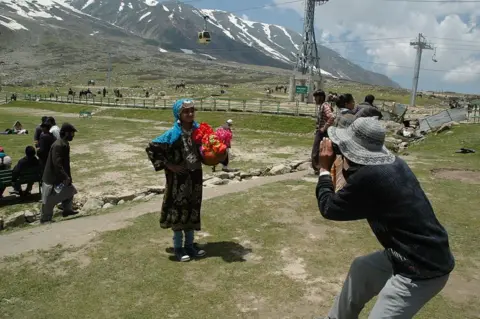
Lay and sometimes illiterate photographers making a living in the Himalayas by taking photos of tourists (Photo by Pallava Bagla/Corbis via Getty Images)Corbis via Getty Images
    The Indian Himalayan region receives roughly 400 million visits a year

    “This is national and international infrastructure,” he said, warning that the ecological system underpinning it is “approaching a tipping point”.

    Not all the forces driving glacier loss are beyond the region’s control.

    The Systemiq research estimates that roughly a third of Himalayan glacier melt is driven by black carbon, much of it originating from brick kilns in the plains. Soot deposited on snow and ice absorbs more sunlight and accelerates melting.

    Unlike global greenhouse-gas emissions, black-carbon pollution is a lever that India and its neighbours can act on directly, the report argues.

    “The Himalayas are approaching a tipping point, with millions of lives and livelihoods hanging in the balance,” said Arushi Chopra, Systemiq’s senior director and lead author. “Glaciers are melting faster than they were a decade ago.”

    The report proposes 10 priority transitions, ranging from reducing black-carbon emissions and expanding glacier monitoring to improving disaster early-warning systems and changing the way tourism is developed in the mountains.

    One priority is to strengthen disaster preparedness, with governments agreeing in advance what action to take when hazards emerge – from evacuation to protecting vulnerable infrastructure.

    Another is to rethink tourism. The Indian Himalayan region receives roughly 400 million tourist visits a year, according to the report, and researchers argue that the objective should shift from maximising visitor numbers towards generating value that is retained and reinvested locally.

    Pema Gyamtsho, director general of ICIMOD, said the risks were becoming increasingly complex.

    “Glaciers are retreating, permafrost and high-mountain slopes are becoming increasingly unstable, and communities and infrastructure downstream face growing risks from complex and cascading hazards,” he said.

    And those risks do not stop at the borders drawn across the Himalayas. Such hazards, Gyamtsho said, “do not respect national borders, and no single country can address them alone”.

    That makes cross-border monitoring, shared risk information and early-warning systems, and joint investment in resilience increasingly urgent – not just to save lives, but to protect the livelihoods and economies of hundreds of millions of people who depend on the mountains.

    India
    The Himalayas
    Glaciers
    Nepal
    Climate
    Floods
    Share. Facebook Twitter Pinterest LinkedIn Tumblr Email Telegram Copy Link
    Gulf News Week

    Related Posts

    Most Viewed News

    Why a fresh wave of North Korean soldiers may fight in Russia's war in UkraineNorth Korea will continue to send its soldiers to fight in Russia's war, but only for as long as it is profitable to do so, writes the BBC's Quentin Sommerville.2 hrs agoBBC InDepth

    September 14, 2026
    Most Viewed News

    Zverev caps transformational year with US Open triumphAlexander Zverev lands his second Grand Slam title after ending Ben Shelton's hopes of becoming a rare home US Open men's champion.26 mins agoTennis

    September 14, 2026
    Most Viewed News

    LIVEUS Open final: Zverev beats Shelton to claim second Grand Slam title of year – reactionAlexander Zverev beats Ben Shelton to win the US Open and claim his second Grand Slam title – follow live.

    September 13, 2026
    Most Viewed News

    Meghan shares glimpse of family life after Sussexes return to UK It's the first time the Duchess of Sussex had posted her family on her Instagram grid since they return to the UK last month. 4 hrs agoUK

    September 13, 2026
    Most Viewed News

    Left-wing bloc leads Swedish vote after far-right lose support, exit polls saySocial Democrats leader Magdalena Andersson may return as prime minister – a job she held from 2021 to 2022.30 mins agoEurope

    September 13, 2026
    Most Viewed News

    Questions mount over what an AI 'slowdown' would look likeWhile pacing AI development might sound like a quick fix, it is far from an easy solution.57 mins ago

    September 13, 2026
    Add A Comment
    Leave A Reply Cancel Reply

    Editors Picks

    The Himalayas are melting faster – and India's economy is 'at risk'A new report warns Himalayan glaciers are melting faster, threatening India’s water, economy and communities.3 hrs agoAsia

    September 14, 2026

    Why a fresh wave of North Korean soldiers may fight in Russia's war in UkraineNorth Korea will continue to send its soldiers to fight in Russia's war, but only for as long as it is profitable to do so, writes the BBC's Quentin Sommerville.2 hrs agoBBC InDepth

    September 14, 2026

    Zverev caps transformational year with US Open triumphAlexander Zverev lands his second Grand Slam title after ending Ben Shelton's hopes of becoming a rare home US Open men's champion.26 mins agoTennis

    September 14, 2026

    LIVEUS Open final: Zverev beats Shelton to claim second Grand Slam title of year – reactionAlexander Zverev beats Ben Shelton to win the US Open and claim his second Grand Slam title – follow live.

    September 13, 2026
    Latest Posts

    Why a fresh wave of North Korean soldiers may fight in Russia's war in UkraineNorth Korea will continue to send its soldiers to fight in Russia's war, but only for as long as it is profitable to do so, writes the BBC's Quentin Sommerville.2 hrs agoBBC InDepth

    September 14, 2026

    Zverev caps transformational year with US Open triumphAlexander Zverev lands his second Grand Slam title after ending Ben Shelton's hopes of becoming a rare home US Open men's champion.26 mins agoTennis

    September 14, 2026

    LIVEUS Open final: Zverev beats Shelton to claim second Grand Slam title of year – reactionAlexander Zverev beats Ben Shelton to win the US Open and claim his second Grand Slam title – follow live.

    September 13, 2026

    Subscribe to News

    Get the latest sports news from NewsSite about world, sports and politics.

    Advertisement
    Demo
    Gulf News Week

    Your source for the serious news. This demo is crafted specifically to exhibit the use of the theme as a news site. Visit our main page for more demos.

    We're social. Connect with us:

    Facebook X (Twitter) Instagram Pinterest YouTube
    Latest Posts

    The Himalayas are melting faster – and India's economy is 'at risk'A new report warns Himalayan glaciers are melting faster, threatening India’s water, economy and communities.3 hrs agoAsia

    September 14, 2026

    Why a fresh wave of North Korean soldiers may fight in Russia's war in UkraineNorth Korea will continue to send its soldiers to fight in Russia's war, but only for as long as it is profitable to do so, writes the BBC's Quentin Sommerville.2 hrs agoBBC InDepth

    September 14, 2026

    Zverev caps transformational year with US Open triumphAlexander Zverev lands his second Grand Slam title after ending Ben Shelton's hopes of becoming a rare home US Open men's champion.26 mins agoTennis

    September 14, 2026

    Subscribe to Updates

    Get the latest creative news from FooBar about art, design and business.

    © 2026 Gulf News Week. Designed by HAM Digital Media.
    • Home
    • Politics
    • Economy
    • Sports

    Type above and press Enter to search. Press Esc to cancel.