
 BBC
BBCAn enemy that swarmed the battlefield in large groups while under fire, seemingly oblivious to the dangers of drones and fire from automatic weapons. An elite corps of ghost soldiers who chose suicide over surrender. They fought and died in their thousands, then apparently vanished from the battlefield.
North Korea’s soldiers were sent to fight by Pyongyang alongside Russian forces as they sought to repel a Ukrainian offensive on Moscow’s territory at the end of 2024. They paid a heavy price, as many as 3,000 killed in action from the 13,000 deployed.
Ultimately, they would adapt their tactics, and with Russia would drive Ukrainian forces from its Kursk region. In combat terms, little has been heard of them since, but according to Ukraine’s president, Volodymyr Zelensky, North Korean forces, and their weaponry, are soon to make a dramatic return to Russia’s war in Ukraine.
Last month, Zelensky warned that up to 50,000 North Koreans will be deployed in Russia, revising an earlier estimate of 30,000 troops. He called on South Korea to provide support for his country’s air defence.
“They’re still there”, said Dr Yang Uk, research fellow at the Asan Institute for Policy Studies, Center for Foreign Policy and National Security in Seoul. “They are defending Russian territory for another counterattack from Ukraine. And we believe that some of the engineer corps or workers might be in [the Russian-occupied] Donbas area but that’s not the combat troops.”

 AFP via Getty Images
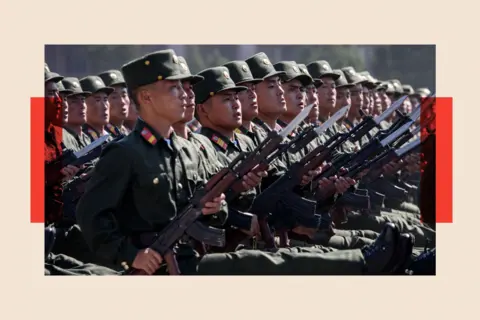
The Main Intelligence Directorate of Ukraine’s Ministry of Defense, HUR, estimates that 8,500 North Korean servicemen are still on Russian territory. They are organised into four brigades, which operate as part of the “North” Group of Forces and are assigned to protecting the state border of the Russian Federation in the Kursk Region from Ukrainian incursions.
“They do not participate in active combat operations. Units of the Korean People’s Army have not been observed in the temporarily occupied territories of Ukraine,” HUR said in a statement to the BBC.
A first for North Korea
For North Korea’s leader, Kim Jong Un, the Kursk deployment was a gamble, its largest combat force ever sent overseas. (In 1973, North Korea sent 1,500 military personnel and instructors to Egypt during the Yom Kippur war with Israel, and in the late 1960s, an estimated 87 North Korean pilots fought for the North Vietnamese against US forces).
And despite the bloodshed, it was a gamble that paid off, reaping countless benefits for the isolated and impoverished country, transforming both its economic and military fortunes. And one that could serve as a blueprint for even deeper military cooperation.
North Koreans, “now know what modern combat is about”, said Yang.
The soldiers sent to fight in Russia were from Storm Corps, the elite of the North Korean armed forces. Extremely isolated, totalitarian North Korea is a militarised and heavily indoctrinated state.
At first, neither Russia, nor North Korea, even acknowledged their presence. Ukrainian forces first clashed with them in November 2024, and the first live North Korean prisoners of war wouldn’t be captured until January of the following year.
It wasn’t until April 2025 that Russia first acknowledged their role, when Valery Gerasimov, chief of the General Staff of the Russian Armed Forces, described their “heroism” on the battlefield.
 Reuters
Yang continued, “North Korean soldiers are very brave I mean, especially those of Storm Corps. They are willing to die for their country. But the problem is that passion doesn’t mean efficient combat skills… [They suffered] a lot of bloodshed in the early stage of the Kursk campaign, but they learned the lessons of modern drone warfare.”
“Cannon fodder”, is how “Sultan”, a soldier with Ukraine’s 95th Air Assault Brigade described North Korean troops. He faced them in the battle for Kursk at the end of 2024.
“They would begin with one large assault group, then another 15–20 men would be sent into the same position, and then more after that. The North Koreans operated differently. They kept moving all the time. That gave them a certain advantage, but not a decisive one,” he recalled recently in Kyiv.
Communication between them and their Russian allies appeared poor, he said, and their soldiers were inadequately equipped.
After combat, Sultan and his men would search enemy corpses for documents and intelligence information. On the Russian dead they would find personal belongings, identification and equipment. “But when we searched the North Koreans specifically, the only thing we found on them was simply ammo. We checked absolutely all the small pockets – there were no documents, nothing at all,” he explained.
Other Ukrainian soldiers reported the North Koreans lacked body armour, winter clothing and helmets.
In one chilling video from a Ukrainian assault, a wounded North Korean soldier lies prone on the snow-covered ground in a wooded area. As the Ukrainians approach, he detonates a grenade under his chin, after calling out, with his last words, the name of his leader, Kim Jong Un.
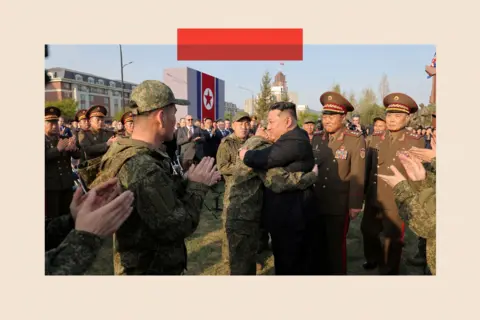
In April 2025, at a memorial service in Pyongyang at the newly created Museum of Foreign Military Operations, Kim praised heroes who choose suicide over capture.
In a speech to relatives, with Russia’s Defence Minister Andrey Belousov in attendance, he said they were “heroes who unhesitatingly opted for self-blasting, suicide attack, in order to defend the great honour”.
 Reuters
While North Korea has never officially acknowledged the death toll from the Kursk operation, a BBC Korea analysis of the memorial site estimated that 2,300 soldiers were killed fighting for Russia.
Ukraine’s intelligence arm, HUR, puts the figure at 3,000 killed and 1,500 injured.
But aside from the combat experience, why did North Korea sacrifice so many of its best troops in a foreign war?
An economic windfall
The deployment has been a much-needed economic windfall for the country and a geopolitical win, according to Lim Soo-ho, a senior research fellow at the Institute for National Security Strategy, in Seoul.
He estimates that arms sales to Russia and the troop deployment have netted the impoverished country close to $10bn.
“North Korea’s annual GDP is estimated at around $30bn (£22bn),” he told me. “That means they earned a third of a year’s GDP over two and a half years through weapons exports and troop deployment, which, for an economy as small as North Korea’s, is a very significant effect.”
In exchange for its manpower, North Korea gets food, oil and hard currency. While China says it complies with sanctions against Pyongyang, Russia does not.
But equally important, the cooperation with Russia has shifted North Korea’s long-term dependency on China.
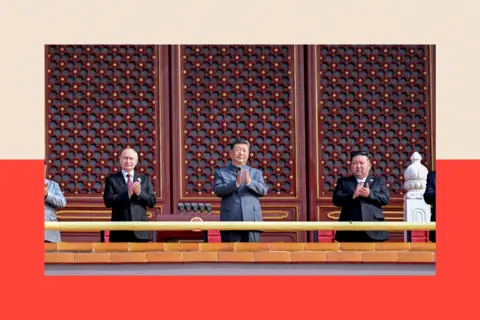
So in Beijing in September last year, Kim Jong Un was able to stand shoulder to shoulder with China’s leader Xi Jinping and Russian President Vladimir Putin, in the first public meeting of all three. Not quite as an equal, but no longer reliant on China alone.
ReutersThis is significant, said Lim, “It’s a major geopolitical shift”.
“Whenever things got difficult under isolation, North Korea would reach out first toward South Korea, Japan, or especially the US to try to normalise relations, that was the pattern of Korean Peninsula diplomacy. But now that ties with Russia have tightened, Kim Jong Un argues that the world is in a new Cold War, a multipolar system.”
The arrangement with Russia, which began as economic and military expediency appears to be developing into something deeper and longer-term. At this year’s 9th Party Congress of the Korean Workers’ Party, Kim Jong Un was emboldened and spoke of accomplishments that his grandfather Kim Il Sung and father Kim Jong Il never achieved.
But dangers lie ahead. To date, no North Koreans have fought on Ukrainian or Russian-occupied Ukrainian land. If they did so, there would be diplomatic consequences, not least in South Korea, an ally of Ukraine, albeit one which so far has only provided “non-lethal” aid.
This is something that President Zelensky has emphasised as he presses for Seoul to provide advanced military hardware, including air defence systems. He said that since June, preparations have been underway in Russia’s Voronezh region to receive fresh North Korean forces and claimed that Pyongyang was preparing to transfer additional ballistic weapons to Russia.
“Russia is helping North Korea learn modern warfare, improve its weapons, and gain real combat experience. This poses a threat to every country in Asia that lies within range of North Korean missiles,” he said in a presidential address in July.
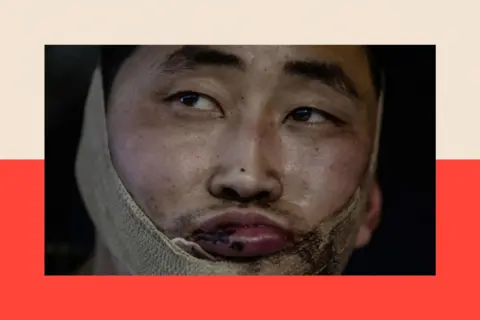
Only two North Korean soldiers were captured alive in battles with Ukrainian forces. That’s a staggeringly low number, given that between 11,000 and 14,000 fought in the Kursk campaign. (Another was captured alive but died from combat-related injuries, according to the South Korean National Intelligence Service).
 @ZELENSKYYUA/X
Like their comrades who choose suicide over capture, neither man intended to be taken alive.
“For Joseon (North Korean) soldiers, becoming a prisoner of war itself is a crime. That just isn’t an option. We can’t become POWs,” one of the captured men told a South Korean MBC documentary crew who interviewed him in prison in Ukraine.
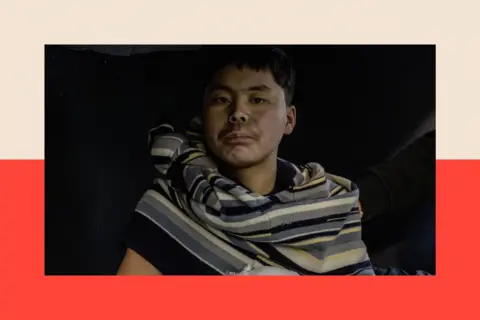
Baek Pyeong-gang, not his real name, lay wounded from a drone strike for four days before being captured. He was tricked into surrendering when he mistook Ukrainian soldiers for his Russian allies.
The second prisoner, Lee Kang-eun, also a pseudonym, told the journalist Kim Young-mi that he felt guilty he was still alive. Barely conscious, he was found by Ukrainian soldiers on the battlefield with extensive injuries to the arm and jaw.
“I had no grenade or knives on me to self-blast (end my life),” he explained.
He described scores of his colleagues killed by drones, early in the war. The battlefield “reeked of the smell of blood”, he said.
Neither man wants to return to North Korea, Lee said he believed that his family members would be “wiped out” as punishment for his capture. Both have said they want to be sent to South Korea, and Seoul is willing to take them.
 @ZELENSKYYUA/X
Only Russia, not Pyongyang, has asked for their return.
But Ukraine, still intent on pressuring Seoul for military aid, has not committed to handing them over to South Korean authorities. Kyiv has said it will honour international human rights obligations which prevent the forced repatriation of prisoners of war.
Their fate remains undecided, but what appears certain is that more North Koreans will join Russia’s war. Their service has enormous economic and political value to Pyongyang; but Russia desperately needs them too.
Four and a half years into Moscow’s full-scale invasion of Ukraine, it is facing a desperate manpower shortage. Western and Ukrainian intelligence agencies estimate that it is losing some 6,000 more troops a month than it can recruit. So, Moscow has been forced to turn to foreign fighters, from Colombia, Kenya, Cameroon and North Korea, to sustain its ranks.
For Russia and North Korea, it is a mutually beneficial relationship, a coalition at a price. Ultimately, North Korea will continue to send its soldiers to fight in Russia’s war, but only for as long as it is profitable to do so.
Top image credit: Getty Images
The Iran war has strengthened Ukraine in surprising ways. Could a ceasefire with Russia be closer?

BBC InDepth is the home on the website and app for the best analysis, with fresh perspectives that challenge assumptions and deep reporting on the biggest issues of the day. Emma Barnett and John Simpson bring their pick of the most thought-provoking deep reads and analysis, every Saturday. Sign up for the newsletter here
