
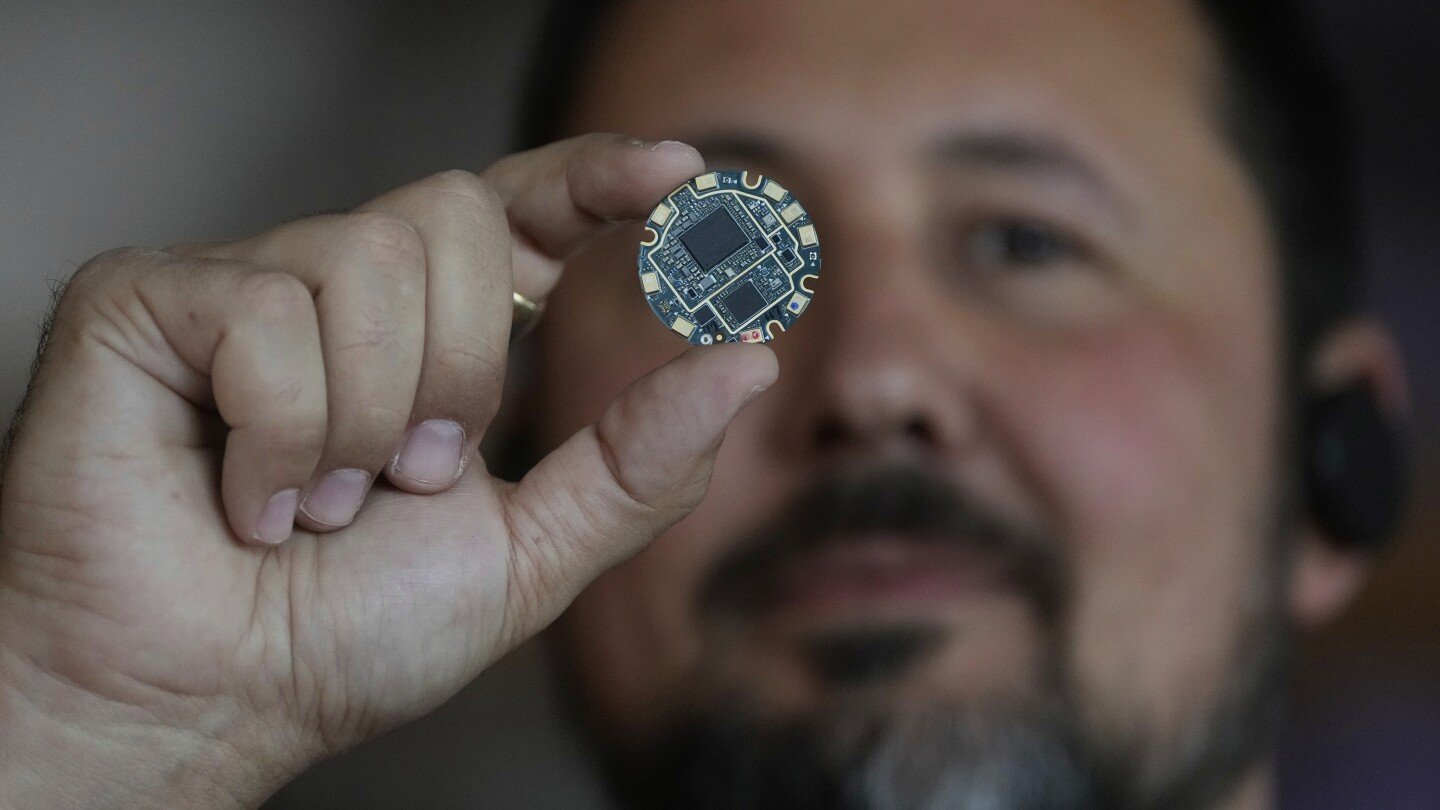
A secretive competition to pioneer a new way of communicating with artificial intelligence chatbots is getting a messy public airing as OpenAI fights a trademark dispute over its stealth hardware collaboration with legendary iPhone designer Jony Ive.
In the latest twist, tech startup iyO Inc., which already sued Ive and OpenAI CEO Sam Altman for trademark infringement, is now suing one of its own former employees for allegedly leaking a confidential drawing of iyO’s unreleased product.
At the heart of this bitter legal wrangling is a big idea: we shouldn’t need to stare at computer or phone screens or talk to a box like Amazon’s Alexa to interact with our future AI assistants in a natural way. And whoever comes up with this new AI interface could profit immensely from it.
OpenAI, maker of ChatGPT, started to outline its own vision in May by buying io Products, a product and engineering company co-founded by Ive, in a deal valued at nearly $6.5 billion. Soon after, iyO sued for trademark infringement for the similar sounding name and because of the firms’ past interactions.
U.S. District Judge Trina Thompson ruled last month that iyO has a strong enough case to proceed to a hearing this fall. Until then, she ordered Altman, Ive and OpenAI to refrain from using the io brand, leading them to take down the web page and all mentions of the venture.
A second lawsuit from iyO filed this week in San Francisco Superior Court accuses a former iyO executive, Dan Sargent, of breach of contract and misappropriation of trade secrets over his meetings with another io co-founder, Tang Yew Tan, a close Ive ally who led design of the Apple Watch.
Sargent left iyO in December and now works for Apple. He and Apple didn’t immediately respond to a request for comment.
“This is not an action we take lightly,” said iyO CEO Jason Rugolo in a statement Thursday. “Our primary goal here is not to target a former employee, whom we considered a friend, but to hold accountable those whom we believe preyed on him from a position of power.”
Rugolo told media last month that he thought he was on the right path in 2022 when he pitched his ideas and showed off his prototypes to firms tied to Altman and Ive. Rugolo later publicly expanded on his earbud-like “audio computer” product in a TED Talk last year.
What he didn’t know was that, by 2023, Ive and Altman had begun quietly collaborating on their own AI hardware initiative.
“I’m happy to compete on product, but calling it the same name, that part is just amazing to me. And it was shocking,” Rugolo said in an interview.
The new venture was revealed publicly in a May video announcement, and to Rugolo about two months earlier after he had emailed Altman with an investment pitch.
“thanks but im working on something competitive so will (respectfully) pass!” Altman wrote to Rugolo in March, adding in parentheses that it was called io.
Altman has dismissed iyO’s lawsuit on social media as a “silly, disappointing and wrong” move from a “quite persistent” Rugolo. Other executives in court documents characterized the product Rugolo was pitching as a failed one that didn’t work properly in a demo.
Altman said in a written declaration that he and Ive chose the name two years ago in reference to the concept of “input/output” that describes how a computer receives and transmits information. Neither io nor iyO was first to play with the phrasing — Google’s flagship annual technology showcase is called I/O — but Altman said he and Ive acquired the io.com domain name in August 2023.
