
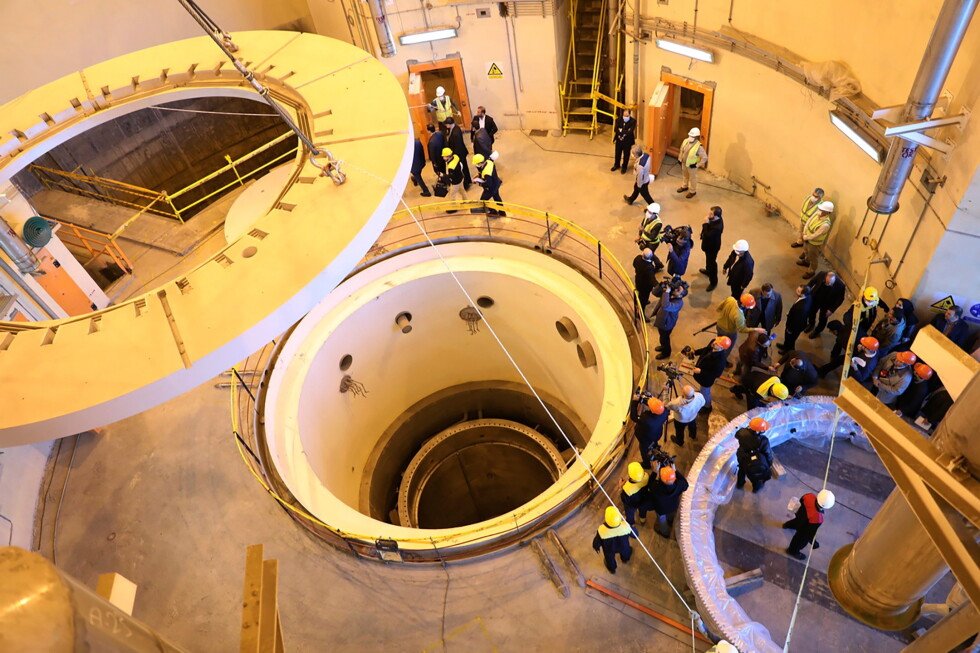
When the U.S. and Israel launched the war against Iran on Feb. 28, President Donald Trump said one of the main objectives was to prevent Iran from building a nuclear weapon.
That has put a focus on Iran’s stockpile of uranium and its program to convert this naturally occurring element into material that can sustain a nuclear reaction — a process called enrichment. Several key nuclear sites in Iran were attacked by the U.S. and Israel last summer, and again during the latest war.
Iran’s leaders insist the country’s nuclear program is only for peaceful purposes. Before the war began, it had a stockpile of enriched uranium that was a short, technical step from weapons-grade material, according to the International Atomic Energy Agency. Iran had an organized nuclear weapons program up until 2003, the U.N. agency and Western nations say.
Here’s a deeper look at uranium enrichment and Iran’s nuclear program.
Uranium, like other elements, is found in slightly different configurations. One, called U-235, is best at powering nuclear reactions. It is less stable than the more common form, which means it’s easier to split to release the energy needed for producing electricity or a weapon. But U-235 makes up less than 1% of the uranium found in nature.
To isolate the more desirable U-235, scientists strip away its more stable cousin, U-238, through a process known as enrichment.
The most common way to enrich uranium is by spinning uranium gas in a centrifuge, where lighter U-235 separates from the heavier U-238. This is done in stages, using multiple centrifuges that enrich the uranium bit by bit.
The early stages are especially labor-intensive because there is so much more U-238 to strip away, said nuclear security specialist Sébastien Philippe at the University of Wisconsin-Madison. Over time, the enrichment process gets easier.
The process can take anywhere from days to months to years, depending on the size of the enrichment plant, the technology being used and how far the uranium is being enriched.
For a nuclear reactor that makes electricity, uranium is typically enriched up to 5%. Nuclear reactors used for science experiments run on uranium enriched up to 20%.
Anything enriched to 20% and above is considered “highly enriched” uranium and above 90% is considered weapons-grade, though some very highly enriched uranium can be used for research and medical purposes, according to the Center for Arms Control and Non-Proliferation.
Iran is thought to have 972 pounds (441 kilograms) of uranium that is enriched up to 60% purity, according to the IAEA.
A crude nuclear weapon could be made with uranium at that enrichment level, Philippe said, and it’s relatively easy to enrich it to the 90% level needed to make a bomb light enough to be carried by a missile.
Iran’s stockpile could allow Iran to build as many as 10 nuclear bombs, should it decide to weaponize its program, IAEA director general Rafael Grossi told the news agencies last year. He added that it doesn’t mean that Iran has such a weapon.
Once enriched, uranium gas undergoes some final processing and then is converted back into a solid, pressed into pellets and stacked into a sealed metal fuel rod that goes into a nuclear reactor.
