
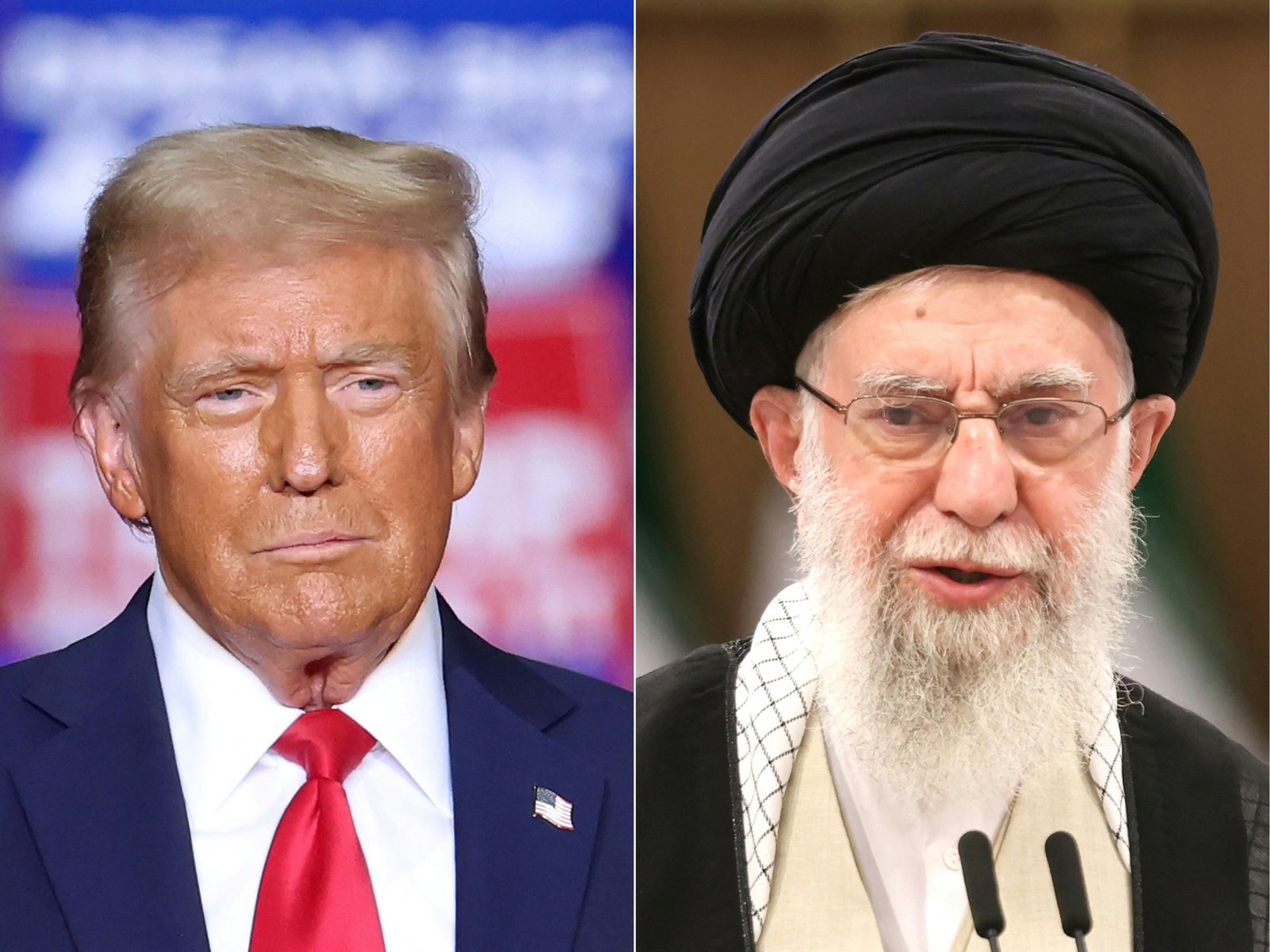
Donald Trump has boxed himself in by promising to ‘help’ Iran’s protesters. But he has few good options for military operations that he can control.
Illiberal systems often look most permanent just before they change. But moments of upheaval can also produce a different illusion: That the system is one dramatic external blow away from collapse. With Iran convulsed by unprecedented protests against the country’s leadership, it is tempting to imagine that the United States’ air power could deliver the final shove.
That temptation misreads how the Islamic Republic actually survives. Coercive cohesion is the cement of the system: The ability of parallel security and political institutions to keep acting together, even when legitimacy erodes. When that cohesion holds, the system absorbs shocks that would more conventional states would fall under.
Iran is not a single pyramid with one man at the apex. It is a heterarchical, networked state: Overlapping hubs of power around the Supreme Leader’s office, the Revolutionary Guards, intelligence organs, clerical gatekeepers, and a patronage economy. In such a system, removing one node, even the most symbolic one, does not reliably collapse the structure; redundancy and substitute chains of command are a design feature. Decapitation – a prominent narrative after US President Donald Trump’s tactical “success” in Venezuela – thus looks less like a strategy and more like a gamble on chaos.
This is why Trump’s dilemma matters. He sits between neoconservative hawks who want regime change by force and an America First base that will not support lengthy wars, post-conflict stabilisation, or another Middle Eastern adventure. The instinct, therefore, is quick-in, quick-out punishment that looks decisive without creating obligations.
Regional politics further narrow Trump’s menu. Israel wants Washington to do the heavy lifting against Tehran. Key Gulf interlocutors, notably Saudi Arabia, Qatar and Oman, have pressed for de-escalation and diplomacy. Operationally, the Gulf’s lack of support for a new campaign might push the US towards military options launched from a distance, making sustained air operations harder to sustain.
Trump has also boxed himself in rhetorically. Having warned that if Iran “violently kills peaceful protesters”, the US would “come to their rescue”, he has had to signal credible military options even as he suggests diplomacy is preferable and hints that the killing is “stopping”. In practice, this oscillation appears to be less strategic ambiguity and more bargaining and indecision, encouraging every faction around him to believe it can still win the argument.
It is important to be clear about what Washington’s inner circle seems to want. The goal is not liberal democracy. The prize is a pragmatic Iran that can be drawn into a regional geo-economic framework, opened to business with the US, and nudged away from overreliance on China. That implies constraints on nuclear activity, some curbs on ballistic missiles, and a drawdown – real or cosmetic – of Iran’s support for the so-called “axis of resistance”. This is a transformation of posture, not a wholesale replacement of the Islamic Republic.
Air power can punish and signal. It can degrade specific facilities. It can raise the cost of repression by authorities. But it cannot reorganise a security sector, arbitrate succession, or deliver a behaviour change. And it cannot protect protesters from the air. Libya in 2011 remains the cautionary tale. Military force, at most, is a high-risk attempt to coerce Iranians to the negotiation table that will likely backfire.
The most plausible military scenario is limited standoff punitive strikes, using cruise missiles and long-range munitions against Iranian Revolutionary Guard centres or enabling infrastructure. This fits the “quick and clean” preference and can be framed as punishment rather than war. Its strategic downside is that it hands the Guards an “existential threat” narrative that can legitimise harsher repression, while raising retaliation risk through proxies, shipping disruption, and pressure on US bases in the Gulf. It can also reduce the chance of internal fragmentation by pushing rival factions to rally around the flag.
A leadership “decapitation” attempt is more cinematic and less credible. It is the most escalatory option, likely to unify hardliners, and still unlikely to collapse a networked system.
A sustained air campaign is the least plausible and the most dangerous. Without Gulf basing and overflight, the logistics push operations towards more distant platforms and thinner sortie generation. Politically, it would violate the America First premise; strategically, it would internationalise the crisis, widen the battlefield, and invite a tit-for-tat escalation cycle that neither side can reliably control.
Cyber- and electronic disruption sits in a different category: Lower visibility, sometimes deniable, and potentially compatible with Gulf preferences for avoiding open war. But the effects are uncertain and often temporary, and a networked state can route around disruption. The most realistic outcome is that cyberoperations might accompany other moves, yet they are unlikely to deliver decisive political change on their own.
The deeper point is that external shocks rarely produce the specific internal outcome Washington claims to want: A pragmatic transition at the top. Severe outside pressure often hardens a system’s coercive core, because escalating violence is not always confidence; it is frequently panic wearing a uniform. The only durable trigger for transformation is internal: Fractures within the security services or elite splits that create competing centres of authority with incompatible survival strategies.
If the US wants to influence those dynamics, it should focus on cohesion-shaping levers rather than dramatic bombing. Maintain deterrence against mass slaughter but avoid promising “rescue” that cannot be delivered without war. Calibrate economic pressure towards the individuals and entities driving violence while leaving credible off-ramps for technocrats and pragmatists who might prefer de-escalation and negotiation. Above all, coordinate with the US’s friends in the region, chief of all Qatar, Oman and Saudi Arabia, who can constrain escalation and translate coercive discourse into bargaining space.
The Islamic Republic may still crush this round of protests. It may also rearrange itself internally and survive in a new form. But the anger witnessed on the streets cannot be reined in unless sanctions are lifted and the economy transformed. For that, the regime needs to transform from theocratic paralysis to a more pragmatic system.
