Close Menu
    What's Hot

    Party Rock Anthem singer Lauren Bennett dies aged 37Bennett's cause of death was not immediately clear and bandmates from her former group G.R.L say their "hearts are broken".8 hrs agoCulture

    July 7, 2026

    Fans react to US World Cup loss after red card dramaThe BBC's Nada Tawfik spoke to US fans after the FIFA World Cup co-hosts were knocked out of the tournament.2 hrs ago

    July 7, 2026

    Marine Le Pen appeal verdict: Why this moment matters for FranceThe leader of France's National Rally leads the opinion polls ahead of the 2027 presidential election and will now find out if she can stand.1 day agoEurope

    July 7, 2026
    Facebook X (Twitter) Instagram
    • Politics
    • Economy
    Facebook X (Twitter) Instagram
    Gulf News Week
    Subscribe
    Tuesday, July 7
    • Home
    • Politics
      • Europe
      • Middle East
      • Russia
      • Social
      • Ukraine Conflict
      • US Politics
      • World
    • Region
      • Middle East News
    • World
    • Economy
      • Banking
      • Business
      • Markets
    • Real Estate
    • Science & Tech
      • AI & Tech
      • Climate
      • Computing
      • Science
      • Space Science
      • Tech
    • Sports

      Dominant PSG put Liverpool on the brink with 2-0 Champions League quarter-final first-leg win

      April 9, 2026

      Dubai Basketball U-18 Elite Crowned Basket Cup Sarajevo 2026 Champions in Historic Debut

      April 6, 2026

      Saudi boxing crowns 20 champions as Kingdom’s Elite Belt concludes in Riyadh

      April 4, 2026

      “He Signed for a Real Fight”: Pacquiao Contradicts Mayweather Over Rematch Status

      April 3, 2026

      Arsenal Hold Off Chelsea Fightback to Reach Women’s Champions League Semi-Finals

      April 2, 2026
    • Health
    • Travel
    • Contact
    Gulf News Week
    Home»Most Viewed News»Can China repeat its EV success with robotaxis?China's self-driving car firms have been given a headstart by the country's EV supply chain as they expand globally.4 hrs agoAsia
    Most Viewed News

    Can China repeat its EV success with robotaxis?China's self-driving car firms have been given a headstart by the country's EV supply chain as they expand globally.4 hrs agoAsia

    Gulf News WeekBy Gulf News WeekJuly 7, 2026No Comments6 Mins Read
    Share Facebook Twitter Pinterest Copy Link LinkedIn Tumblr Email VKontakte Telegram
    Can China repeat its EV success with robotaxis?China's self-driving car firms have been given a headstart by the country's EV supply chain as they expand globally.4 hrs agoAsia
    Share
    Facebook Twitter Pinterest Email Copy Link
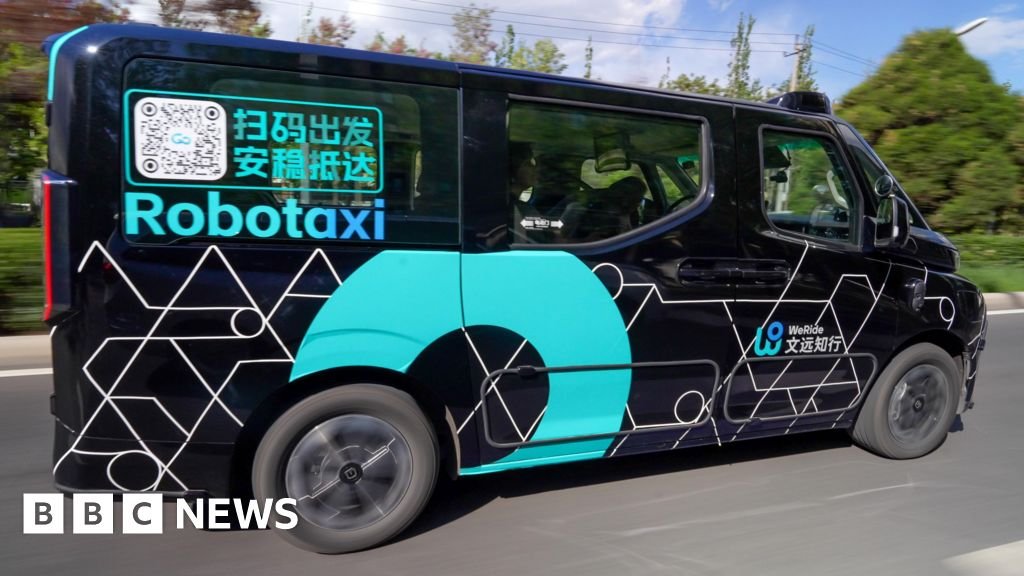
    BBC WeRide Robotaxi in BeijingBBC
    Chinese companies are testing out robotaxis in several Chinese cities

    In Beijing’s Yizhuang district, driverless vehicles have become a common sight. Robotaxis weave through traffic alongside ordinary cars, while autonomous delivery vans glide along the inside lane as they carry packages to collection points.

    The district has become one of China’s testing grounds for autonomous driving, with companies including Baidu, WeRide and Pony.ai operating commercial robotaxi services within designated areas.

    Booking a ride requires little more than opening an app. Within minutes, a robotaxi pulls up with nobody behind the wheel. After confirming the journey on a touchscreen, the vehicle merges into Beijing’s dense traffic, navigating buses, cyclists, scooters and pedestrians with little hesitation.

    The technology is still evolving. But a bigger question now looms: can Chinese companies turn robotaxis into another sector they dominate globally, as they have with electric vehicles (EVs)?

    China’s autonomous driving companies already have a powerful advantage – the industrial ecosystem that helped turn the country into the world’s largest EV market.

    Unlike Tesla, which designs much of its technology in-house, China’s self-driving industry is built around a network of companies.

    Established carmakers including BYD, Chery, Geely, and SAIC build the cars, while specialist firms develop the software.

    Autonomous vehicles rely on many of the same batteries, sensors, chips and onboard computers as electric cars.

    Because those supply chains already exist at enormous scale, companies can develop technology faster and at a lower cost.

    “What you see is a pace of innovation and adaptation in the Chinese EV industry that I don’t think is matched anywhere else around the world,” says Kyle Chan, a foreign policy fellow at the Brookings Institution.

    “China’s EV capacity doesn’t just stop there. It actually spills over into other related industries through something that I call these overlapping tech industrial ecosystems.”

    New productive forces

    Government policy has also played a role. Pilot programmes in several cities allow companies to test the technology on some public roads.

    But China also offers something else to firms that are trying to make the technology smarter: complex driving conditions.

    A single journey through Beijing can require an autonomous vehicle to deal with buses, scooters, cyclists, pedestrians and unpredictable traffic.

    “The traffic environment here in China is very complex,” Maeve Zhang, chief marketing officer at WeRide, told the BBC.

    That diversity of road users generates vast amounts of data to help improve software.

    Although driving data from China is useful, there are other challenging conditions abroad which could hinder any rapid expansion in overseas markets.

    “In the Middle East, the temperature is very high. In South East Asia, there is heavy rain… and in Switzerland, winter temperatures can be very, very low,” says Zhang.

    Extreme temperatures can reduce battery performance, while heavy rain, snow and fog interfere with the cameras and sensors that autonomous vehicles rely on.

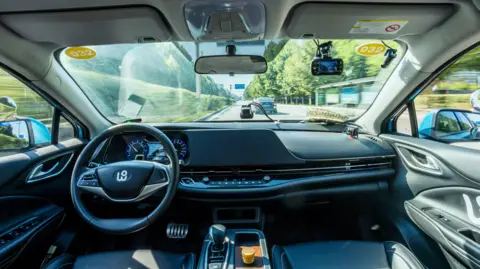
    WeRide Inside of a WeRide RobotaxiWeRide
    The inside of a WeRide Robotaxi, one of the leading driverless cab firms

    Robotaxis are only one part of China’s autonomous driving ambitions.

    QCraft is applying its autonomous software to passenger cars, as well as autonomous buses and delivery vehicles. It says its buses already operate in more than 20 Chinese cities and it is expanding overseas.

    “It’s very promising on the technology side that maybe the next five, seven, at most 10 years, it will get into everybody’s life,” says James Yu, the company’s chairman and chief executive.

    The Waymo benchmark

    Chinese companies are expanding globally, and fast. Their biggest commercial competitors are in the US.

    Waymo, Alphabet’s robotaxi business, remains the commercial leader, operating paid driverless services in several US cities. Amazon-owned Zoox and Tesla are expanding more cautiously, while Uber has abandoned the development of its own autonomous vehicles, which had been marred by a fatal accident in 2018.

    Uber, and its ride-hailing rival Lyft, are now partnering with Chinese firms.

    That gives them automatic “access to millions of customers that they wouldn’t have if they created their own app,” says Tu Le, founder of consultancy Sino Auto Insights.

    “Through these partnerships, they’re able to commercialise and broaden their scope.”

    Although Chinese companies are able to manufacture cheaply, Waymo has spent years building expertise in customer service and the app technology.

    “Having experienced Waymo and the WeRides and the Ponys… I would have to say the user experience for Waymo is much better than all the other competitors. I feel like Waymo is really becoming a standard mode of transportation for California,” says Tu Le.

    Perceptions also differ across markets.

    In the US, unions have warned robotaxis could displace taxi, delivery and freight drivers.

    China’s policymakers present automation as a remedy for its shrinking workforce but government censorship of dissenting voices makes it difficult to gauge opinions in the wider population.

    President Xi Jinping has promoted AI and robotics as part of China’s drive to develop “new quality productive forces” – that will create jobs and boost economic growth.

    And so there are incentives and impetus for companies to invest in the technology and expand.

    One of the industry’s arguments is that autonomous vehicles could improve mobility for people who cannot easily drive themselves.

    “If we can bring the cost down for a robotaxi ride so that it’s as cheap – or maybe even cheaper – than hailing an Uber with a normal driver, then it really helps broaden mobility,” Le says. “Elderly folks, folks that are disabled – these robotaxis really allow them a lot more ability to travel.”
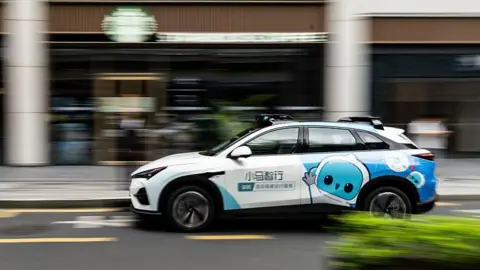
    Getty Images A Pony AI Inc. autonomous taxi travels along a road in Shenzhen, ChinaGetty Images
    PonyAI is one of the main robotaxi players in China

    But there are still many concerns around safety.

    Earlier this year, Baidu’s Apollo Go service suffered a software malfunction that left about 100 robotaxis stranded in Wuhan.

    Some passengers reported being unable to leave vehicles because the doors had automatically locked.

    Services were suspended for several weeks although Baidu has said it remains on track to launch in the UK later this year.

    But the episode highlighted how failures can quickly undermine public confidence.

    Similar issues have emerged elsewhere. GM shut down its robotaxi division Cruise to “refocus autonomous driving development on personal vehicles”.

    California regulators had suspended its permit following a 2023 crash in which one of its robotaxis dragged a pedestrian several metres after she had been struck by another vehicle.

    That is one reason some analysts say robotaxis will be harder to export than electric vehicles.

    Operating robotaxis is more difficult than traditional carmaking, or even ride-hailing platforms, as it faces issues like complicated regulatory approvals, detailed mapping, local operating teams and public trust.

    This is something even homegrown brands have struggled with in the US.

    They may also face growing geopolitical barriers. Unlike EVs, robotaxis generate a great deal of mapping, camera and location data. That makes them particularly vulnerable to national security concerns in overseas markets.

    Despite the challenges of rolling out the technology, WeRide says regulators are becoming receptive to autonomous driving.

    “We see very positive attitudes and very good policies and regulations coming out from governments both here in China and in some other international markets,” Zhang says.

    For Chan, however, robotaxis represent something much bigger than a new mode of transport.

    “China is trying to create this sort of high-tech economy that’s digitally connected, that’s AI-powered, and that builds on its existing strengths today in batteries, EVs, motors and other related technology.”

    Additional reporting by Jaltson Akkanath Chummar

    The US-China robotaxi race
    International Business
    China
    Electric cars
    Driverless cars
    Share. Facebook Twitter Pinterest LinkedIn Tumblr Email Telegram Copy Link
    Gulf News Week

    Related Posts

    Most Viewed News

    Party Rock Anthem singer Lauren Bennett dies aged 37Bennett's cause of death was not immediately clear and bandmates from her former group G.R.L say their "hearts are broken".8 hrs agoCulture

    July 7, 2026
    Most Viewed News

    Fans react to US World Cup loss after red card dramaThe BBC's Nada Tawfik spoke to US fans after the FIFA World Cup co-hosts were knocked out of the tournament.2 hrs ago

    July 7, 2026
    Most Viewed News

    Marine Le Pen appeal verdict: Why this moment matters for FranceThe leader of France's National Rally leads the opinion polls ahead of the 2027 presidential election and will now find out if she can stand.1 day agoEurope

    July 7, 2026
    Most Viewed News

    Resistance and revenge – Iran wanted to send a message with its farewell to KhameneiThree days of public mourning in Tehran was a political spectacle Iran's leaders wanted the world to see, writes the BBC's international correspondent Lyse Doucet.4 hrs agoMiddle East

    July 7, 2026
    Most Viewed News

    USA limp out of World Cup as Belgium reach quarter-finalsReaction, analysis and interviews as World Cup co-hosts USA exit the tournament, with Belgium reaching the quarter-finals.

    July 7, 2026
    Most Viewed News

    Zelensky to press Nato for air defence systems after intense Russian strikesThe Ukrainian president will use the Nato meeting in Turkey to argue he needs more interceptor missiles.44 mins agoEurope

    July 7, 2026
    Add A Comment
    Leave A Reply Cancel Reply

    Editors Picks

    Party Rock Anthem singer Lauren Bennett dies aged 37Bennett's cause of death was not immediately clear and bandmates from her former group G.R.L say their "hearts are broken".8 hrs agoCulture

    July 7, 2026

    Fans react to US World Cup loss after red card dramaThe BBC's Nada Tawfik spoke to US fans after the FIFA World Cup co-hosts were knocked out of the tournament.2 hrs ago

    July 7, 2026

    Marine Le Pen appeal verdict: Why this moment matters for FranceThe leader of France's National Rally leads the opinion polls ahead of the 2027 presidential election and will now find out if she can stand.1 day agoEurope

    July 7, 2026

    Resistance and revenge – Iran wanted to send a message with its farewell to KhameneiThree days of public mourning in Tehran was a political spectacle Iran's leaders wanted the world to see, writes the BBC's international correspondent Lyse Doucet.4 hrs agoMiddle East

    July 7, 2026
    Latest Posts

    Party Rock Anthem singer Lauren Bennett dies aged 37Bennett's cause of death was not immediately clear and bandmates from her former group G.R.L say their "hearts are broken".8 hrs agoCulture

    July 7, 2026

    Fans react to US World Cup loss after red card dramaThe BBC's Nada Tawfik spoke to US fans after the FIFA World Cup co-hosts were knocked out of the tournament.2 hrs ago

    July 7, 2026

    Marine Le Pen appeal verdict: Why this moment matters for FranceThe leader of France's National Rally leads the opinion polls ahead of the 2027 presidential election and will now find out if she can stand.1 day agoEurope

    July 7, 2026

    Subscribe to News

    Get the latest sports news from NewsSite about world, sports and politics.

    Advertisement
    Demo
    Gulf News Week

    Your source for the serious news. This demo is crafted specifically to exhibit the use of the theme as a news site. Visit our main page for more demos.

    We're social. Connect with us:

    Facebook X (Twitter) Instagram Pinterest YouTube
    Latest Posts

    Party Rock Anthem singer Lauren Bennett dies aged 37Bennett's cause of death was not immediately clear and bandmates from her former group G.R.L say their "hearts are broken".8 hrs agoCulture

    July 7, 2026

    Fans react to US World Cup loss after red card dramaThe BBC's Nada Tawfik spoke to US fans after the FIFA World Cup co-hosts were knocked out of the tournament.2 hrs ago

    July 7, 2026

    Marine Le Pen appeal verdict: Why this moment matters for FranceThe leader of France's National Rally leads the opinion polls ahead of the 2027 presidential election and will now find out if she can stand.1 day agoEurope

    July 7, 2026

    Subscribe to Updates

    Get the latest creative news from FooBar about art, design and business.

    © 2026 Gulf News Week. Designed by HAM Digital Media.
    • Home
    • Politics
    • Economy
    • Sports

    Type above and press Enter to search. Press Esc to cancel.