
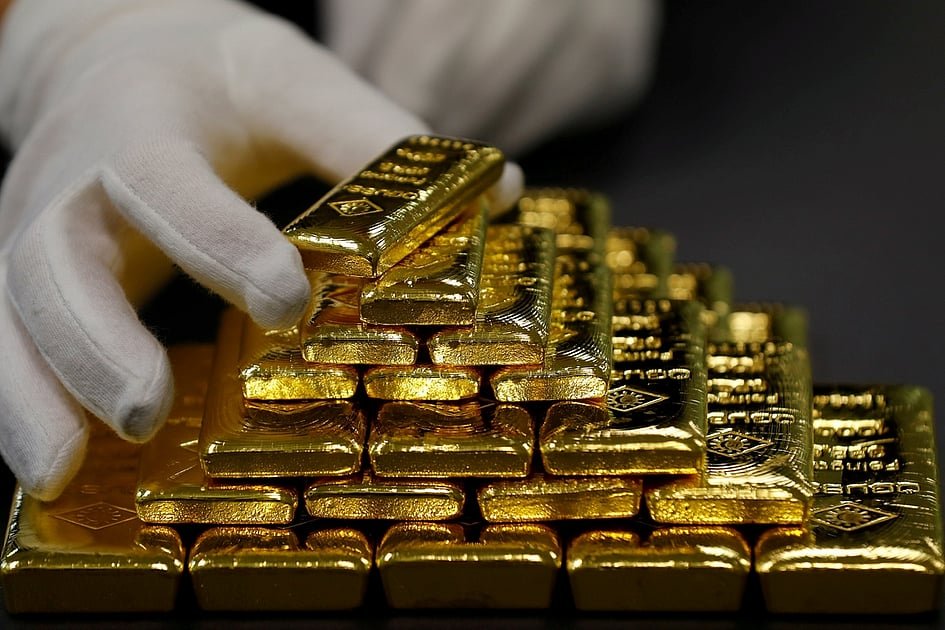
A quiet revolution is underway in the vaults of the world’s central banks, a move that underscores deepening doubts about the stability of the global financial order.
Monetary authorities across the globe are buying gold at a pace unmatched in modern history, reshaping reserves and redefining the balance between traditional paper assets and hard stores of value.
As of mid-2025, central banks collectively hold nearly 36,700 tonnes of gold, representing about 27 per cent of their total reserves. This is a remarkable milestone: for the first time since 1996, gold holdings have overtaken US Treasuries in official portfolios. In dollar terms, the shift is even starker. The value of central bank gold is estimated at $4.5 trillion, compared with just $3.5 trillion in Treasuries. The symbolism is clear: institutions tasked with monetary stability are placing more faith in the permanence of gold than in the creditworthiness of Washington.
This transformation has been building for several years but accelerated sharply from 2022 onwards. Annual purchases have now exceeded 1,000 tonnes for three consecutive years, dwarfing the 400-500 tonne averages of the previous decade.
According to the World Gold Council (WGC), central banks acquired 1,045 tonnes in 2024 alone, the highest since records began in 1967. Even in 2025, with gold trading above $3,500 per ounce, the appetite remains strong. July saw net purchases of 10 tonnes, while May brought in 20 tonnes, led by Kazakhstan, Turkey, and Poland.
Why are central banks paying record prices for bullion? The answer lies in a combination of strategic foresight and hard-nosed risk management. In its 2025 survey, the WGC reported that an unprecedented 95 per cent of central banks expect global gold reserves to keep rising over the next year, up from 81 per cent in 2024. Even more tellingly, 43 per cent expect their own institutions to add to their stockpiles. Not a single respondent anticipated a reduction. That central banks are continuing to buy, even at record highs, shows they are not chasing short-term gains. They are preparing for systemic changes.
At the heart of this pivot is waning trust in the dollar. The US faces a debt burden exceeding $37 trillion, rising at an astonishing pace — half a trillion dollars in just 30 days earlier this year. Interest payments now rival or exceed spending in areas such as education and transportation. Layered on top of this is political interference with the independence of the Federal Reserve, raising fears of inflationary spirals. For central banks abroad, holding US Treasuries increasingly looks like betting on a fragile model.
The geopolitics of sanctions has also played a role. Washington’s weaponisation of the dollar system against adversaries has persuaded many countries to hedge against financial exclusion. For Russia, which has been cut off from Western markets, gold is a sanction-proof anchor. China’s steady monthly purchases align with its strategy of reducing reliance on the dollar and boosting the yuan’s global role. India, Turkey, Kazakhstan, and Poland have all expanded reserves to protect against volatility, currency weakness, or regional instability.
Developed economies are hardly immune to this rethink. The European Central Bank’s Eurosystem collectively holds over 10,000 tonnes. The Bank of England has reconsidered earlier sales, often lamented as short-sighted, while the Reserve Bank of Australia has begun to raise allocations after decades of minimal holdings. This convergence across advanced and emerging markets signals a shared recognition: gold is not just another asset class but the ultimate insurance against systemic fragility.
Historical precedents reinforce this perspective. In the 1930s, during the Great Depression, gold hoarding accompanied the collapse of the gold standard. The 1970s saw a rush into bullion as Bretton Woods disintegrated and inflation surged. After the 2008 financial crisis, gold purchases accelerated again amid fears of fiat instability. Each period of crisis rewarded those who had prepared by accumulating hard assets. Today’s environment, marked by unprecedented global debt levels and weakening faith in traditional anchors, appears to rhyme strongly with those earlier eras.
According to monetary experts, the implications for markets are profound. Persistent official sector demand provides a powerful “price floor” that insulates gold from the speculative swings of private investors. The London Bullion Market Association has reported increased physical allocations, while futures exchanges like COMEX are seeing rising delivery requests — signs of a shift toward tangible ownership. Meanwhile, constrained mine supply, with global output growing only 1.5 to 2 per cent annually, is struggling to match demand. The combination of steady central bank buying and tight supply sets the stage for structurally higher prices.
Christopher Louney, gold strategist at RBC Capital Markets, observes: “Gold remains a strategic asset as the world faces uncertainty and tumult. Central banks are concerned about interest rates, inflation, and instability — all reasons to turn to gold to mitigate risk.”
Ed Yardeni, analyst contributing to Barron’s, sees sustained momentum ahead, saying central banks’ increased reserves and rising global demand — including from China, India, and amid trade-war tensions — are key supports. He forecasts gold could reach $4,000 by year-end and $5,000 by 2026.
Experts argue that the consequences for the US Treasury market are equally striking. As central banks scale back their appetite for government debt, the US faces higher borrowing costs, rising yields, and a shrinking buyer base. This feedback loop of debt issuance and falling demand exacerbates fiscal strains, raising the risk of a destabilising reset.
What emerges from this picture is not simply a story about gold prices, but about a broader monetary realignment. Central banks are preparing for a world where the dollar’s supremacy is no longer assured, where financial systems may fragment into regional blocs, and where tangible assets like gold reclaim a central role in international settlements.
For individual investors, the lesson is equally compelling. Central banks are signalling how to navigate uncertainty. By steadily raising allocations to gold — now averaging around 27 per cent of their reserves — they demonstrate that wealth preservation matters more than chasing yield in fragile markets. While traditional advice often recommends 5 to 10 per cent of a portfolio in precious metals, today’s environment suggests it may be prudent to rethink exposure. As with central banks, the focus should be on physical ownership and long-term resilience rather than short-term speculation.
