
President’s last-minute reprieve sparks sharp market relief rally, but analysts warn of fragile calm with Strait of Hormuz still closed and broader conflict unresolved.
The dollar tumbled and oil prices suffered their steepest drop in weeks after U.S. President Donald Trump announced a temporary halt to planned military strikes on Iranian energy infrastructure, triggering a frantic but cautious rally across global financial markets.
In a post on Truth Social early Monday, Trump said he had instructed the Department of Defense to postpone “any and all” strikes against Iranian power plants and energy facilities for a five-day period. The announcement came just hours before a deadline the president had set for Tehran to “fully open” the Strait of Hormuz, intensifying a conflict now in its fourth week.
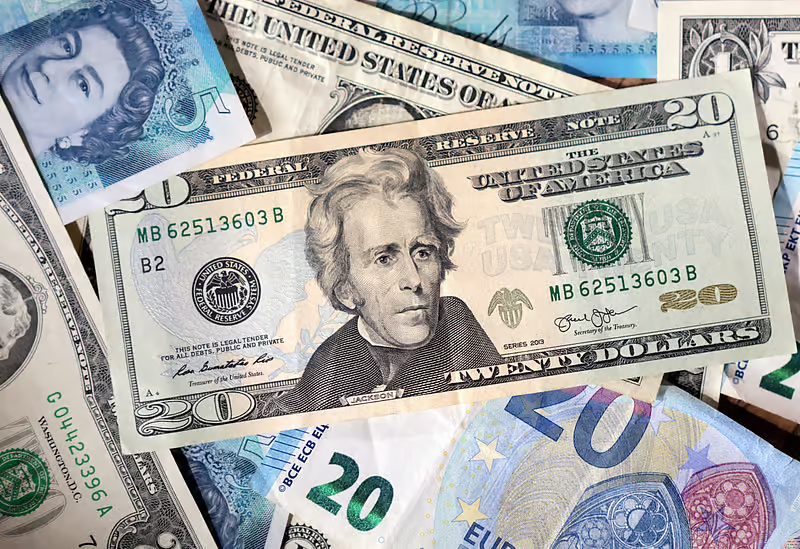
The greenback fell sharply in immediate reaction, dropping 0.7% against the euro and 0.6% against the yen in early U.S. trading. While it later pared some losses, the dollar remained lower against both majors for the session.
U.S. stock futures surged more than 2%, while Europe’s STOXX 600 erased deep intraday losses to turn positive, climbing 0.7% after having been down as much as 2.2% earlier in the day.
Crude oil, which had soared on fears of a wider confrontation, plunged as much as 14% to hit $96 a barrel before stabilizing near $100—still down roughly 5.4% on the day.
Markets interpreted the move as the first concrete sign of de-escalation since hostilities began in late February.
“This is clearly a positive development. The two sides are in discussions, and this is the first material sign of de-escalation that we have seen since conflict broke out,” said Michael Brown, a strategist at Pepperstone.
However, Brown cautioned against reading the pause as an end to hostilities. “The war is not yet over. While positive, it is only strikes on energy infrastructure that have been ruled out at this stage, presumably meaning that kinetic action will continue elsewhere, at least for the time being.”
Iran’s embassy in Kabul struck a defiant tone, saying Trump was backing down “after Iran’s firm warning.” Meanwhile, Iran’s FARS news agency quoted a source denying any direct or indirect communication with Washington, underscoring the deep mistrust between the two sides.
Strategists warned that the market’s initial euphoria could prove short-lived, citing a host of unresolved questions.
“This says ‘strikes on energy infrastructure.’ What about the rest — do the Iranians twiddle their thumbs for five days, and what about Israel? There are so many questions here that are unresolved,” said Chris Beauchamp, a strategist at IG.
“Yes, markets have reacted positively,” he added. “But it doesn’t change the fact that the Straits are still closed.”
With the five-day window now open, investors remain on edge, awaiting any further signals from Washington, Tehran, or regional players that could determine whether the pause becomes a pathway to broader de-escalation or merely a brief interlude in a protracted conflict.
