
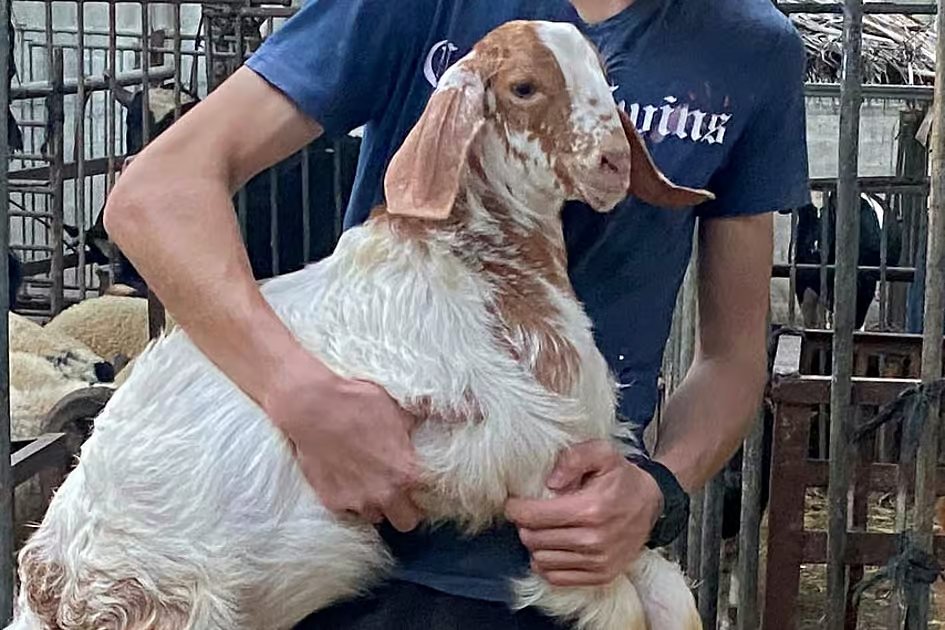
Livestock traders are offering Buy Now, Pay Later payment plans alongside cash prize draws of up to Dh100,000, luxury car raffles, and iPhone 17 giveaways to attract buyers
As UAE livestock traders roll out marketing campaigns ahead of Eid Al Adha, Dubai’s Grand Mufti has issued a firm religious ruling against the season’s commercial trends, buying sacrificial animals on instalment and entering prize raffles tied to the purchase.
The warning was issued on Dubai’s Direct Line programme, where Dr Ahmed bin Abdulaziz Al Haddad, Grand Mufti and Director of the Ifta Department at the Islamic Affairs and Charitable Activities Department in Dubai, appeared.
A local Arabic newspaper had revealed that, for the first time, livestock companies are offering Buy Now, Pay Later (BNPL) payment plans alongside cash prize draws of up to Dh100,000, luxury car raffles, and iPhone 17 giveaways to attract sacrifice buyers.
Dr Al Haddad emphasised that Qurbani, or Udhiya, is a pure act of worship, tracing back to Prophet Ibrahim and Prophet Muhammad (Peace Be Upon Him), and that mixing it with any worldly motive, such as financial gain or prize-seeking, nullifies its religious reward entirely.
“It is a pure worship for God Almighty, and it must not be mixed with worldly purposes,” he stated. “If a person seeks material gain from their sacrifice, the reward is nullified. God Almighty only accepts deeds that are done purely for His sake.”
Regarding BNPL apps, the Grand Mufti explained that even though the consumer pays no direct interest, the platform charges the merchant a percentage of the sale value in exchange for facilitating deferred payment, making the buyer an indirect enabler of riba (usury).
“Every loan that brings a benefit is riba,” Dr Al Haddad said. “Whether the interest is taken from you directly or through the merchant, you are assisting this company in taking riba. Without your transaction, they would not have taken that interest.”
He added that late payment fees imposed by these platforms, whether absorbed by the merchant or the customer, further compound the religious impermissibility, as any fee tied to the extension or delay of a debt constitutes riba.
Dr Al Haddad also referenced a Hadith of the Prophet Mohammed (Peace Be Upon Him) stipulating that the butcher who slaughters the animal must not be paid from the meat itself, but must be compensated separately, underscoring that no part of the sacrifice may be used for commercial exchange.
“This invalidates the intention of the person who buys with the hope of winning a prize,” he noted. “They wanted to benefit materially from their sacrifice, so its spiritual value is lost.”
The Arabic Newspaper had attributed the surge in such promotions to intensifying competition among traders and to rising livestock prices, driven by regional factors and higher shipping costs.
The Grand Mufti urged Muslims to guard their religious duties in these blessed days. “A Muslim must be careful with their religion and observe God Almighty in their dealings, so that they may be blessed and kept away from prohibitions,” he said.
