
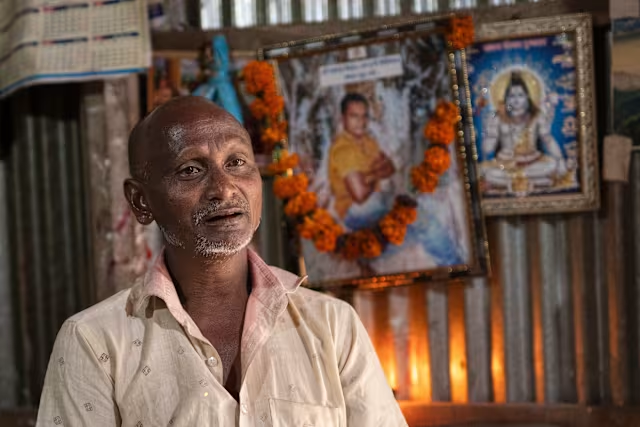
A brutal killing underscores widespread violence and impunity, stoking domestic fear and inflaming tensions with neighboring India.
DHAKA,— As Bangladesh approaches a pivotal national election, its Hindu minority is confronting a sharp escalation in targeted violence, driven by political polarization and a resurgent Islamist movement, human rights groups say.
The climate of fear was punctuated in December by the mob killing of Dipu Chandra Das, a 27-year-old Hindu garment worker. Accused of blasphemy by colleagues, Das was beaten, hanged from a tree, and set on fire—an act recorded and circulated widely, becoming a grim symbol of the community’s vulnerability.
“This was not an isolated act,” said Ranjan Karmaker, a Dhaka-based Hindu rights activist. “No one feels safe anymore. Everyone is terrified.”
A Documented Surge and a “Culture of Impunity”
The killing is part of a broader pattern. The Bangladesh Hindu Buddhist Christian Unity Council reports over 2,000 incidents of communal violence since the ouster of former Prime Minister Sheikh Hasina in August 2024, including at least 61 killings and 95 attacks on temples. The group accuses the interim government of Nobel laureate Muhammad Yunus of downplaying the violence.
While the administration denies failing to protect minorities and insists most incidents are not religiously motivated, activists point to a “culture of impunity.”
“The individuals involved in this violence are not being brought under the law,” Karmaker warned, stating the community in some areas faces an “existential crisis.”
Political Recalculations and Regional Fallout
The violence coincides with the political re-emergence of Jamaat-e-Islami, the country’s largest Islamist party, which is seeking to recast its image despite advocating for Shariah law. Analysts like Altaf Parvez view its inclusive gestures as largely symbolic and warn that systematic attacks in rural areas aim to intimidate minority voters ahead of the February 12 poll.
The crisis has also ruptured regional relations. India’s government has condemned Bangladesh for downplaying a “disturbing pattern” of attacks, leading to diplomatic spats, suspended visa services, and a boycott of international cricket events.
“For those in exit mode, it is easier to look the other way,” said Sreeradha Datta, a Bangladesh expert at India’s Jindal School of International Affairs, referencing the Yunus administration.
A Family’s Loss, A Community’s Plea
Beyond the statistics and diplomacy lies profound personal loss. Das’s family, now without its sole breadwinner, watches as his killing becomes a political flashpoint.
“They beat him, hung him from a tree, and burned him. I demand justice,” said his mother, Shefali Rani Das—a plea echoing a community’s call for security and accountability as the nation votes.
