
 BBC
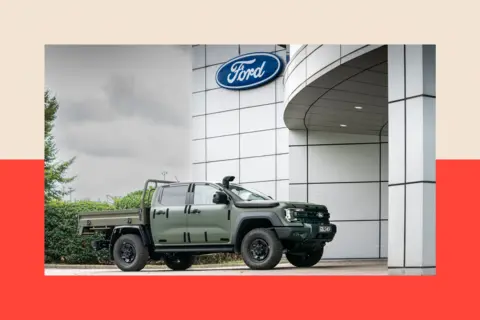
BBCIt’s green, bulging and intimidating. Ford’s latest vehicle looks like a pick-up truck that has been through an Incredible Hulk transformation. Based on its popular Ranger series, this beefy number parked outside the front door of Ford’s Dagenham plant can carry a load of two tonnes, tow up to four tonnes and is also shouldering the hopes of the 2,000-strong workforce that still makes engines here.
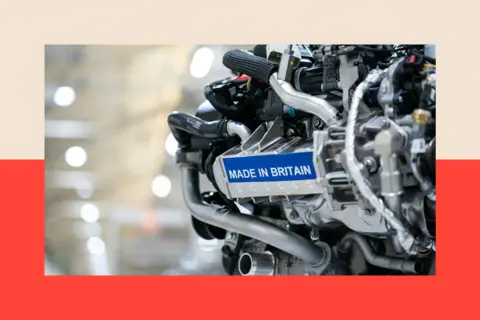
Inside the factory, the three-litre diesel engines that will power this camo-painted beast drift down a production line that has seen output cut from 90,000 engines a year to about half that over the last decade.
Ford is hoping that a pivot towards military vehicles can help fill the void created by what the company’s UK boss calls the most challenging environment since the invention of the motor car. Once mighty, the European car industry is starting to look puny and is hoping surging defence budgets as Europe re-arms can help it flex its industrial muscles once more.

 Ford
FordLisa Brankin, chair of Ford UK, says it is a chance to showcase their abilities to respond quickly to defence needs: “As a manufacturer you look at every opportunity that comes at you and this is a great opportunity that we would love to take advantage of.”
This is not the first time Ford has busied itself with defence work.
Ahead of World War Two, Ford’s factory in Dagenham, east London, was the largest car plant in Europe.
When war broke out, civilian car assembly stopped completely, and the factory was converted entirely to military production. Between 1939 and 1945, the Dagenham plant built 360,000 vehicles for the Allied war effort.
Ford workers in Manchester manufactured 34,000 Rolls-Royce-designed Merlin engines, which powered Spitfires and Hurricane fighter planes.
Eighty years later, the UK and European car industries are hoping that the engines of war can help defend against what one supplier told the BBC was a “terminal decline”.
As Europe feels compelled to commit hundreds of billions to ramp up defence spending in the face of the menace from Russia and US reluctance to be Europe’s protector, car makers that are under commercial attack from Chinese rivals have taken notice.
So can the rearmament of Europe save an auto industry and a supply chain facing crisis?
The shift to defence
Ford is far from the only car company that sees defence as a growth industry – and one that can utilise the growing overcapacity at car plants across Europe.
French car maker Renault has signed a strategic agreement with defence giant Thales to produce military drones – targeting an output of up to 1,000 units per month. The French military and Directorate General for Armament want to tap into Renault’s mass-production capabilities to bypass traditional, slower defence supply chains.
Meanwhile, Volkswagen has agreed to sell an under-used factory in Osnabruck, western Germany, which will become a military manufacturing hub in a joint venture with an Israeli-based defence investor.

Jaguar Land Rover (JLR), which makes the Land Rover, is also bidding for the same contract as Ford – as the Army retires its existing Land Rover-based fleet by 2030. JLR has also established a new dedicated business unit to support its global military ambitions.
It makes sense for under-utilised auto manufacturing capacity to switch to defence, says Mike Hawes of the Society for Motor Manufacturers and Traders (SMMT) trade association.
The UK car industry and its suppliers are heavily reliant on a few big manufacturers – Nissan in Sunderland, Toyota in Derbyshire, BMW in Oxfordshire and the biggest of them all by value of output, JLR at multiple sites in the Midlands and Merseyside.
And Hawes says the supply chain is very vulnerable.
“UK automotive output has been in decline over the last eight or nine years,” he says. “We’re probably half of what we were 10 years ago. Now, that’s obviously going to hit the supply chain because they’re not making the same number of parts. So they’ve got capacity. They may be quite dependent on one particular manufacturer as well.”
So they will welcome “the opportunity to broaden their customer base and potentially move into defence”, he says.
Just two weeks ago, JLR announced it was cutting 4,000 jobs from its 30,000-strong UK workforce in order to reduce costs to stay competitive with international – particularly Chinese – rivals. Dave Roberts of the firm Evtec, which supplies cooling systems components to JLR, is worried about the implications of this.
“JLR is the critical mass in the UK automotive manufacturing space,” he says. “It is the glue that holds the whole of the sector together. Because remember, when you’re making volumes for JLR, they’re significantly higher than any other car maker in the UK.
“If they suffer, the ripples run deeper through the supply chain.”
Earlier this week, major JLR suppliers urged the government to help automotive manufacturers move into aerospace and defence, warning that large-scale car production in the UK faces long-term decline.
 Ford
FordIn an open letter to the prime minister, chancellor and West Midlands Mayor Richard Parker, industry leaders argued Britain’s automotive supply chain was “not in decline” but “in the wrong market”.
The letter was signed by executives representing businesses with more than 8,600 direct employees, alongside the Confederation of British Metalforming, which represents about 75,000 workers.
Signatories to the letter said the redundancies were “the first visible crack” in a UK automotive supply chain supporting about 183,000 manufacturing jobs.
Across Europe, the industry is facing what Sigrid de Vries, director general of the ACEA auto industry manufacturers’ association called “a perfect storm”. Car makers are spending billions to shift to electric vehicles and insist that government sales targets for EVs are outpacing consumer demand.
And the EVs people are buying are increasingly from the biggest new threat to the industry – China.
The China syndrome
In the early 2000s, Western firms saw China as a land of opportunity. The country’s rapidly growing middle class had plenty of money and a seemingly insatiable appetite for cars, including the most profitable upmarket models. It was a lucrative business – the Chinese market once accounted for half of Volkswagen’s profits.
However, it didn’t last. China wanted a home-grown car industry and lavish state funding was ploughed into making the country a leader in high-tech businesses, including electric cars.
Today, the Chinese market is overloaded with brands, both foreign and domestic, and is characterised by cut-throat competition. Chinese car makers have focused their attention on foreign markets, and have used the transition to electric vehicles as a pathway to gaining market share. The likes of BYD, Chery and Geely are moving aggressively into Europe.
For European brands, all of this could not have happened at a worse time. The loss of the steady stream of profits from China, and the emergence of Chinese rivals on their home turf, has come after they invested heavily in producing electric vehicles (EVs). But EV sales have not increased as quickly as expected. Executives admit they have struggled to match the low production costs and development speed of the Chinese insurgents.
The result is that European manufacturers are now rushing to cut costs, while wondering what to do with expensive factories capable of producing millions more cars than they are able to sell.
Volkswagen has already announced plans to cut 100,000 jobs over the next few years. Whereas once closing plants in Germany would have been unthinkable, the company has now shuttered one in Dresden and may shut down four more. That includes a site in Zwickau, where VW spent over €1bn (£857m) converting production lines to build electric vehicles – a process that was completed just four years ago.
Industry estimates indicate that western European car plants have roughly 2.5 million vehicles worth of annual spare capacity.
Little wonder that car makers are jealously eyeing soaring defence budgets across Europe.
Sigrid de Vries says car makers are well placed to help Europe rearm.
“Many of the capabilities that defence needs are needed for and also delivered by the automotive sector,” she says. “So automotive manufacturers and suppliers possess industrial assets, they possess manufacturing expertise, logistics capabilities, also advanced technologies. They have vast and also very integrated supply chains that may be relevant for Europe’s broader defence preparedness objective.”
But it is not that simple – security protocols, political and economic rivalries within Europe plus the fact that unless you’re actually at war, the volumes will not replace the mass consumer market, all of which present challenges, she says.
“These are two very different worlds,” she says. Governments want to invest in their defence capabilities and that is why it’s now, more than ever, interesting for manufacturers and suppliers to see what’s possible, but it will not be enough to address the underutilisation of manufacturing capacity we currently see.”
Let the fox into the henhouse?
If defence can’t plug the yawning gaps in UK and European car manufacturing production – is it time for the henhouse to rent a room to the fox?
In other words, let Chinese companies move into European production facilities?
To offset the immense fixed costs of running idle assembly lines, legacy European and UK automakers are opening their doors to Chinese rivals.
Stellantis – owners of the Vauxhall, Fiat, Peugeot and Citroen marques – has taken a 20% stake in Chinese EV maker Leapmotor and production of the Chinese brand started in Poland two years ago. (Leapmotor then moved production to Spain after Poland voted to impose steep tariffs on Chinese EVs while Spain abstained – an example of how trade politics can get complicated.)
Nissan and Chery International UK have signed a non-binding Memorandum of Understanding for the study of contract manufacturing for Nissan to manufacture Chery vehicles at its Sunderland plant.
VW CEO Oliver Blume said in April of this year that Volkswagen was considering sharing spare European factory capacity with Chinese joint-venture partners.
In one sense it could be a win-win. European factories would have extra work while Chinese manufacturers could avoid high tariffs when selling into the US and the EU by making and exporting the cars in and from those markets.
But building cars in Europe does not automatically mean creating or saving European supply chains.
Some plants may only perform final assembly while many of the components – especially batteries – may continue to come from China.
Car making is still seen as central to countries’ sovereign manufacturing capability – in the old days the mantra was: “What’s good for General Motors is good for America.” You could say the same for Volkswagen, Mercedes and BMW for Germany and JLR for the UK.
Car plants are often the major employer in their area and support local supply chains, so job losses can hit particularly hard. That’s why countries go to great lengths to protect and preserve them.
“They’re vulnerable. They’re not resilient in those sectors anymore.”
Ford UK’s Lisa Brankin acknowledges 9,000 engines over five to seven years is a far cry from the 90,000 per year the plant used to produce – but she insists every little helps.
“It is a drop in the ocean but every single opportunity is worth having, isn’t it?”
A spokesperson for the Ministry of Defence says it wants UK industry to play a “central role” in delivering thousands of modern light mobility vehicles. The spokesperson adds: “We are backing British businesses and supporting our defence industrial base with 85% of our defence spending currently staying in the UK, driving reindustrialisation and making defence an engine for growth.”
It’s understandable why a declining European car industry wants to gatecrash the spending splurge in the defence sector. But even if they can, right now it is hard to see how they’ll ever be able to wield the muscle that they once did.

BBC InDepth is the home on the website and app for the best analysis, with fresh perspectives that challenge assumptions and deep reporting on the biggest issues of the day. Emma Barnett and John Simpson bring their pick of the most thought-provoking deep reads and analysis, every Saturday. Sign up for the newsletter here
