
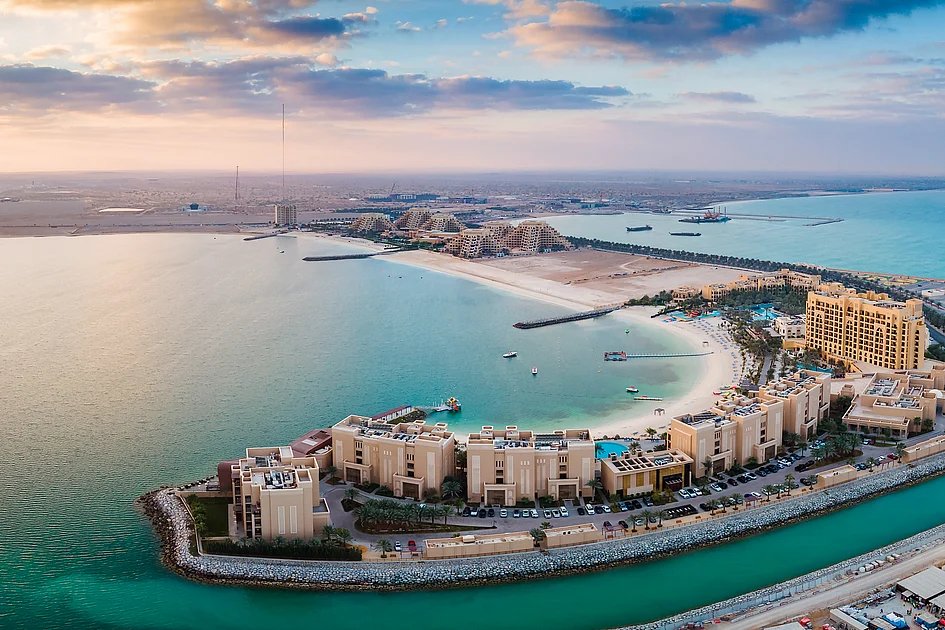
Ras Al Khaimah’s transformation into one of the Gulf’s fastest-growing tourism and hospitality hubs is accelerating, with global hotel operators racing to secure a presence in the emirate as visitor numbers surge and a multi-billion-dollar luxury pipeline reshapes its coastline.
Fresh research from CBRE Middle East shows Ras Al Khaimah’s real estate market ended 2025 on a strong footing, led by a standout performance in hospitality as the emirate capitalised on rising international tourism, expanding air connectivity and a wave of landmark resort developments that are rapidly elevating its global profile.
Hotel performance metrics improved across the board, with occupancy rising by 4.6 percentage points, average daily rates climbing 6.6 per cent and revenue per available room surging 11.5 per cent year-on-year, reflecting stronger pricing power and sustained demand.
The emirate’s hotel inventory now exceeds 9,000 keys, but the development pipeline signals a far more dramatic expansion ahead. More than 9,500 additional rooms are expected to be delivered between 2026 and 2030, with 92 per cent positioned in the five-star category, highlighting Ras Al Khaimah’s push into the ultra-luxury tourism segment.
At the centre of this transformation is the Dh19 billion ($5.2 billion) Wynn Al Marjan Island integrated resort — the largest foreign direct investment project in the emirate’s history — which is set to include the Middle East’s first integrated gaming resort.
The project has already triggered a surge in land values, branded residence launches and hotel announcements across the northern emirate.International hotel operators are deepening their presence in anticipation of the tourism boom.
Accor and Hilton continue to lead expansion activity, while new entrants such as Aman Group and Wynn Resorts are set to redefine the luxury landscape. Marriott International has also significantly expanded its pipeline with new projects under The Luxury Collection and JW Marriott brands, signalling sustained confidence among global operators in Ras Al Khaimah’s long-term tourism prospects.
“Ras Al Khaimah’s real estate market continues to evolve at an unprecedented pace, supported by strong macroeconomic fundamentals, record levels of foreign investment and a maturing property ecosystem,” said Matthew Green, head of Research at CBRE Mena.
“The emirate’s hospitality sector has entered a new phase of growth driven by global brand partnerships, major tourism-led projects and a deepening pool of international visitors and investors.”
Data from Ras Al Khaimah Tourism Development Authority (RAKTDA) show the emirate is targeting more than 3 million annual visitors by 2030, nearly tripling current levels. To support this ambition, authorities are investing heavily in infrastructure, events and destination marketing, while expanding air connectivity with new routes from Europe, Central Asia and key GCC markets.
Industry analysts say the influx of international hotel brands reflects rising investor confidence in Ras Al Khaimah’s positioning as an affordable luxury alternative to Dubai, offering beachfront developments, natural attractions and competitive development costs.
STR Global data indicate that Ras Al Khaimah’s hotel market has been among the fastest-growing in the Middle East in terms of occupancy recovery and rate growth since 2022.
Haitham Mattar, managing director for India, Middle East and Africa at IHG Hotels & Resorts, said the emirate’s tourism strategy and infrastructure investments are creating strong fundamentals for sustained hospitality expansion.
“Ras Al Khaimah is emerging as one of the region’s most exciting leisure destinations, supported by clear government vision and increasing international demand for experiential travel,” he said recently.
JLL Middle East has also highlighted Ras Al Khaimah as a rising hospitality hotspot, noting that the emirate’s growing calendar of international events, adventure tourism offerings and integrated resort developments are broadening its appeal beyond traditional beach tourism.
The consultancy expects hotel supply growth to accelerate sharply from 2027 onwards as several large-scale projects reach completion. The hospitality surge is feeding directly into the wider real estate market.
CBRE data show residential prices rose sharply in 2025, with prime apartment values climbing 32 per cent year-on-year to Dh2,428 per square foot, driven largely by demand in coastal destinations such as Al Marjan Island, Al Hamra and Mina Al Arab. Villa prices increased 11 per cent to an average of Dh1,211 per square foot, while apartment rents surged nearly 25 per cent amid limited ready supply and rising population inflows linked to tourism and new business activity. More than 19,000 new companies were added to Ras Al Khaimah Economic Zone (RAKEZ) in 2025, reinforcing the emirate’s economic diversification drive and supporting demand for residential and hospitality assets.
Analysts say the interplay between tourism growth, business expansion and high-profile developments is creating a powerful investment cycle that is positioning Ras Al Khaimah as one of the UAE’s most dynamic real estate markets.
