Close Menu
    What's Hot

    Ferrari wanted to take on Chinese EVs with the Luce – then the backlash startedThe brand's first EV has been heavily criticised, with some saying it has abandoned Ferrari's roots.10 hrs ago

    May 31, 2026

    How stamps and postcards helped India count its peopleIndia's post office turned stamps, postcards and letters into tools for counting a nation after independence in 1947.8 hrs agoAsia

    May 31, 2026

    Japan defence minister denies militarism and criticises China's 'huge arsenal'Shinjiro Koizumi makes some of Tokyo's most pointed remarks yet in the dispute over Japan's military build-up.30 mins agoAsia

    May 31, 2026
    Facebook X (Twitter) Instagram
    • Politics
    • Economy
    Facebook X (Twitter) Instagram
    Gulf News Week
    Subscribe
    Sunday, May 31
    • Home
    • Politics
      • Europe
      • Middle East
      • Russia
      • Social
      • Ukraine Conflict
      • US Politics
      • World
    • Region
      • Middle East News
    • World
    • Economy
      • Banking
      • Business
      • Markets
    • Real Estate
    • Science & Tech
      • AI & Tech
      • Climate
      • Computing
      • Science
      • Space Science
      • Tech
    • Sports

      Dominant PSG put Liverpool on the brink with 2-0 Champions League quarter-final first-leg win

      April 9, 2026

      Dubai Basketball U-18 Elite Crowned Basket Cup Sarajevo 2026 Champions in Historic Debut

      April 6, 2026

      Saudi boxing crowns 20 champions as Kingdom’s Elite Belt concludes in Riyadh

      April 4, 2026

      “He Signed for a Real Fight”: Pacquiao Contradicts Mayweather Over Rematch Status

      April 3, 2026

      Arsenal Hold Off Chelsea Fightback to Reach Women’s Champions League Semi-Finals

      April 2, 2026
    • Health
    • Travel
    • Contact
    Gulf News Week
    Home»Most Viewed News»How stamps and postcards helped India count its peopleIndia's post office turned stamps, postcards and letters into tools for counting a nation after independence in 1947.8 hrs agoAsia
    Most Viewed News

    How stamps and postcards helped India count its peopleIndia's post office turned stamps, postcards and letters into tools for counting a nation after independence in 1947.8 hrs agoAsia

    Gulf News WeekBy Gulf News WeekMay 31, 2026No Comments6 Mins Read
    Share Facebook Twitter Pinterest Copy Link LinkedIn Tumblr Email VKontakte Telegram
    How stamps and postcards helped India count its peopleIndia's post office turned stamps, postcards and letters into tools for counting a nation after independence in 1947.8 hrs agoAsia
    Share
    Facebook Twitter Pinterest Email Copy Link
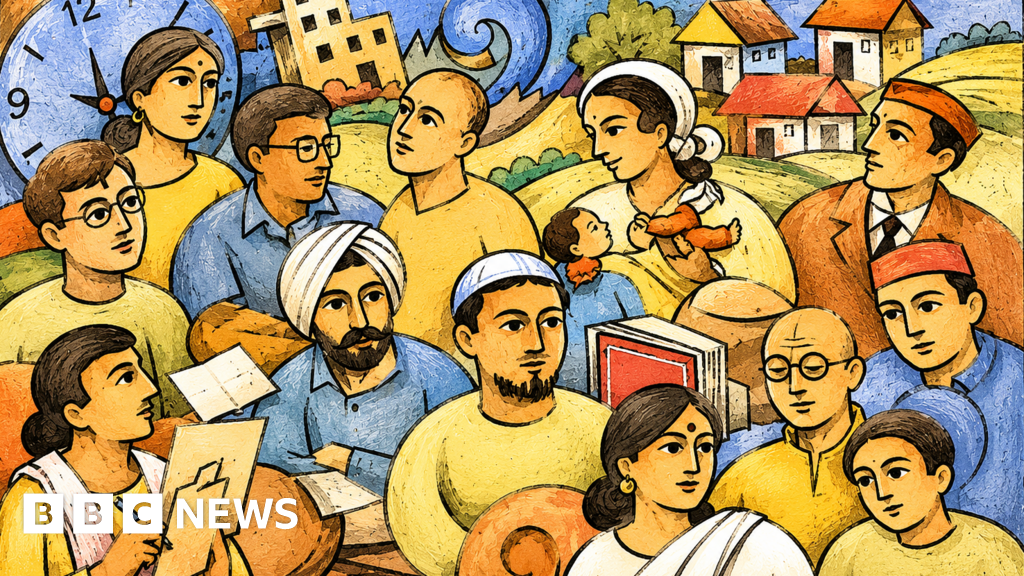
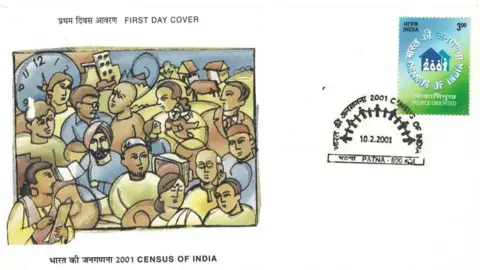
    Vikas Kumar Issued to mark India’s 2001 census, this commemorative stamp featured a family of four beneath the slogan “People Oriented”. The first day cover celebrated India’s diversity with a colourful crowd scene, while its cancellation mark showed men, women and children holding hands in a semi-circle — a symbolic portrait of a nation counting itself.Vikas Kumar
    Issued to mark India’s 2001 census, this commemorative stamp featured a family of four beneath the slogan “People Oriented”. The first day cover celebrated India’s diversity with a colourful crowd scene, while its postmark showed men, women and children holding hands in a semi-circle – a symbolic portrait of a nation counting itself.

    Long before smartphones and government apps, India used its vast postal network to persuade people to take part in one of the world’s biggest statistical exercises: the census.

    Now, as India prepares for its 16th census – the eighth since independence in 1947 – a new exhibition revisits that forgotten history through stamps, postmarks and letters once used to rally citizens behind the national headcount.

    • India begins huge census
    • India’s census: The good and bad news

    The exhibition, curated by Vikas Kumar, an economics professor at Bengaluru’s Azim Premji University, explores how India’s postal system became an unlikely instrument of nation-building in the decades after independence.

    The census was considered so central to the new republic’s political economy that the Constituent Assembly passed the Census Act in 1948, even before the constitution was finalised.

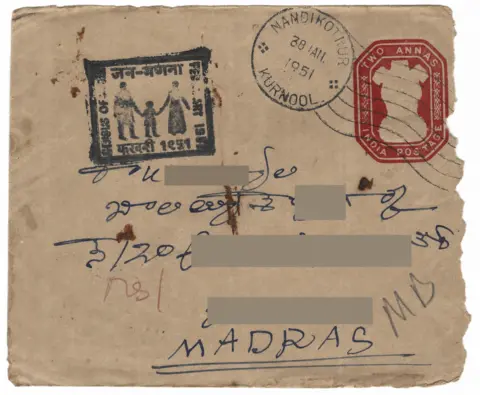
    Vikas Kumar An envelope mailed from Nandikotkur in January 1951 and delivered in Madras (now Chennai) days later bears one of the earliest known bilingual postmarks promoting India's first post-independence census. The black pictorial stamp - showing a family of three with "Census of India, February 1951" in Hindi and English - became the most widely used census postmark of the era.Vikas Kumar
    An envelope mailed from Nandikotkur in January 1951 and delivered in Madras (now Chennai) days later bears one of the earliest known bilingual postmarks promoting India’s first post-independence census. The black pictorial stamp – showing a family of three with “Census of India, February 1951” in Hindi and English – became a widely used census postmark of the era.
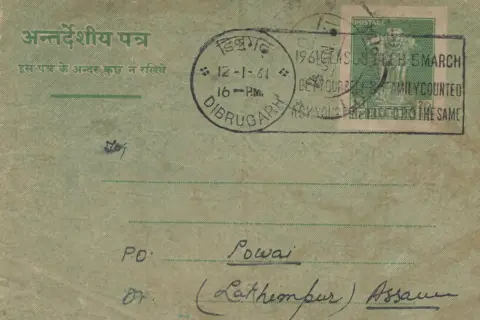
    Vikas Kumar This inland letter card, mailed within Assam in January 1961, carried a census postmark urging Indians to "Get yourself & family counted" - and to persuade friends to do the same. It was part of a nationwide postal campaign that turned everyday mail into a tool of public mobilisation.Vikas Kumar
    This inland letter card, mailed within Assam in January 1961, carried a census postmark urging Indians to “Get yourself & family counted” – and to persuade friends to do the same. It was part of a nationwide postal campaign that turned everyday mail into a tool of public mobilisation.
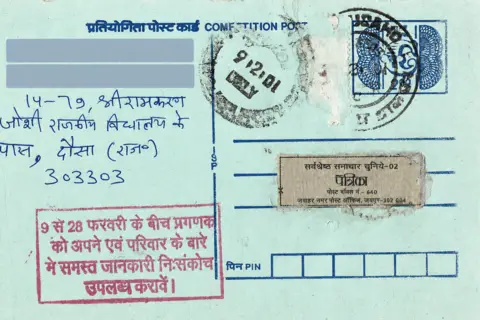
    Vikas Kumar Mailed from Dausa to Jaipur in February 2001, this postcard carried a Hindi census postmark urging Indians to share details about themselves and their families "without any hesitation". It reflected how the census relied not just on counting people, but on persuading them to trust the state with their information.Vikas Kumar
    Mailed from Dausa to Jaipur in February 2001, this postcard carried a Hindi census postmark urging Indians to share details about themselves and their families “without any hesitation”. It reflected how the census relied not just on counting people, but on persuading them to trust the state with their information.

    But the government faced two immediate challenges: how to persuade people to participate in the census, and how to maintain communication between enumerators and census officials across a vast, poor and largely rural country.

    Trust was a particular concern. The colonial censuses of 1931 and 1941 had faced boycotts in parts of India, while the 1941 headcount in Punjab and Bengal was marred by allegations of communal manipulation. Public outreach, therefore, became critical to the legitimacy of independent India’s first census.

    That is where the post office came in.

    Until a few decades ago, the postal department was the largest unified communications network available to the Indian state.
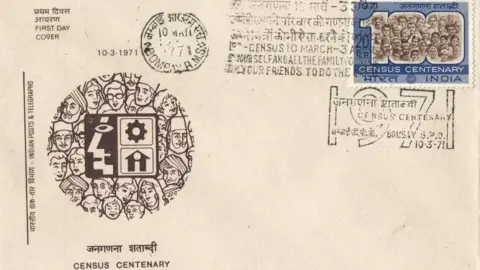
    Vikas Kumar Three million commemorative stamps were issued in 1971 to mark the centenary of the census, celebrating the country's diversity through faces embedded within the number 100. The first day cover paired census imagery with slogan postmarks urging Indians to participate in one of the world's largest counting exercises.Vikas Kumar
    Three million commemorative stamps were issued in 1971 to mark the centenary of the census, celebrating the country’s diversity through faces embedded within the number 100. The first day cover paired census imagery with slogan postmarks urging Indians to participate in one of the world’s largest counting exercises.
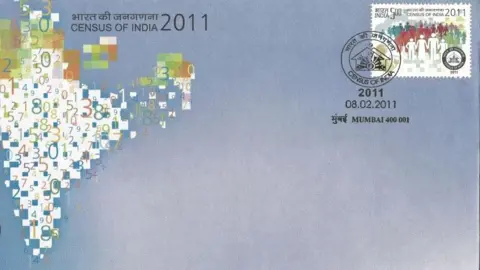
    Vikas Kumar Issued for the 2011 Census, this commemorative stamp showed families holding hands alongside an enumerator and the census emblem. The first day cover paired a pixelated map of India with a cancellation mark carrying the census symbol - reflecting a country entering the digital age of counting.Vikas Kumar
    Issued for the 2011 Census, this commemorative stamp showed families holding hands alongside an enumerator and the census emblem. The first day cover paired a pixellated map of India with a cancellation mark carrying the census symbol – reflecting a country entering the digital age of counting.

    After independence, the postal system expanded faster than most other public networks, including banking. By 1968, more than 100,000 post offices were delivering mail daily to 300,000 villages and weekly to another 300,000 more.

    Kumar’s research shows how differently the Indian state once communicated with citizens.

    In the run-up to the 1951 census – the first after independence – the government used a bilingual pictorial postmark stamped on letters travelling across the country.

    The postmark showed a family of three framed by the words “Census of India” in Hindi and English.
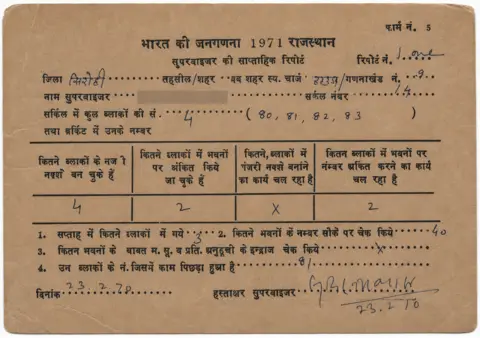
    Vikas Kumar A supervisor in Rajasthan's Bhilwara district mailed this pre-printed postcard on 23 February 1970 to track mapping, house numbering and enumeration work for the 1971 Census.Vikas Kumar
    A supervisor in Rajasthan’s Bhilwara district mailed this pre-printed postcard on 23 February 1970 to track mapping, house numbering and enumeration work for the 1971 Census.

    The campaign was carefully calibrated for a country with low literacy rates. Postmen often doubled as readers, scribes and informal state intermediaries in villages, making the postal network an ideal vehicle for public messaging.

    Over the decades, the messaging evolved with the nation itself.

    In 1961, postmarks urged Indians to “Get yourself and all the family counted” and “Ask your friends to do the same”.

    By 1971, commemorative stamps celebrated the census as “one of the largest administrative operations in the world”, proudly noting that population data was now being processed using electronic computers.

    The postal material also reveals how governments imagined the census itself.

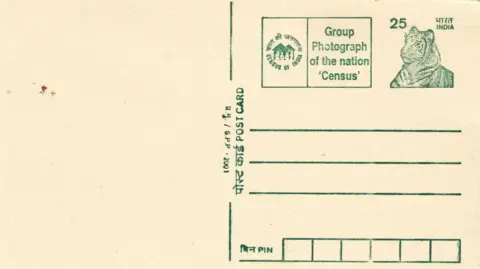
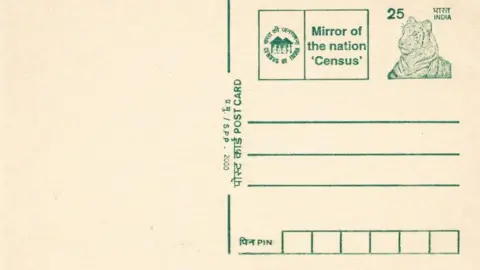
    Advertisements in 2000 described it as the “Mirror of the nation” and a “Group Photograph of the nation”, presenting the census less as a bureaucratic exercise than as a collective self-portrait.
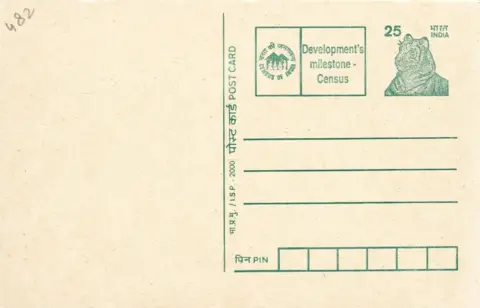
    Vikas Kumar 2001/Development’s milestone - Census: This census advertisement was featured on postcards issued in October 2000 before the household phase of the 2001 census. These postcards were issued in in 13 languages.Vikas Kumar
    “Development’s milestone – Census” read this slogan printed on postcards issued in 13 languages ahead of India’s 2001 census, reflecting how the exercise was framed as central to nation-building and progress.
    Vikas Kumar Group Photograph of the Nation ‘Census’:  This census advertisement was featured on postcards in October 2000 before the household phase of the 2001 census. These postcards were issued in in 11 languagesVikas Kumar
    “Group Photograph of the Nation”: Issued ahead of the 2001 Census, these multilingual postcard advertisements carried the census message across India. This Hindi-English version dates to January 2001.
    Vikas Kumar 2001/Mirror of the Nation ‘Census’: This census advertisement was featured on postcards in October 2000 before the household phase of the 2001 census. These postcards were issued in in 13 languagesVikas Kumar
    2001/Mirror of the Nation ‘Census’: This census advert was featured on postcards in October 2000 before the household phase of the 2001 census. These postcards were issued in 13 languages.

    Later imagery increasingly linked counting with population control, prominently featuring the two-child norm – a reflection of the anxieties of the era.

    For Kumar, these fragile postal artefacts capture more than bureaucratic history.

    They reveal how the Indian state sought to build legitimacy and trust through everyday communication – and how the census became intertwined with ideas of development, diversity and national identity.

    That question of trust remains relevant today.

    While digital tools may speed up data collection, Kumar argues that technology alone cannot guarantee reliable data.

    “Awareness about the census is critical to building trust,” he says, cautioning that the government must find new ways to build public confidence as the reach of the postal system fades.

    And yet, the census India is preparing for today is vastly different from the one remembered in these fading postal artefacts.

    The new census is seen as crucial for policy planning, welfare delivery and political representation in the world’s most populous country. It will also, for the first time in decades, collect caste data – a politically sensitive exercise in a country where caste continues to shape social and economic life.

    The scale remains staggering: the exercise will span 36 states and federally administered territories, more than 7,000 sub-districts, over 9,700 towns and nearly 640,000 villages. Millions of households will be surveyed by enumerators and supervisors – typically teachers, local officials and government staff.

    But one thing has changed fundamentally. For the first time, the census will be conducted digitally, with enumerators using mobile apps to collect and upload data in real time.

    From family-shaped postmarks stamped on envelopes to data uploaded instantly from smartphones, the census has travelled a long way.

    Yet the underlying challenge, as the exhibition suggests, remains much the same: persuading more than a billion people to trust the state enough to count themselves into the story of the nation.

    Censuses
    India
    Asia
    Share. Facebook Twitter Pinterest LinkedIn Tumblr Email Telegram Copy Link
    Gulf News Week

    Related Posts

    Most Viewed News

    Ferrari wanted to take on Chinese EVs with the Luce – then the backlash startedThe brand's first EV has been heavily criticised, with some saying it has abandoned Ferrari's roots.10 hrs ago

    May 31, 2026
    Most Viewed News

    Japan defence minister denies militarism and criticises China's 'huge arsenal'Shinjiro Koizumi makes some of Tokyo's most pointed remarks yet in the dispute over Japan's military build-up.30 mins agoAsia

    May 31, 2026
    Most Viewed News

    PSG go back-to-back and join 'greatest of all time'Paris St-Germain underline their status as one of European football's greatest ever teams by retaining their Champions League crown with victory against Arsenal.10 hrs agoEuropean Football

    May 31, 2026
    Most Viewed News

    Mumbai's famed dabbawalas fed millions for over 100 years – now they are disappearingDabbawalas, who deliver home-cooked meals, are leaving the trade as remote work and rising costs threaten their future.1 day agoAsia

    May 31, 2026
    Most Viewed News

    Ethiopia is heading to the polls, but not everyone can votePrime Minister Abiy Ahmed's party is expected to dominate the election as conflicts overshadow the vote.3 hrs agoAfrica

    May 31, 2026
    Most Viewed News

    Hundreds arrested in France after wild Champions League celebrationsThousands of officers tried to quell unrest as crowds of fans – some firing flares – celebrated PSG's victory over Arsenal.19 mins ago

    May 31, 2026
    Add A Comment
    Leave A Reply Cancel Reply

    Editors Picks

    Ferrari wanted to take on Chinese EVs with the Luce – then the backlash startedThe brand's first EV has been heavily criticised, with some saying it has abandoned Ferrari's roots.10 hrs ago

    May 31, 2026

    How stamps and postcards helped India count its peopleIndia's post office turned stamps, postcards and letters into tools for counting a nation after independence in 1947.8 hrs agoAsia

    May 31, 2026

    Japan defence minister denies militarism and criticises China's 'huge arsenal'Shinjiro Koizumi makes some of Tokyo's most pointed remarks yet in the dispute over Japan's military build-up.30 mins agoAsia

    May 31, 2026

    PSG go back-to-back and join 'greatest of all time'Paris St-Germain underline their status as one of European football's greatest ever teams by retaining their Champions League crown with victory against Arsenal.10 hrs agoEuropean Football

    May 31, 2026
    Latest Posts

    Ferrari wanted to take on Chinese EVs with the Luce – then the backlash startedThe brand's first EV has been heavily criticised, with some saying it has abandoned Ferrari's roots.10 hrs ago

    May 31, 2026

    Japan defence minister denies militarism and criticises China's 'huge arsenal'Shinjiro Koizumi makes some of Tokyo's most pointed remarks yet in the dispute over Japan's military build-up.30 mins agoAsia

    May 31, 2026

    PSG go back-to-back and join 'greatest of all time'Paris St-Germain underline their status as one of European football's greatest ever teams by retaining their Champions League crown with victory against Arsenal.10 hrs agoEuropean Football

    May 31, 2026

    Subscribe to News

    Get the latest sports news from NewsSite about world, sports and politics.

    Advertisement
    Demo
    Gulf News Week

    Your source for the serious news. This demo is crafted specifically to exhibit the use of the theme as a news site. Visit our main page for more demos.

    We're social. Connect with us:

    Facebook X (Twitter) Instagram Pinterest YouTube
    Latest Posts

    Ferrari wanted to take on Chinese EVs with the Luce – then the backlash startedThe brand's first EV has been heavily criticised, with some saying it has abandoned Ferrari's roots.10 hrs ago

    May 31, 2026

    How stamps and postcards helped India count its peopleIndia's post office turned stamps, postcards and letters into tools for counting a nation after independence in 1947.8 hrs agoAsia

    May 31, 2026

    Japan defence minister denies militarism and criticises China's 'huge arsenal'Shinjiro Koizumi makes some of Tokyo's most pointed remarks yet in the dispute over Japan's military build-up.30 mins agoAsia

    May 31, 2026

    Subscribe to Updates

    Get the latest creative news from FooBar about art, design and business.

    © 2026 Gulf News Week. Designed by HAM Digital Media.
    • Home
    • Politics
    • Economy
    • Sports

    Type above and press Enter to search. Press Esc to cancel.