
 BBC
BBCSixteen years ago, Abdi Nor Iftin was a Somali refugee living in one of the roughest slums in Kenya when he found out he had won the lottery of a lifetime. Out of nearly eight million applicants in 2013, he had been one of the lucky 50,000 granted a US visa through a scheme known as the diversity visa scheme that the US government had begun in the 1990s.
Abdi had long dreamt of moving to America. He was so obsessed, his childhood friends even nicknamed him “Abdi America” after he learnt to speak English by watching Hollywood movies. “My whole life I have been in love with America – the best country in the world, the dreamland, the land of opportunity,” he told the BBC in 2014.
That year, Abdi, now 41, arrived in the US, settled in a small town in Maine, got a job installing insulation and became a US citizen. But now, his hopes have run up against reality. He lost his job at a refugee resettlement agency this year, and consequently his health insurance.
On the eve of the United States’ 250th birthday, Abdi, like many Americans, is feeing uneasy about the future of his country.
“I feel like the American Dream is alive, but not well,” he told me.
Meanwhile, Luke Mullen, a 24-year-old actor from California, told me he’s planning on moving to Canada because of a lack of film opportunities in Hollywood, of all places.
“Wealth is getting consolidated in this country and as that happens, the opportunities are dwindling,” he said.
Survey after survey taken ahead of the 250th anniversary of America’s founding shows many Americans feel the “American Dream”- the promise that anyone in the United States can create a bright future for themselves – is fading.
A recent poll from the Associated Press-NORC found that only a third of the public believes the American Dream still exists. The sentiment is the same across many surveys. One recent study from the Pew Research Center, shows that most Americans say the country’s best days are behind it.
America’s 250th birthday also comes at a moment of deep polarisation and partisan divide.
So what does it mean if the Dream – a brand exported around the world in movies, music and pop culture – feels out of reach?
‘Not a dream of motor cars’
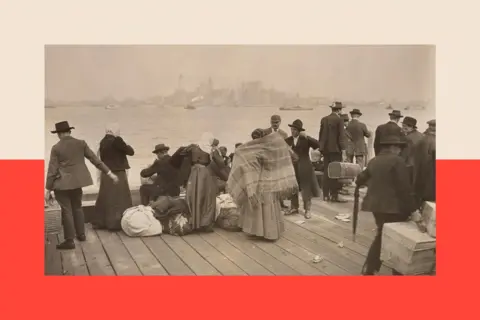
In those early days after the Revolutionary War and well into the 21st Century, what became known as the Dream enticed millions of immigrants to this shiny new nation full of hope, optimism and individualism. Factory workers, farmers, gold diggers, frontiersmen flocked to the US with the belief that they could create a new identity – an “American” – unshackled from the class systems of Europe.
Historians will tell you that the Dream never included everyone – certainly not Native Americans, slaves, or even women. Nevertheless, the idea of the American Dream persisted.
The concept of the American Dream dates back to the founding of the US, but the phrase wasn’t popularised until later, in The Epic of America, a book published in 1931 during the Great Depression.
In it, the historian James Truslow Adams wrote: “It is not a dream of motor cars and high wages merely, but a dream of social order in which each man and each woman shall be able to attain to the fullest stature of which they are innately capable.”
Over the years, the slogan has evolved. These days it’s often associated with entrepreneurialism, social mobility and, above all, economic opportunity.

 Getty Images
“It has always been about doing better in life than before,” says Cyril Ghosh, author of The Politics of the American Dream: Democratic Inclusion in Contemporary American Political Culture. “For some people, the better in life is simply not being persecuted by the Church of England.
“It’s not only about materialism. It’s about security. It’s about doing better than a previous station. That’s what it’s always been about.”
Abdi had grown up in Somalia, hiding in dugouts to avoid getting shot by the militant group al-Shabab.
“Freedom was a huge priority. Living the next day, breathing next day, was a big, big issue, and I really wanted that,” he said, explaining why he had wanted to move to the US.
Researchers say first-generation immigrants, like Abdi, are often more upbeat about the potential of America.
“Many are coming from less wealthy nations. And so they really are going to end up doing better than if they had not emigrated,” says Elizabeth Suhay, author of Debating the American Dream: How Explanations for Inequality Polarize Politics.
“Immigrants, for the most part, are more likely to say that they are achieving the Dream, or they’ve achieved it,” said Mark Hugo Lopez, director of race and ethnicity research at the Pew Research Center who has specifically looked in-depth at attitudes among Latino immigrants. They also tend to be, Lopez said, more optimistic about the prospects for their children.
American Dream interrupted
The American Dream has always been a sell for immigrants. However, fewer of them are coming these days.
President Trump has made curbing immigration a cornerstone of his presidency, after campaigning on a promise to carry out the largest mass deportation programme in history.
During his second term, Trump has not only clamped down on the number of immigrants illegally entering via the southern border, he has blocked some legal pathways to come to the US, including the diversity visa programme that Abdi used.
But today it’s not just that the US is welcoming fewer immigrants, it also appears a record number of people may be leaving.
 Getty Images
One suggestion is that many Americans who grew up in the US don’t think the country has held up its end of the bargain – that if you work hard and you play by the rules, you should have a decent, comfortable life.
Last year, in a historic reversal, the number of Americans moving to Ireland was higher than the number of Irish moving into the US. The US government doesn’t track the number of Americans voluntarily leaving the country, so there aren’t official statistics, but reporting suggests it’s not just Ireland.
A record number of Americans are applying for UK citizenship, and The Wall Street Journal reported that the number of Americans arriving to live and work in nearly all of the EU’s 27 member states is rising.
Why are people leaving? Some point to current US politics, others to healthcare costs and the overall standard of living. In most cases it is likely to be for a variety of reasons, some of them personal.
For Luke Mullen, it’s about job prospects.
The actor, who starred in the Disney show Andi Mack as a teen and has now become more involved with writing and production, says he has more opportunities for film projects these days in Vancouver, Canada than he does in southern California. Vancouver is covered by new government tax credits to try to help it compete with Hollywood and become a major movie hub.
The American Dream has been sold around the world, in part, through American cinema and in many ways, Hollywood epitomises the idea of making it in America. However, for Luke it’s more complicated – he says it seems there were more opportunities in the past. In the last few years, spending from big studios on Hollywood films and TV has stagnated or dropped.
He said: “I can’t even imagine growing up in the 90s and the boom of TV and the rom coms and all all those projects, but especially right now we’re seeing just a total, total cost-cutting effort to make it harder and harder to get projects made, take less and less risks and hire less people.”
He recently became a Canadian citizen thanks to a change in Canadian law last December.
“My process in becoming a Canadian citizen is very much tied to the fact that I can’t get these things made here that I’ve been working on for years and [I’m] passionate about,” he told me.
And so he’s intending to move to Canada. Though, he wants to be clear, not forever.
“I’m never gonna abandon America. This is my home and I think it’s worth fighting for still. There’s so much that we need to do to make it better in this country,” he said.
Aspiration versus reality
These days, the consensus among sociologists and political scientists is that financial success has increasingly become a central tenet of the Dream – the belief that my children or grandchildren will have a better life than me.
“Roughly speaking, the American Dream is the idea that if you work hard, you ought to achieve a comfortable life, what we might call a middle-class lifestyle – a house, healthcare, the ability to take care of your kids, a car, college,” said Suhay.
Statistics also suggest that over the last 50 years, the idea that every generation will do better than the one before has been eroded.
Research by the Harvard University economist Raj Chetty found that among children born in 1940, 90% of them grew up to earn more than their parents. Today, only half of children born in the 1980s are on track to do better than their parents economically.
This perception of economic abundance spread in the 1950s with the post-WWII boom, perhaps best symbolised through the growth of single-family homes adorned with white picket fences. The Dream became particularly popular in political rhetoric, Ghosh says, in the mid-60s with the civil rights movement and more expansive immigration policies.
“It is a core part of America,” said Suhay. “Almost everybody agrees that this is an important ideal. But… we have huge debates about whether or not the United States actually delivers the American Dream.”
 EPA/Shutterstock
So when did the Dream start to fade?
The Dream started to decline some 50 years ago, beginning in the 1970s, with globalisation and wage stagnation, according to Mark Rank, co-author of Chasing the American Dream: Understanding What Shapes Our Fortunes.
“It’s become much harder to attain the American Dream – this idea of an economic bargain that if you work hard and you play by the rules, you should have a decent, comfortable economic life,” he said. “That idea of each generation doing economically better than the past generation is a key component of the American Dream. And that had been the case up until about the 1970s,” he says.
And experts say that in the subsequent years, the Dream began to experience a prolonged decline as socioeconomic inequality increased.
Then, some experts say, there was another tipping point: the financial crisis of 2008 and the aftershocks that meant home ownership and job stability were increasingly out of reach.
And many Americans never recovered that economic optimism. Despite this, American wages remain much higher than ones in the UK, and across much of Europe.
Irrespective, wide partisan divides persist over whether the Dream is achievable. Surveys show more Republicans still appear to hold the faith, as do older Americans. Young adults seem particularly cynical. One poll found only a fifth of adults aged 18-29, people like Luke, think the Dream remains a possibility.
That being said, the Dream has never been entirely about financial success. For many, it’s a dream of freedom and individual rights that trace back to America’s founding documents, such as the Bill of Rights.
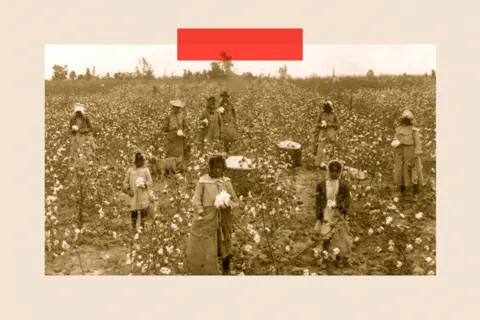
And in that vein, it’s worth noting that many black Americans have long thought the Dream was a myth built upon lofty rhetoric from the Founding Fathers that didn’t mesh with the reality of American slavery and segregation.
 Getty Images
Martin Luther King Jr described America as manifesting a “schizophrenic personality” long before the nationwide disillusionment with the Dream began.
“Black folks have their own experiences with the American Dream partially because so much of their experience has been fighting for literal freedom,” she told me. And, yet she added “the American Dream is a part of me – that hope for a better day, even though I find it hard. I find it really hard.”
Keeping the Dream alive
One nugget that stood out to me as I dug through all the various polls of the last several months was a survey conducted by The Times that suggested, despite the overall pessimism about the Dream in this moment, “61% of poll respondents said they believed in the concept”.
Brandon Patty, a 44-year-old clerk and comptroller in St John’s County, Florida and a Navy Reserve commander, is one such American who believes passionately that the Dream is alive and working. “I’m just honoured to kind of be a part of it,” he told me. “Even just by God’s grace, being born here, and being a part of American experiment”.
“When I hear the phrase ‘American Dream’, it means to me that the opportunities are limitless – that in America, you can go from nothing and find your way… it’s something that is intrinsic as an American in many ways.”
Brandon was the first in his family to graduate from college, the first in his generation to graduate from high school.
“I’m 44 now, and, candidly, I’m living it,” he said, he said of the Dream.
Gonzalo Schwarz, president and CEO of The Archbridge Institute, a public policy think tank, agrees that it’s important to focus on the positives of living in America.
The Archbridge Institute’s own polling found that majorities across various demographic groups agree that the American Dream is alive and well. The organisation says this is because it has a different methodology and asks more direct questions than most other polls, which it says are more conceptual in nature.
“If we focus only on the negative aspects and on the share of people who believe the Dream is out of reach, we risk making the demise of the American Dream a self-fulfilling prophecy,” Schwarz says. “We should step back, take a longer-term view, and be inspired to rekindle the American Dream as a beacon of hope for America’s next 250 years.”
 Getty Images
For Mark Rank, the sociologist who’s written about this, the Dream, even if more conditional than before, is still alive.
“If you say it’s no longer alive… You have ripped out a key component of America’s identity,” he says. “I think there are questions about it, and there is uncertainty about it.” But the way he sees it – in the spirit of American optimism, these questions are a chance to rethink how the US can ensure the Dream remains accessible to everyone for the next 250 years.
Back in Maine, Abdi said his brother Hassan, who couldn’t immigrate to the US because of visa restrictions, instead recently became a citizen of Canada. “My brother says they have better healthcare,” he tells me with a laugh.
Despite the setbacks, Abdi says if he had to do it all over, he would still choose the US. “I guess it’s my first love.”
Listen to the rest of The Global Story podcast series on America’s 250th anniversary here

BBC InDepth is the home on the website and app for the best analysis, with fresh perspectives that challenge assumptions and deep reporting on the biggest issues of the day. Emma Barnett and John Simpson bring their pick of the most thought-provoking deep reads and analysis, every Saturday. Sign up for the newsletter here
