
A sovereign Lebanon and a demilitarised Hezbollah cannot happen without a credible political transition.
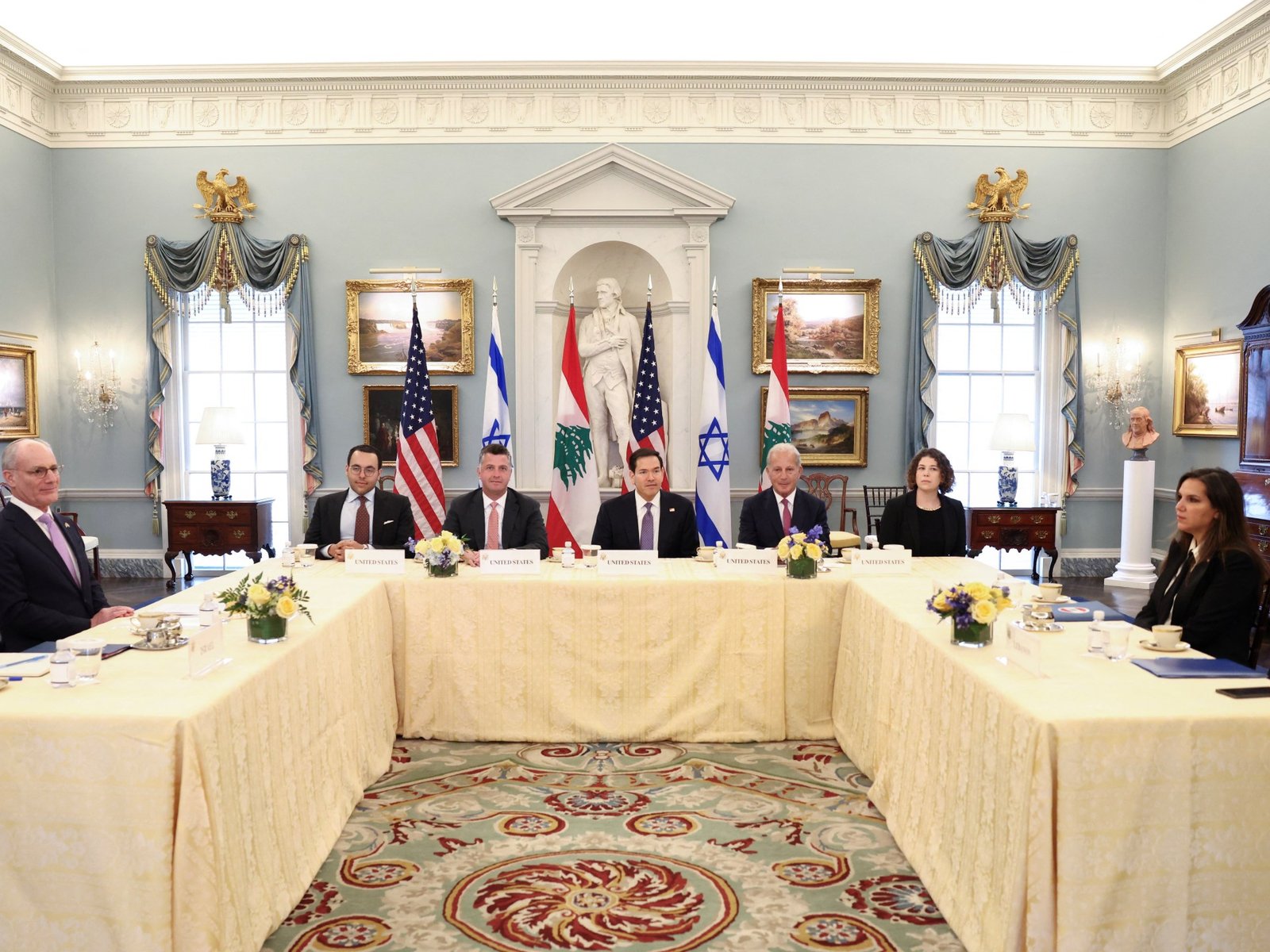
Lebanese leaders have gone to Washington for the first direct negotiations with Israel in over 30 years, attempting to restore sovereignty under near-impossible terms.
According to the ceasefire deal agreed on April 16, Lebanon must “effectively demonstrate its ability to assert its sovereignty” as a condition for extending the fragile pause in hostilities. Israel, for its part, preserves the right to take “all necessary measures in self-defence, at any time” and to keep its forces deployed on Lebanese soil.
This is the framework through which Lebanese sovereignty is to be performed. Beirut is expected to move against Hezbollah’s armament while Israel retains effectively open-ended military freedom inside Lebanese territory, with no credible pathway to deterrence on the table.
From Washington’s perspective, the logic is easy enough to understand. Hezbollah is weaker, Tehran is under pressure, Damascus is amenable and the government in Beirut has never been more willing to accede to United States demands. From the White House, it can look like a convergence: a moment where giving Israel military latitude to occupy land, displace southern communities, and float annexation will produce a Lebanese state that the US can shape.
But a government easier to influence is not one that can actually govern. There is a way to disarm Hezbollah and consolidate Lebanese sovereignty, but it is not the current path imposed by the US and Israel.
Hezbollah, the state and the limits of force
No serious argument for Lebanese statehood can evade what Hezbollah has done; more than any other Lebanese actor, it has undermined the state’s monopoly on force. It has built and maintained a military structure outside formal institutions, reserved for itself the right to shape decisions of war and peace, vetoed government decisions and done away with many of its domestic opponents by force or the threat of it. The result has been a hybrid order where sovereignty existed in law but not in full practice.
Yet the belief that external force can correct this condition has been tested before and failed. In 1982, Israel invaded Lebanon to expel the Palestine Liberation Organization (PLO). It succeeded in driving the PLO leadership out of Beirut but did not produce a stable Lebanese government or a settlement aligned with Israeli preferences.
The Lebanese Civil War entered a new and arguably more brutal phase, epitomised by an Israeli occupation that lasted until 2000. That occupation became one of the central conditions in which Hezbollah emerged, consolidated and claimed the legitimacy it trades on today.
Brute force repeatedly altered the immediate balance while helping create the social and political terrain in which new armed legitimacy could emerge.
Lebanon has also been here before in another sense. Throughout its modern history, as one patron has weakened, another has moved in to fill the vacuum, claiming to champion Lebanese sovereignty on its own terms.
Today fits that pattern. Hezbollah and Iran are losing the sway they have held over Beirut for two decades, and Washington and Israel are moving to establish a new dominion. The language of sovereignty is once again doing work that sovereignty, in substance, is not.
Leaders without leverage
The government of Prime Minister Nawaf Salam and President Joseph Aoun, brought about with US-Saudi backing after the 2024 war with Israel ended, is the first national unity government to include Hezbollah and its allies while also clearly articulating a position on consolidating military power under the state.
Under this policy, the Lebanese Armed Forces (LAF) began dismantling Hezbollah infrastructure south of the Litani River before the conflict reignited last month. Since then, the government has outlawed Hezbollah’s military wing, expelled the Iranian ambassador and ordered the authorities to identify, arrest and deport members of the Iranian Islamic Revolutionary Guard Corps (IRGC).
Some of these moves were performative, some genuine, but all were limited by the current reality in which the Lebanese state has very little leverage, domestically and internationally. That hasn’t stopped Salam and Aoun from trying.
The convergence at present with US and Israeli interests is temporary and will break the moment the question shifts from Hezbollah’s weapons to what Israeli troops are still doing on Lebanese land.
The reality is that Lebanon’s current deterrence arrangement cannot be broken militarily before it is replaced politically. Hezbollah’s arsenal is not just a military fact; it is also the hard expression of a political claim: that the Lebanese state, as it exists, cannot reliably defend parts of its population against Israel and therefore an alternative structure of deterrence is necessary. One can reject that claim and still recognise its force.
If Hezbollah is to be durably disarmed, Lebanon requires a credible replacement for the functions it has come to perform: military deterrence, political representation, social protection and the assurance that someone can absorb the costs of confronting Israel. Absent that replacement, military pressure, occupation and violations of international law will not settle the question. They will reopen it in harsher form.
What a durable settlement would require
A sequenced political process is the only plausible route to the outcome Washington says it wants. It should begin with reciprocity. Lebanon cannot be expected to move decisively on its most explosive internal issue while Israel retains open-ended military freedom inside its territory.
If communities in the south and the eastern Bekaa Valley are to see the threat environment changing, that has to mean a monitored halt to attacks, a timetable for Israeli withdrawal from Lebanese territory and a mechanism for adjudicating violations that does not reduce Lebanese sovereignty to an Israeli claim of necessity. The current agreement contains none of these. It contains the opposite.
A durable settlement would require a phased extension of state authority. The LAF can absorb responsibilities gradually, deploy, monitor and expand its role over time.
Even if Washington wants the LAF to fight Hezbollah, it is quite rightly neither willing nor able to do so, not least while Israel is pummelling the country and Washington is forcing it into unrealistic timelines as part of pressure-driven diplomacy. To ask the army to do that is not to strengthen the state; it is to expose its weakness and herald civil strife.
State sovereignty would require a national defence doctrine. If Hezbollah is to relinquish its claim to deterrence, the replacement has to be a doctrine backed by credible resources and diplomacy that can produce state-led deterrence against Israeli aggression.
Hezbollah’s endurance has never rested only on weapons. It grew inside zones of state failure. Strip its military infrastructure back while the state still cannot provide security, reconstruction and services, and the result would not be sovereign consolidation. It would be abandonment. And abandonment is the soil in which armed alternatives grow.
None of this can succeed without political guarantees. One need not celebrate Lebanon’s confessional system to understand that transitions fail when major communities conclude that the language of statehood is being used to rearrange power against them. If Hezbollah’s military role is to end, the Shia in Lebanon have to see a future for themselves inside a stronger state, not outside of it.
All of this would be a slow process. For Washington, it may be less satisfying than the language of decisive moments and offer no catharsis, no spectacle of history being settled through pressure and alignment. But Lebanon has rarely yielded to that kind of impatience. More often, it has exposed its costs.
Washington says it wants a stronger Lebanese state and a weaker Hezbollah. Perhaps it does. But its actions increasingly suggest something else: not the construction of sovereignty, but the management of fracture under Israeli military primacy.
That path is unlikely to end in neat annexation or orderly control. Lebanon has too many armed memories, unresolved scores and regional entanglements. What is more likely to yield is a conflict that proves far harder to stop once it is set in motion.
The views expressed in this article are the author’s own and do not necessarily reflect media’s editorial stance.
