
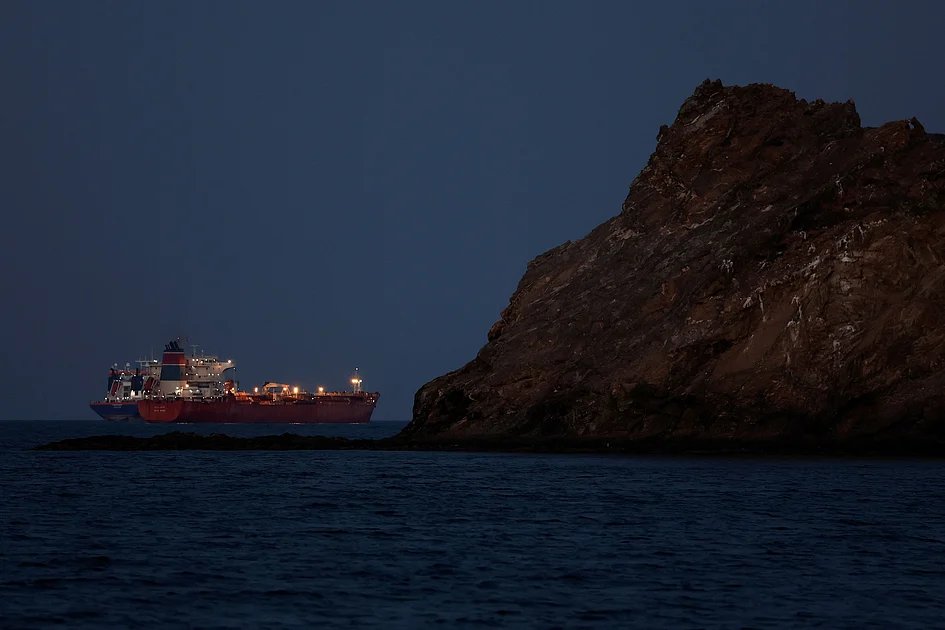
The escalating crisis in the Strait of Hormuz has triggered one of the most severe maritime disruptions in recent decades, with hundreds of vessels — including around 200 oil and gas tankers — stranded across Gulf waters, choking energy supplies and raising fears of a global inflation shock.
Shipping data from maritime intelligence firms and industry trackers show that traffic through the narrow but vital waterway has collapsed since hostilities intensified in the region, effectively paralysing the world’s most important energy corridor.
Under normal conditions, between 130 and 150 ships pass through the strait every day, carrying crude oil, liquefied natural gas and cargo from Gulf exporters to markets in Asia, Europe and North America. In recent days, however, vessel movements have plunged dramatically, with maritime monitoring centres reporting daily transit numbers falling to just a handful of ships as security risks, attacks on vessels and the withdrawal of war-risk insurance forced shipping companies to halt operations.
The disruption has created a growing backlog of vessels across the Gulf.
Industry estimates suggest more than 200 oil and LNG tankers are currently anchored or waiting in Gulf waters, unable to exit the region as shipowners avoid navigating through what has effectively become a conflict zone. In addition, more than 140 container ships and numerous bulk carriers remain stranded, pushing the total number of affected vessels into the several hundreds.
Ports across the region are now struggling to manage the congestion. In the UAE, Jebel Ali Port has emerged as a temporary refuge for dozens of ships, while others remain anchored offshore awaiting security clearance or insurance coverage before attempting the risky passage.
The Strait of Hormuz — located between Iran and Oman — is one of the most critical chokepoints in global trade, handling around one-fifth of the world’s seaborne oil and liquefied natural gas exports. Even a short disruption to shipping through the corridor can send shockwaves across global energy markets.
“This is the most serious disruption to Gulf shipping in decades,” said Vishnu Sudhakaran, CEO and founder of Dubai-based Livro Shipping.
“When transit through the Strait of Hormuz slows or stops, the entire global energy supply chain is immediately affected. Tankers cannot move crude, cargo flows stall, and markets begin to react almost instantly.”
Sudhakaran said the current disruption has created an unprecedented backlog of vessels in Gulf waters.
“Shipowners are unwilling to risk crews and cargo without insurance coverage, and insurers are extremely cautious about underwriting voyages through a conflict zone,” he said. “Until security risks are reduced and insurance returns, vessel traffic will remain severely constrained.”
Energy analysts warn that prolonged disruption could send oil prices sharply higher.
In a recent interview, Qatar’s Energy Minister Saad Al Kaabi warned that crude prices could climb towards $150 per barrel within weeks if the strait remains effectively closed to tanker traffic.
Such a spike would reverberate across the global economy.
Speaking at a symposium hosted by Japan’s finance ministry, International Monetary Fund Managing Director Kristalina Georgieva warned that the conflict is already testing global economic resilience.
“We are seeing resilience tested again by the new conflict in the Middle East,” Georgieva said.
She cautioned that a sustained 10 per cent increase in oil prices could raise global inflation by around 40 basis points, complicating efforts by central banks to stabilise economies after years of monetary tightening.
Energy market specialists say the scale of disruption in the strait makes it particularly dangerous for global markets.
“The Strait of Hormuz is the single most important oil transit chokepoint in the world,” said Vandana Hari, founder of Singapore-based Vanda Insights. “If tanker traffic remains severely restricted, the impact on oil supply and prices could be swift and significant.”
Some Gulf producers are already facing logistical pressure as exports stall.
Reports indicate that storage facilities in parts of the region are filling up, forcing some producers to consider scaling back output until tanker traffic resumes. Kuwait has reportedly begun shutting in production at certain fields because exports cannot move freely through the strait.
Shipping industry executives say the crisis is also threatening broader global supply chains.
With container ships, bulk carriers and tankers immobilised across Gulf waters, delays are beginning to ripple through international trade routes, affecting everything from energy supplies to manufactured goods.
“If this disruption lasts several weeks, the world could face not only higher energy prices but also wider trade bottlenecks,” Sudhakaran said. “Shipping is the backbone of global commerce, and when a critical chokepoint like Hormuz is compromised, the consequences are felt everywhere.”
