
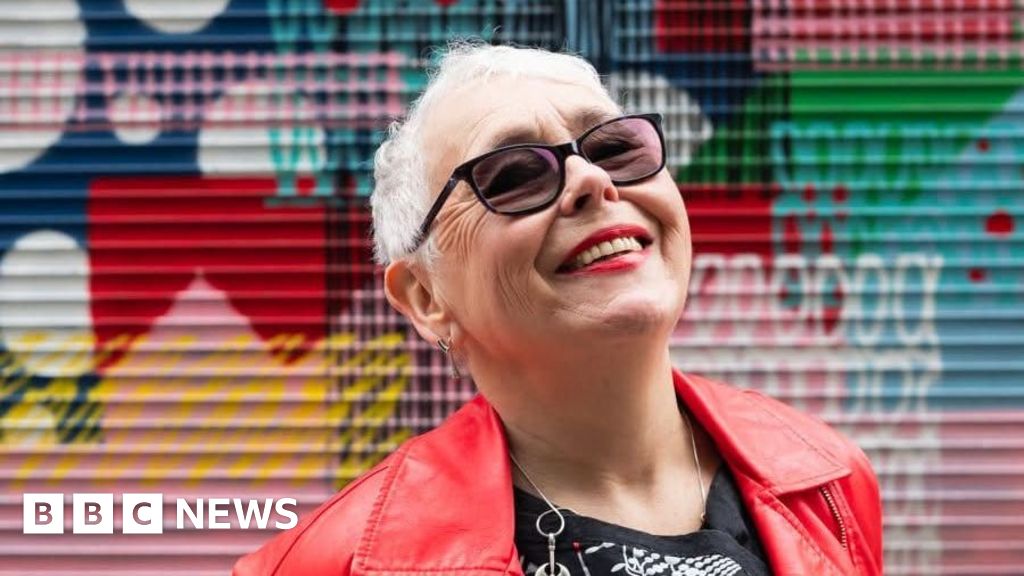
 Mindy Meleyal
As a 75-year-old lesbian, Mindy Meleyal has lived through every major milestone in the modern LGBT rights movement, from the start of decriminalisation in 1967 to the first same-sex marriages in 2014.
But now she says this important part of her identity is frequently overlooked due to her age.
She’s part of England’s older LGBTQ+ community, which a new report suggests often experiences poorer health, more limited finances and greater social isolation than the wider older population.
The report, from the Centre for Ageing Better, says without specialist support, this growing demographic could be forced “back into the closet” when accessing care, warning they may even delay getting the care they need because of concerns about homophobia.
“It’s very common for people to hide things if they have a carer visiting their home, for example hiding their wedding photos or taking down a trans flag,” he says.
“In the case of someone moving into a care environment, that means hiding who they are in their own home, for what could be the rest of their life.”
He says he has been “horrified” by some of the stories he has heard meeting older LGBTQ+ people, including some who have had carers offer to “pray for them” regarding their sexuality.
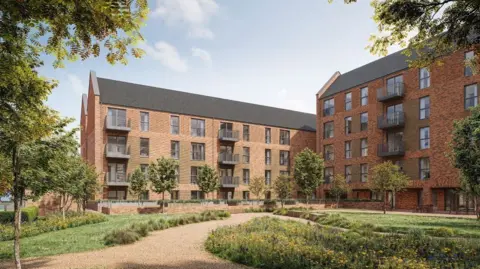
Porter is part of the team behind Kindred House, a first-of-its-kind LGBTQ+ social housing scheme for over-55s, set to open in Manchester next year.

 Great Places
The scheme, a joint project with the local council, will provide 80 self-contained apartments and communal areas available to the local community.
The majority of residents will be LGBTQ+.
The Kindred House scheme is what’s known as extra-care housing, which means residents live independently, but there is a 24/7 care team available for those who need extra help, and all staff will receive specialist training around LGBTQ+ inclusion.
Porter says he hopes the scheme will “trigger some conversations” about how to best support older LGBTQ+ people in the challenges they face.
‘People start clumping you together with other stereotypes’
Mindy and her wife Linda have been together for more than 30 years, but says they’re often mistaken for sisters.
“She’s 18 inches taller than me, I’ve got a Yorkshire accent and she’s got a Northern Irish accent,” Mindy says. “I think it’s pretty obvious we weren’t brought up in the same building.”
She believes part of that is often down to people presuming she is straight because of her age.
“There are different tribes of people in every age group, but when you get older, people start clumping you together with other stereotypes,” she says.
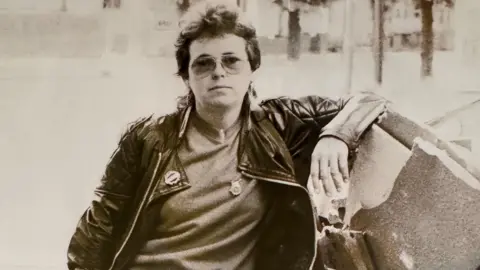 Mindy Meleyal
On one occasion, while Mindy was in hospital after a stroke, a nurse referred to Linda as Mindy’s husband. She said it was not only “insulting”, but made her consider what sort of training the staff might have had.
The Spotlight on Ageing report says these sort of experiences can also have an impact on the support people receive.
Sarah Wilkinson, research and analysis manager at the Centre for Ageing Better, says after a “lifetime of homophobia and transphobia”, older LGBTQ+ people now face the “additional, and overlapping, challenge of ageism”.
The report says older LGBTQ+ people are less likely to have children – someone born in 1950 would have been in their 50s by the time same-sex couples could legally adopt – and that they are more likely to be estranged from their families when compared to their heterosexual counterparts.
The report also found more than half of gay and bisexual men aged 65 and above live alone, compared with less than a quarter of heterosexual men. Bisexual women aged 50 to 64 are twice as likely as their heterosexual peers to live alone.
It also suggests that only half of gay and bisexual men aged 50 and above definitely agree they would have someone to help them if they needed, 14 percentage points lower than heterosexual men of the same age.
‘Chosen family means a lot to me’
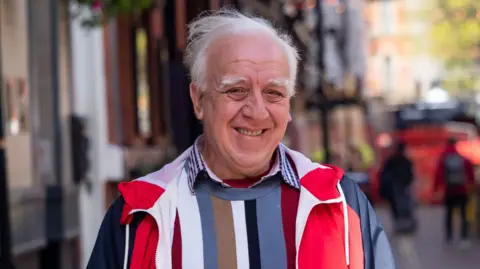
Norman Goodman, 75, came out as bisexual in his late 60s after the death of his wife Marilyn.
The couple never had children, and Norman now has no immediate family nearby to help him with things like hospital visits or housework.
He says his support system comes in the form of his partner Tony, and a group of friends and neighbours he refers to as his “chosen family”.
“I’m lucky, I’ve got great friends and great neighbours, and I know I can knock on somebody’s door day or night and I could get help,” he says.
 LGBT Foundation
But despite having their support while he’s relatively independent, Norman says he worries about the prospect of facing discrimination if he needs more formal care as he ages.
“Hopefully I will maintain and look after myself the best I can, but I’ve heard horror stories of gay people in nursing homes being treated terribly,” he says.
“I think nurses, doctors, carers should all be trained on how to look after LGBT people.”
It’s the reason behind schemes like Manchester’s Kindred House, which are not unusual in other parts of the world.
There are similar projects in Spain, Sweden, Germany, the US and Canada, but in the UK they are few and far between.
In 2021, the UK’s first LGBTQ+ retirement home, Tonic, opened in London with 19 apartments for private rental or shared ownership.
The scheme attracted so much attention, later this year it is set to feature in a Netflix documentary telling the story of one of its first residents, Chek Min-Ong.
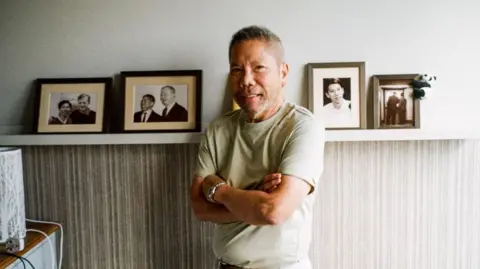
After 43 years together, Min, 77, and his late partner Tim, had discussed their plans for a future where one of them would live alone, as Tim’s health deteriorated.
 Dani d’Ingeo
“Tim and I have always had this very open discussion, we wanted to know, when one of us is not here anymore, the other person will have a community and feel safe,” Min says.
When Tim died five months after moving into Tonic, Min says his new-found community rallied around him.
“It is what [Tim and I] always wanted, that we’d never have to explain ourselves,” he says. “We’d never have to face a question and feel guilty about not telling the full story, or having to lie.
“You’re just here, being yourself.”
‘It’s something I’m really proud to be a part of’
While schemes like Kindred House and Tonic are welcomed by Mindy, Norman and Min, the Spotlight on Ageing report warns that, because the older LGBTQ+ population is growing, the demand for specialist services is expected to outstrip supply.
Between 2019 and 2024, the number of over-50s identifying as lesbian, gay or bisexual in the UK increased by around a third – from roughly 340,000 to almost 460,000.
There was a 4% rise in the number of heterosexual people aged 50 and above in the same period.
These numbers are projected to continue to increase as the relatively larger younger generations of people identifying as LGBTQ+ age.
Porter warns that without more schemes like Kindred House, and more training and awareness for those in other care settings, the ageing population may struggle to get proper support.
For Mindy, who is part of a steering group advising on the plans, knowing there may be more options available in the future is reassuring.
“It’s important that you can go, that you think, ‘You know what, I could live there because I know the staffing, the ethics, the rules, everything about the place has been put together from an LGBTQ+ focus,'” she says.
“That’s what we’ve been doing and it’s something I’m really proud of being a part of.”
