
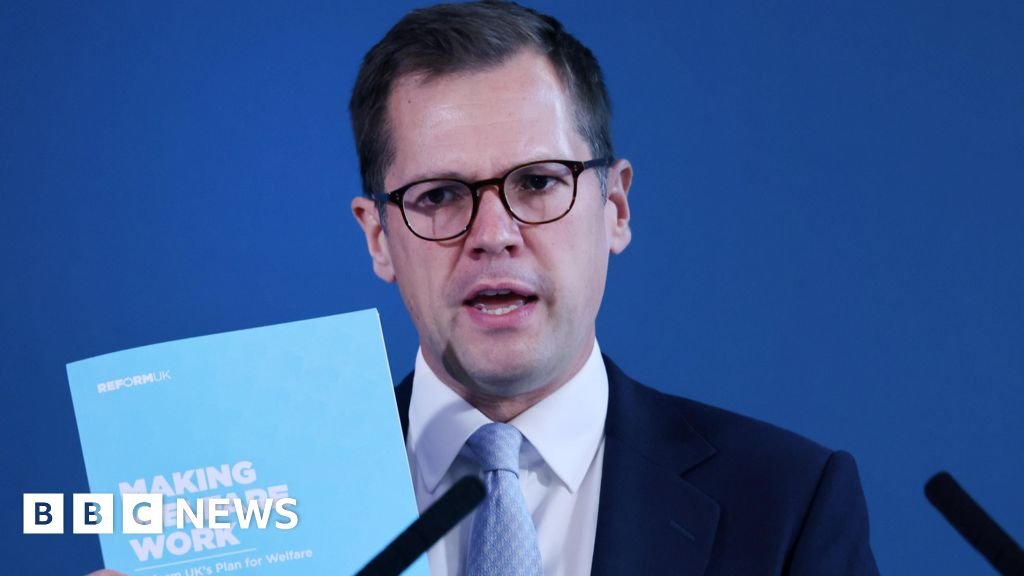
Foreign nationals would be excluded from most benefits under a Reform UK government, the party has said.
The ban, part of a proposed overhaul of Britain’s benefits system, would include European Union (EU) nationals with settled status in the UK, meaning a renegotiation of the UK’s Brexit deal with the EU.
In a speech on Monday, the party’s economy spokesman, Robert Jenrick, said: “The British taxpayer is acting as the welfare state for the world. That’s unfair, we all know it.”
Reform claims the policy would save £21bn a year by its fifth year, but Labour insists the “vast majority” of migrants have no access to benefits and the Conservatives have dismissed the plans as “cobbled together”.
He said one-in-six Universal Credit claimants are not a British or Irish citizen and suggested the money should instead be used to “make the lives of British people better”.
This year the government expects to spend a total of £322bn on welfare in Great Britain, or 10.6% of GDP, just over half of which goes to pensioners.
Reform says it has spent six months drawing up a 50-page plan that it claims will save a total of £50bn a year.
Jenrick said the proposals also include a “welfare to work” scheme which will require people who have claimed benefits for more than 12 months to provide 20 hours-a-week of work for their community.
This would apply to those deemed fit to work and will be organised by their local council, the MP said.
Those who fail to take part or poorly perform will face sanctions, including potential cuts to their benefits, according to Reform’s policy document.
Jenrick said: “They’ll work to clean up high streets and parks, to beautify neglected places, to carry out minor repairs to staff libraries and community centres, to perform many other tasks from the list that we’ve published today.”
In an interview with the BBC, Jenrick would not say how many people would lose access to benefits but insisted his party would treat people claiming benefits “with respect and dignity”.
“Those who need them, under a Reform government, will continue to receive them but those people who are shirking, who are taking advantage, they will be reassessed and they will be helped back into the workplace.
“That is the right and fair thing to do.”
On Saturday, the party said it would replace the disability payments system, Pip, if it entered Number 10 at the next election.
The latest proposals would ban foreign nationals from almost all welfare payments including housing benefit, pension credit, jobseeker’s allowance, child benefit, free childcare and disability benefits.
Only a small number of exemptions would apply, including the war widows pension and Armed Forces compensation.
Reform claims that by 2029, around 1.5 million adults who are not British citizens would receive Universal Credit and around 215,000 would receive Pip.
The party had previously pledged to ban foreign nationals from claiming Universal Credit.
Given those affected would include EU nationals with settled status who have an indefinite right to live, work and study in the UK – and have usually lived in the UK for a continuous five-year period – the Brexit deal secured under the last Tory government would need to be renegotiated.
It means potentially that British expatriates living in the EU could lose equivalent rights.
Figures published in 2025 showed that more than a million UC claimants were born overseas, including around 700,000 EU citizens who arrived in the UK before Brexit and have the right to live and work in the UK.
The party said it had accounted for a potential £500m cost of British expats returning from the EU to the UK to claim benefits if the EU retaliates.
Reform UK MP Danny Kruger told BBC Breakfast it is a “reasonable principle” that the country to which people are citizens of should be paying their welfare.
He said: “So I’d understand if the Europeans decided to apply the same principle that we are and to deny our nationals access to their welfare system and we will pay for that ourselves.”
Asked what would happen to British people living abroad who claim a disability benefit, Kruger replied: “They would have two options – they can either return to the UK, they might wish to do that if the benefits system is preferable for them, but we’re open to a negotiation that it might mean that we could pay British disability benefits to them, if they qualify under our new scheme.”
Reform’s plans also include making businesses with more than five members of staff paying a “return to work cover” insurance to fund the cost of the first two years after an employee is signed off sick.
The party says this is modelled on the Dutch system and aims to incentivise employers to make adaptions and encourage people back to work, while also reducing the number of people entering the disability benefit system.
Reform adds it would cut the National Insurance contributions paid by employers to offset the cost of this measure.
Pressed about the potential costs for businesses, Jenrick said “nothing that we’ve outlined today will adversely affect businesses”.
‘Plunging UK back into Brexit spats’
The Institute for Fiscal Studies said: “Most of the planned savings here would come from a new disability needs assessment which is intended to be substantially tougher.
“But there is relatively little detail on what the new assessment would actually entail or on how they would avoid the experience of previous attempts to toughen up the system, which saw savings falling significantly short of government’s expectations.”
The think tank also said Reform proposals to use to a lower measure of inflation when setting benefit levels each year would save around £4.8bn in 2033-34.
Labour said Reform’s plans would be “plunging the UK back into years of Brexit renegotiations and stripping support from potentially millions of people who have lawfully lived, worked and paid taxes in Britain for years, and in many cases decades”.
Helen Whately, the Tories’ shadow pensions secretary, said that rather than disputes about Brexit, “British people want welfare spending under control, abuse stamped out and dignity for people who are seriously disabled”.
The Lib Dems said fixing the NHS and social care was key to slashing Britain’s benefits bill.
And the Greens said it was “cowardly to take from the most defenceless when we should be taxing the super wealthy including those who are in the privileged position of accepting £5m donations”.
That is a reference to the £5m gift given to Reform leader Nigel Farage before he became an MP, which is being investigated by the parliamentary standards watchdog.

Sign up for our Politics Essential newsletter to keep up with the inner workings of Westminster and beyond.
