
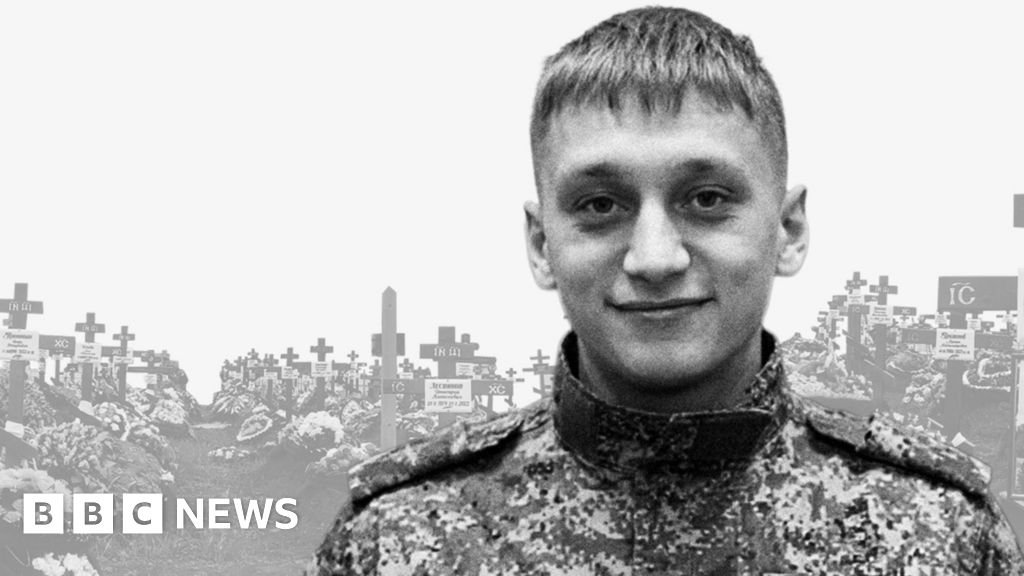
 VK/Kyakhtinsky District
“He studied drones for three months – and yet they still threw him into a frontal assault, into the meat grinder,” said Valery Averin’s foster mother Oksana Afanayeva.
The 23-year-old is among the first Russian students known to have been killed in Ukraine after signing up as part of a new large-scale drive to recruit young people from universities and colleges into Russia’s drone forces.
“He had never even served in the army,” Afanasyeva complained.
The campaign to encourage students at universities, technical colleges and vocational schools to sign army contracts began early this year, as Russia sought to sustain its war effort into a fifth year. It has focused particularly on those struggling academically or considering taking a break from their studies.
Averin grew up in an orphanage in eastern Siberia until he was taken into foster care aged 11. By the time he was recruited into the army he was in his final year at the Buryat Republican Technical School of Construction.
Early in April, he called his foster mother to say he was being sent somewhere “with no [phone] signal”, and that she should not worry.
Initially he said he had gone away to earn money at Wildberries, a Russian online retailer, and she was shocked to find out he had signed a military contract and had completed training as a drone operator.
“He told me: ‘Nothing will happen to me, everything will be fine.'”
A week later, on 8 April, she learned he had been killed in a mortar strike near Russian-occupied Luhansk in eastern Ukraine.
Vladislav Gorbunov, an 18-year-old from the small town of Unecha 70km (43 miles) north of the Ukrainian border died 4 months after signing a contract – on 6 April.
He had studied railway construction and maintenance at his local State Technical School of Sectoral Technologies and Transport and was initially sent to an infantry frontline assault unit before being transferred to a drone operators’ unit.
Rakhim Abdullin had enrolled at Kumertau Mining College to train as a welder two years ago, but his studies did not work out and in January, little more than two weeks after his 18th birthday, he signed a military contract aiming to become a drone operator as it seemed a safe option.
“But once he got there, it turned out not to be safe at all,” his mother Elena explained. “Because they see the assault troops too, and they are right on the front line.”
By 13 March he was dead. “He left quickly, and he came back quickly,” she said.
The three former students – Abdullin, Gorbunov and Averin – are among 230,407 Russian soldiers and officers whose deaths have been verified by the BBC, based on analysis of cemeteries, war memorials, government registers and obituaries.
The real death toll is believed to be far higher, and military experts believe our analysis of open source reflects 45-55% of the total number. That would put the real death toll at between 417,000 and 509,500. The UK’s biggest spy agency, GCHQ, said in May the number was almost 500,000.
Ukraine’s losses are also very high. President Volodymyr Zelensky last acknowledged 55,000 deaths in February 2026, as well as a large number who were missing.
An anonymous Ukrainian website suggests the total number of military deaths may reach 213,000, and Dutch military intelligence puts the number of dead, wounded and missing at about 500,000.
Replacing the dead and wounded has become key to maintaining Russia’s full-scale war in Ukraine, and authorities have presented the scheme that Averin was recruited through as a voluntary route into a modern, high-tech and relatively safe branch of the military.
Students are offered a special one-year contract to serve in a new branch of the military known as “unmanned systems troops” – as drones have become central to the war in Ukraine.
Russian Defence Minister Andrei Belousov said in November 2025 that the force would primarily seek to attract under-35s, as younger recruits were considered more receptive to “new technologies and speeds”.
Within weeks, recruitment meetings began appearing at educational institutions across Russia.
BBC Russian found evidence of recruitment activity in at least 95 universities and colleges by late February, and in April student publication Groza put the number of universities and colleges that had promoted contracts for the drone forces at almost 270.

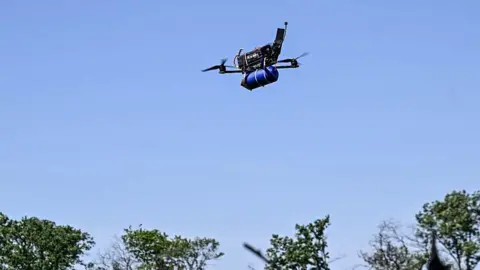 Ukrinform/NurPhoto via Getty Images
The pitch is carefully designed.
Students are told they can sign up for only one year, including training, and serve specifically in drone units rather than regular infantry, acquiring large payments and valuable technical skills, before returning to their studies.
In some universities, students are promised additional benefits, including lump-sum payments, budget-funded places, easier admission to postgraduate courses, or better accommodation.
In the capital Moscow, leaflets distributed to students say volunteers could receive at least five million roubles (£43,000; $57,000) in the first year.
But lawyers and rights activists warn these promises may not be enforceable.
Since President Vladimir Putin’s partial mobilisation decree of September 2022, military contracts have in effect been extended until mobilisation ends, so a recruit is highly unlikely to leave after 12 months.
A central part of the defence ministry’s pitch is that the job of a drone operator is safer than other combat roles, away from the front line.
But they have become high-value targets in this war, hunted by both sides because of their importance on the battlefield.
At least 920 Russian drone operators have been killed since the start of the full-scale invasion in February 2022, according to analysis by BBC Russian, Mediazona and a team of volunteers. That number comes from publicly available sources, so again the true figure is likely to be higher.
Confirmed losses among drone operators are already comparable to those recorded in artillery units – one of the army’s most exposed combat specialisms.
And students may not even make the drone forces as it is up to the defence ministry to decide whether a recruit is suitable. Failure could mean transfer to another branch of the army.
As well as financial incentives and patriotic appeals, students are sometimes pressured into signing up.
BBC Russian has found evidence of students being targeted if they were on the verge of expulsion or considering academic leave.
In one Novosibirsk college, a director was recorded calling students cowards for refusing to sign contracts.
Some institutions have also reportedly faced recruitment targets.
A former adviser to the rector of Far Eastern Federal University said the institution had been given a quota to send 32 students to the war in February. However, the university has denied it and called the report fake, adding that it supports students who have voluntarily decided to sign contracts.
Russia’s focus on students shows how the war is moving deeper into civilian institutions, from universities and colleges to vocational schools.
Young men are offered money, status and the promise of a short, specialist path through the war. But the death of Valery Averin lays bare how fragile – and how fleeting – such promises can be.
His foster mother believes he was not used as the protected technical specialist he had expected to become: “He said nothing would happen to him.”
