
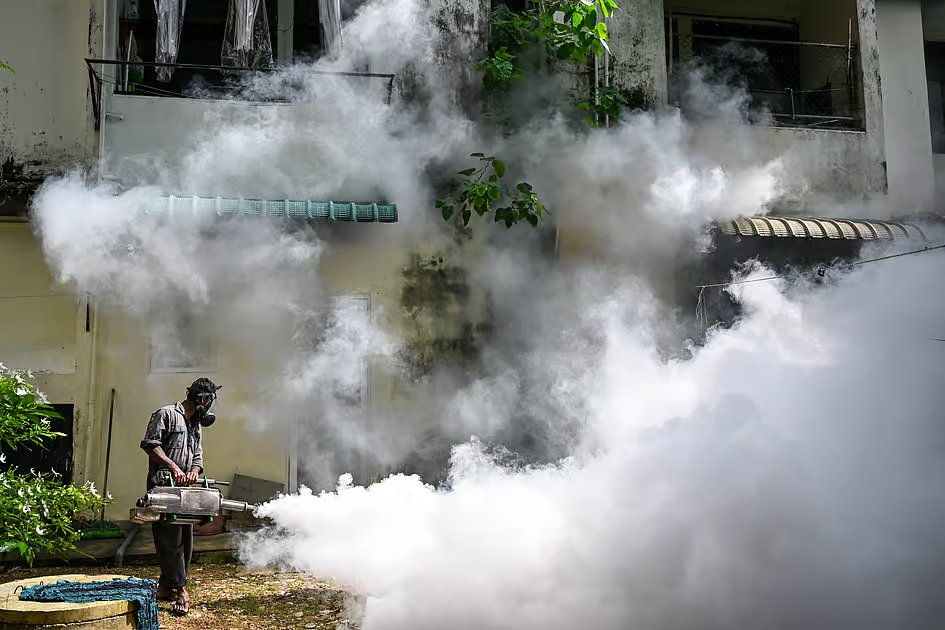
Move comes amid a surge in cases, with nearly 50,000 infections and 29 deaths reported this year. The figures, however, remain below the 2017 peak of 186,000 patients and 440 fatalities
Sri Lanka is grappling with a severe dengue fever outbreak, prompting President Anura Kumara Dissanayake to deploy military forces to combat the escalating crisis. Health authorities issued a dire warning on Tuesday stating that hospitals are being overwhelmed, recording over 1,000 admissions daily as the mosquito-borne disease spreads rapidly across the island nation.
According to an AFP report, the President’s office confirmed that army, navy, and air force officers would join a specialized unit tasked with identifying and destroying mosquito breeding sites.
This decisive action comes as the country faces a surge in cases, with nearly 50,000 infections reported this year and 29 deaths. While these figures remain below the 2017 peak of 186,000 patients and 440 fatalities, health officials fear a repeat of that devastating period.
Dr. Kapila Kannangara, Acting Director of the National Dengue Control Unit (NDCU), expressed grave concerns about the capacity of the healthcare system. “Hospitals are already under pressure,” Dr. Kannangara told reporters in Colombo. “We don’t want to have a situation like the one we faced in 2017.”
He noted that daily infections had recently climbed to between 600 and 650 cases, a significant jump from the typical 150 to 200 cases per day during non-epidemic periods.
Adding to the alarm, health experts have highlighted a critical public health concern: significant garbage accumulation near the Health Ministry in Colombo.
Specialist Dr. Chamal Sanjeewa, Chairman of the Doctors’ Trade Union Alliance for Medical and Civil Rights, reported that large amounts of waste, including discarded items like orange peels, had been dumped along Norris Canal Road and surrounding areas within a 50-meter radius of the Ministry. This neglect has created prime breeding grounds for dengue-carrying mosquitoes.
Dr. Sanjeewa warned that these unsanitary conditions pose a direct risk to patients receiving treatment at the nearby National Hospital of Sri Lanka and several private hospitals. He urged the Deputy Director General of the National Hospital, the Secretary to the Health Ministry, and the relevant divisions of the Colombo Municipal Council to “take immediate action to remove the garbage and address the potential dengue threat.”
Strict enforcement and global warning
In addition to military deployment, the government announced that laws would be strictly enforced against those allowing mosquito breeding on their premises. A nationwide campaign to clean up breeding sites is set to launch on Wednesday.
This local crisis resonates with global warnings from the World Health Organization (WHO), which has cautioned that dengue and other mosquito-borne viruses are spreading faster and further due to climate change. Sri Lanka’s current battle against dengue serves as a poignant reminder of the interconnectedness of environmental factors, public health, and national security.
Dengue, characterised by high fevers, headaches, nausea, vomiting, and muscle pain, can lead to severe bleeding and even death in its most serious forms.
The Aedes mosquito, identifiable by its distinctive black and white striped legs, is the primary vector for the disease, breeding prolifically in stagnant water. Monsoon rains, recent flooding, and haphazardly dumped waste have created ideal conditions for the rapid proliferation of these mosquitoes.
(With reports from AFP and ANI)
