
 BBC
BBCNot long after the UK left the EU in 2020, a Bristol-based firm called Eskimo started selling a new kind of high-fashion and energy-efficient electric radiator, based on new technology developed by academics in the city.
They planned to send them around Europe using the Channel Tunnel.
It was a timely product given Europe’s green ambitions, and with orders flowing, its Birmingham factory was being kept busy.
The boss Phil Ward tells me his start-up has continued to grow, but that in his view it could have been so much more without what he calls “the Long Brexit effect”: in 2020, 40% of his exports went to the European Union, and by 2025 it was just 5%.
Eskimo did manage to export some goods to agents in France but it stopped selling directly to European consumers entirely. A planned expansion to Germany floundered.
And as Eskimo discovered when it attempted to export towel rails to Australia and New Zealand, both countries abide by international safety standards that are heavily influenced by the EU’s CE mark.
This matters because one theoretical potential Brexit benefit was that it would allow UK regulators to not follow the EU’s safety regulations and take a more pro-innovation, less regulatory approach for high-tech inventions.
Eskimo’s experience is one example of a broader trend reflected in export figures. The UK Trade Policy Observatory at Sussex University calculated a rapid 26% reduction in the different types of UK exports by 2023, while a new study from Aston University Business School using five years of more detailed trade data concludes a loss of 53.8% of the type of exports and 31.5% for imports.
These figures for “trade varieties” are falls in the number of products sent to different EU countries.
A decade ago, many economists argued the UK would sustain longer-term economic damage by leaving the EU and many believe that damage has come to pass.
But to make that call you have to compare what did happen with what might otherwise have happened were it not for Brexit and doing that is a matter of method and statistical judgement.
And that judgement has to account for the fact that the period since Brexit has been a time of huge global flux. The pandemic that struck in the spring of 2020, the war in Ukraine that began two years later and, more recently, the energy price shock sparked by the conflict in Iran all have to be accounted for.
So too does the question of whether a Brexit-free UK would have really kept up with the Silicon Valley tech boom in recent years to the extent Brexit Britain has.
The clear consensus of economists making the calculations say they have factored in the global turmoil when assessing Brexit’s impact. Others question their methods and the extent of Brexit’s impact.
Some of the most negative predictions back in 2016, including those that said the UK could experience a Great Depression‑style hit, proved unduly pessimistic. Whatever economic hit there was, it was not sudden enough to cause an instant recession.
But those who believe the UK did sustain longer-term economic damage by leaving the EU say the hit was no less profound.

 AFP via Getty Images
“Among economists there is not much debate, but there still is among policy folks. The experts were right. It was, if anything, worse than we thought, but it’s taken longer to get there,” says Nick Bloom, a British Stanford University professor and author of one of the most prominent recent major studies using Bank of England data.
His work sits among dozens of academic economics papers that have analysed vast amounts of data to try to assess what effect Brexit had on the UK’s economy.
UK trade with Europe
UK trade with Europe had been on an upward trend before 2016. But official figures show that compared to 2019, 2025 UK exports to the EU were 14% down and imports were down 10%.
And they’ve been getting worse. Last year, 2025, was the worst year for UK goods export volumes to the EU this century, apart from one year in the depths of the financial crisis.
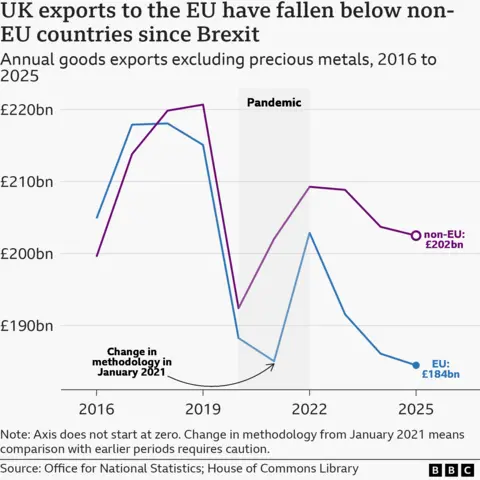
Think tank Niesr calculates exports were 16.9% lower and imports 16.1% less than what could have been expected based on positive pre-2016 trends. The Centre for European Reform uses a different method, trying to take account of what could have happened if the UK had not been excluded from a more recent surge in intra-EU trade, leading to a goods trade hit of 16% to exports and 14% to imports. It’s all in the same ballpark and there is other research from European countries that suggest similar drops in their trade with the UK. Again, these calculations rely on selecting a method and statistical judgment.
Most studies conclude similarly, but using raw trade figures, so not accounting for significant inflationary spikes, you see a 4% rise in cash terms since 2019 of UK goods exports to the EU, which some analysts have used to argue there has been minimal impact.
Services trade boom
One area that has performed more strongly since 2016 is services, which make up over 80% of total UK economic output. Services sector exports from the UK to the EU are up 57% over the last decade, driven by a category that includes accountancy, legal services and consultancy. Non-EU services exports are up 49%. Imports from the EU are up 35% in the same time, and up 60% from outside the EU.
It is also true that there has been a service boom across the advanced world and some argue Britain might have done even better without Brexit. But either way, financial services clearly remained in healthier shape than the worst projections during the referendum.
Business investment
Investment by businesses was significantly lower than what might have continued after Brexit, according to two studies. Former Bank of England independent economist Jonathan Haskel calculates a £29bn or 1.3% reduction in the size of the economy from lower investment than would have been expected since 2016.
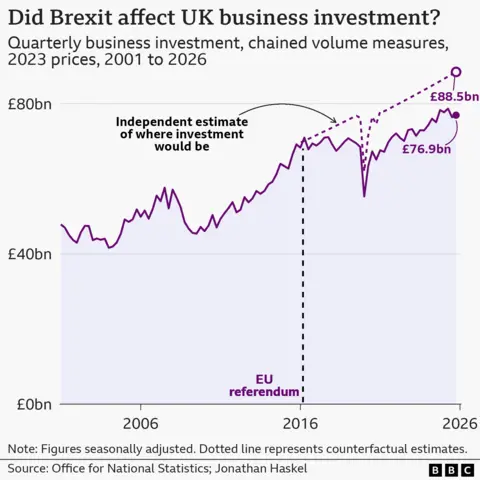
Business investment flattened in real terms immediately after 2016, and notably underperformed various measures of UK long term-trends and comparisons with other countries. Professor Haskel’s latest calculation is a shortfall of 13% against the pre referendum trend from 1997-2016.
Using different methods, the National Institute of Economic and Social Research and the top US economic research body the NBER find that UK business investment is down 12-13% against where it would have been, compared to a representative basket of advanced economies.
Much of these findings predate the energy shock in 2022, and attribute the hit to uncertainty in the first years after Brexit. The latest analyses show the UK still behind most of the G7 but having overtaken Germany after the hit to its economy from the 2022 energy crisis.
The currency
The most visible sign of economic shock was the fall in the value of the pound in the minutes and then years after the referendum. This makes imports and travel more expensive, and makes UK assets worth less in the world.
Pre-referendum, the pound had reached new highs against major currencies. It then fell sharply after the referendum and has since traded lower, particularly against the dollar and the euro. It fell again further at various points of post-Brexit uncertainty and then too during the mini-budget in 2022 when Liz Truss was prime minister. Since then, sterling has broadly strengthened and taken advantage of a weaker dollar and is currently near the top of its post-Brexit range.
The impact of an overall weaker pound has raised prices for imported goods, from fresh foods to manufactured goods. But it has also helped cushion disruption for exporters by making their goods cheaper in international markets. In turn, some food prices have been helped a little by lower tariffs on international imports not produced in the UK.
The new trade deals
One potential Brexit benefit was the UK’s ability to sign its own trade deals outside the EU. The UK-India deal stands out as an example of where the UK broke ground well beyond what might have happened within the EU.
The UK also signed the first “deal” to alleviate the impact of President Trump’s tariffs. The Government itself calculates that the trade deals Britain has signed will only slightly boost economic growth, by fractions of a percentage point over decades.
It is worth noting that even former Prime Minister Tony Blair, an avowed Remainer who was previously a backer of a second referendum, recently suggested the UK had enjoyed some benefit from being able to have its own AI regulations and that this would have implications for any attempt to rejoin the EU or single market in the future.
 Getty Images
But it is also the case that it is not all one way. The EU has signed a deal with South America, the Mercosur deal, which gives access to EU car exporters to Brazil, the world’s sixth biggest market, at zero tariffs, versus 35% for the UK.
And while Britain also achieved the first and best deal to alleviate President Trump’s tariffs, the EU has since received many of the same benefits. The rate at 10% is better for the UK than the EU at 15%, but there is no quota for EU car exports to the US, and there is one of 100,000 for the UK.
It could be that the quiet competition between London and Brussels prompted by Brexit has motivated dealmaking that might have otherwise taken years.
The overall hit
There is a place that is as central to the UK’s relations with the EU as the Strait of Hormuz is to global energy markets: the Channel Tunnel. When Britain was in the EU, the tunnel was the living embodiment of frictionless goods trade.
Back in 2016, 1.64m trucks went through the tunnel. Last year, post Brexit, there were 1.16m. So there are almost half a million missing lorry journeys a year – nearly 30% of this economically critical, high-value cross-Channel traffic has been lost.
Exactly how many trucks there would have been were it not for Brexit is impossible to say, but the hit from the pandemic, for example, would have subsided by now.
An industry participant describes the pattern as “pure Brexit” with small exporters leaving, unable to afford to invest in systems and surviving business models changing from “just in time” to increased stock-holding. HMRC trade data analysed by LSE also pointed to 16,400 firms – 14% of EU exporters – stopping exporting to the EU between 2019 and 2023 altogether, and that falls in exporting were concentrated among smaller firms.
What has happened in the Channel Tunnel tallies with the academic consensus that the UK economy is smaller now than it would have been based on the trajectory it was on in 2016.
The numbers range from about 3% to 8%. “The fact that it is harder to trade with the EU is about half the hit, in line with previous forecasts,” says lead author of the NBER research, Nick Bloom.
He attributes the rest to the consequences of what at times felt like near-nightly political meltdown during the Brexit negotiations. “The other half is the uncertainty from the fact the Brexit process itself was such an enormous mess… We can never get that second 4% back.”
These calculations are based on modelling how a UK still within the EU could have been expected to perform economically had it still experienced the pandemic and the 2022 energy shock but not Brexit.
The most recent study by the NBER takes account of population growth, and says the UK lost 6-8% of per capita output.
Bloom says he has used a variety of approaches including accounting for distance, economic gravity, the size of the economy and selectively omitting potential outliers.
There are, however, other figures. The authors, including Bank of England economists, also used a special survey of thousands of firms, accounting for a tenth of private employment, that was created by the Bank in 2016 to track Brexit reaction. The first Brexit analysis based on this survey was only published this year and updated on Friday and it shows how prolonged Brexit uncertainty hit commercial decision-making.
This entirely different firm-level method also leads to a conclusion of an economy about 6% smaller than without Brexit. That means an economy that would have otherwise grown about two thirds of a percentage point faster every year over the past decade.
Next ten years of Brexit
The world that post-Brexit Britain entered in 2016 has changed beyond any recognition.
Back in 2016, Brexiteers talked up the prospects of a free trade deal with the US when the reality in 2026 is a US that has put up higher trade barriers and weaponised tariffs. A decade ago, the idea was floated that the EU could collapse – it hasn’t, and has introduced protections for its manufacturers. And China is now increasingly assertive.
The questions the above raise about UK global economic strategy are almost entirely different questions to those posed a decade ago.
What’s clear from the data is that many UK goods exporters, especially smaller ones, have not become used to Brexit and that in certain sectors it’s not getting any better.
Does the UK align itself with the US and its focus on lightly-regulated tech and in particular AI? Can a closer UK-EU relationship be squared with that? The EU has responded to the new economic nationalism with “Made in Europe” legislation that may require a certain percentage of parts to be made in Europe – it’s unclear if the UK is included or not. An early test will be steel next month, and then a deal to avoid UK-EU electricity car tariffs at the end of the year.
UK officials recently suggested establishing a single market for goods trade with the EU as part of the next phase of a Brexit reset, something the EU says is incompatible with current government red lines around freedom of movement.
Unions have shifted position from wanting to rejoin the customs union, to looking for a Swiss-style deal in the European Economic Area.
In recent weeks government ministers have begun to quietly say that these red lines are specifically for this Parliament and will be looked at again. What path Sir Keir Starmer’s replacement as prime minister decides to go down, we don’t yet know.
Next month’s UK-EU summit has now been postponed. Sir Keir had wanted to seal a deal to row back many of the post-Brexit frictions on food and farm trade that have impacted the cross-Channel trade flows. Other political parties have vowed to rip up the government’s EU reset or even try to row back on elements of the post-Brexit deal.
Put bluntly, the status quo will not hold. Ten years on, Brexit, and its impacts on the economy, remain very much with us, and the policy debates may be about to return.
Top picture credit: Getty Images

BBC InDepth is the home on the website and app for the best analysis, with fresh perspectives that challenge assumptions and deep reporting on the biggest issues of the day. Emma Barnett and John Simpson bring their pick of the most thought-provoking deep reads and analysis, every Saturday. Sign up for the newsletter here
