
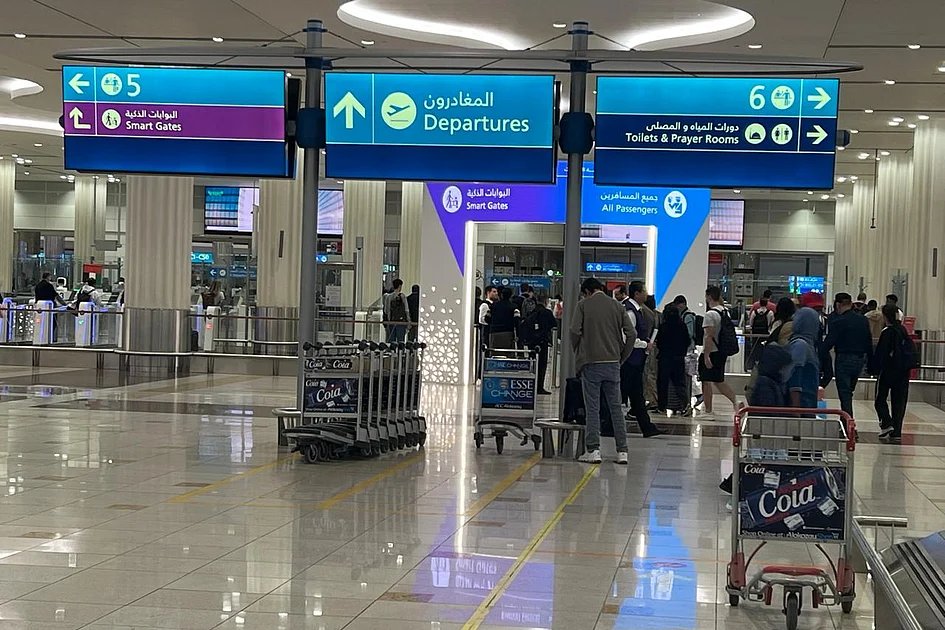
A looming seat shortage on the UAE-India air corridor is setting the stage for sustained airfare pressure, threatening to leave millions of travellers unserved and slow the economic momentum generated by one of the world’s busiest international aviation markets.
Rising demand is on track to outstrip available capacity over the next decade, according to new analysis by Tourism Economics, an Oxford Economics company. If current limits remain unchanged, about 27 per cent of forecast passenger demand between the two countries could go unmet by 2035. That would translate into a cumulative shortfall of roughly 54.5 million passenger journeys between 2026 and 2035.
The strain is already visible. Load factors on major routes exceed 80 per cent, leaving little spare capacity. Tourism Economics projects that under existing schedules, available seats will be fully absorbed as early as 2026. The Abu Dhabi-India corridor is among the most exposed, with an estimated 13.2 million passengers expected to be unaccommodated over the next decade.
India’s aviation boom is the main driver. The country’s “travelling class” — households with sufficient income to fly — expanded from 24 per cent of the population in 2010 to 40 per cent in 2024, adding nearly 300 million potential flyers. Air travel demand linked to this shift is forecast to grow at 7.2 per cent annually through 2035, generating close to 22 million additional passenger journeys each year.
For airlines, the surge underpins revenue growth. For travellers, it signals tighter supply and higher prices. Limited capacity curbs competition, particularly during peak travel periods, giving carriers greater pricing power on high-demand routes linking major Indian cities with Dubai and Abu Dhabi.
“Load factors exceed 80 per cent on major routes, indicating limited spare capacity,” said Matthew Dass, director of consulting at Tourism Economics. “In our baseline outlook, the gap between forecast demand and available seats widens over time and available capacity is expected to be exhausted by 2026.”
UAE aviation executives say demand on India routes continues to outperform most other international markets. “India remains one of the fastest-growing source markets for Gulf carriers, both for point-to-point traffic and onward connections,” said Sudheesh TP, general manager, at Deira Travel & Tourist.
“Sustained demand growth without corresponding capacity expansion inevitably tightens supply and places upward pressure on fares, especially during seasonal peaks,” said Sudheesh.
The UAE remains India’s largest international aviation market by a wide margin. As of November 2025, the corridor accounted for around 1.1 million monthly seats and a 27 per cent market share. Thailand, the second-largest market, accounts for just 9 per cent. While capacity on the India–UAE route rose 3 per cent year-on-year, growth has failed to keep pace with accelerating demand.
Traffic volumes highlight the corridor’s strategic role. Dubai International Airport handled 92.3 million passengers in 2024, with about 12 million travelling between Dubai and India. That means more than one in eight passengers at the world’s busiest international hub is linked to India. Six major carriers operate a combined 538 weekly flights between Dubai and 23 Indian destinations, placing the corridor among the most active globally.
Emirates remains the backbone of the market. Since launching its first India flights in 1985, the airline has carried more than 90 million passengers on the Dubai–India corridor and now operates 167 weekly services connecting Dubai to nine Indian cities. Abu Dhabi-based Etihad Airways has expanded its India footprint to 11 destinations and retains about 10,000 unutilised seats from its 50,000 weekly bilateral entitlement, providing limited room for near-term expansion.
Indian carriers have scaled rapidly as well. IndiGo operates roughly 220 weekly services between India and the UAE. Air India flies about 82 weekly frequencies, while Air India Express is the largest Indian operator on the corridor with more than 240 weekly flights across multiple UAE destinations.
Even with this scale, demand continues to outstrip supply.
Travel industry executives in India say the imbalance is already reshaping booking patterns. “We are seeing earlier sell-outs on popular India routes and rising last-minute fares, particularly around school holidays and festival seasons,” said K. V. Muraleedharan, president of Kerala Association of Travel Agents. “Passengers are being forced to book weeks in advance or accept significantly higher ticket prices.”
The economic consequences extend beyond airline pricing. Tourism Economics estimates that if capacity remains capped, the India–UAE air corridor’s GDP contribution will grow by about 3 per cent annually over the next five years. Easing restrictions could lift that growth to between 5.5 per cent and 7 per cent. Doubling seat capacity on the Abu Dhabi–India route alone could generate an additional $7.2 billion in GDP over five years and support more than 170,000 jobs annually on average.
Muraleedharan added that policy remains the central bottleneck. Under the 2014 air service agreement, weekly seat entitlements are capped at approximately 66,000 for Dubai and 55,000 for Abu Dhabi. “These limits are effectively fully utilised. Talks to raise capacity remain stalled, with India pushing for a 4:1 ratio in favour of Indian carriers for new seats, while the UAE is seeking broader access to address rising unmet demand.”
- India
