
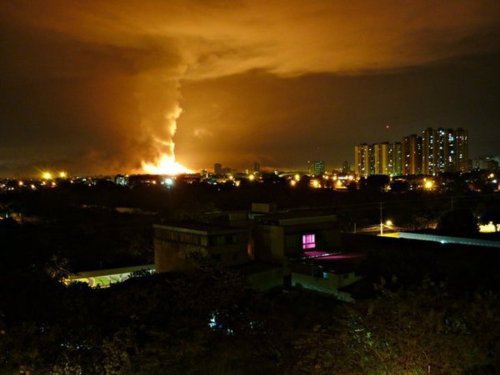
Early morning blasts coincide with heightened U.S. naval presence and recent strikes, escalating tensions between Washington and Caracas.
CARACAS – Venezuela’s government declared a state of emergency on Saturday, condemning an “extremely serious military aggression” by the United States following a series of loud explosions heard in the capital, Caracas.
Residents reported multiple blasts and sounds resembling low-flying aircraft beginning around 2:00 a.m. local time (0600 GMT), continuing for at least 15 minutes. The exact source and location of the disturbances remain unconfirmed.
The incident comes amid a significant escalation of U.S. pressure on the government of President Nicolás Maduro. Earlier in the week, U.S. President Donald Trump announced that American forces had destroyed a docking area used by alleged Venezuelan drug-trafficking boats—marking what would be the first acknowledged U.S. land strike on Venezuelan territory.
“Venezuela rejects, repudiates, and denounces before the international community the extremely serious military aggression perpetrated by the current government of the United States of America against Venezuelan territory and people,” Maduro’s administration said in a statement.
The Trump administration has labeled Maduro’s government a narcotics trafficking organization and has intensified a military and economic campaign in recent months. A U.S. Navy task force is currently deployed in the Caribbean, and Trump has openly discussed the possibility of ground operations in Venezuela.
Maduro has denied all allegations of drug trafficking, framing Washington’s actions as an attempt to seize control of Venezuela’s vast oil reserves, the largest in the world. Despite the accusations, he indicated earlier this week an openness to dialogue with the U.S.
In addition to military posturing, the U.S. has increased economic pressure by imposing sanctions, moving to seize Venezuelan oil shipments, and restricting the country’s airspace.
Since last September, U.S. forces have conducted numerous maritime strikes targeting boats allegedly linked to drug smuggling in the Caribbean and Eastern Pacific. The U.S. military reports at least 107 fatalities across more than 30 such operations, though the administration has not publicly detailed evidence connecting each engagement to narcotics trafficking. The campaign has raised legal and diplomatic questions internationally.
The situation remains volatile, with Saturday’s events marking a new peak in tensions as both nations trade accusations and military activity in the region grows.
