
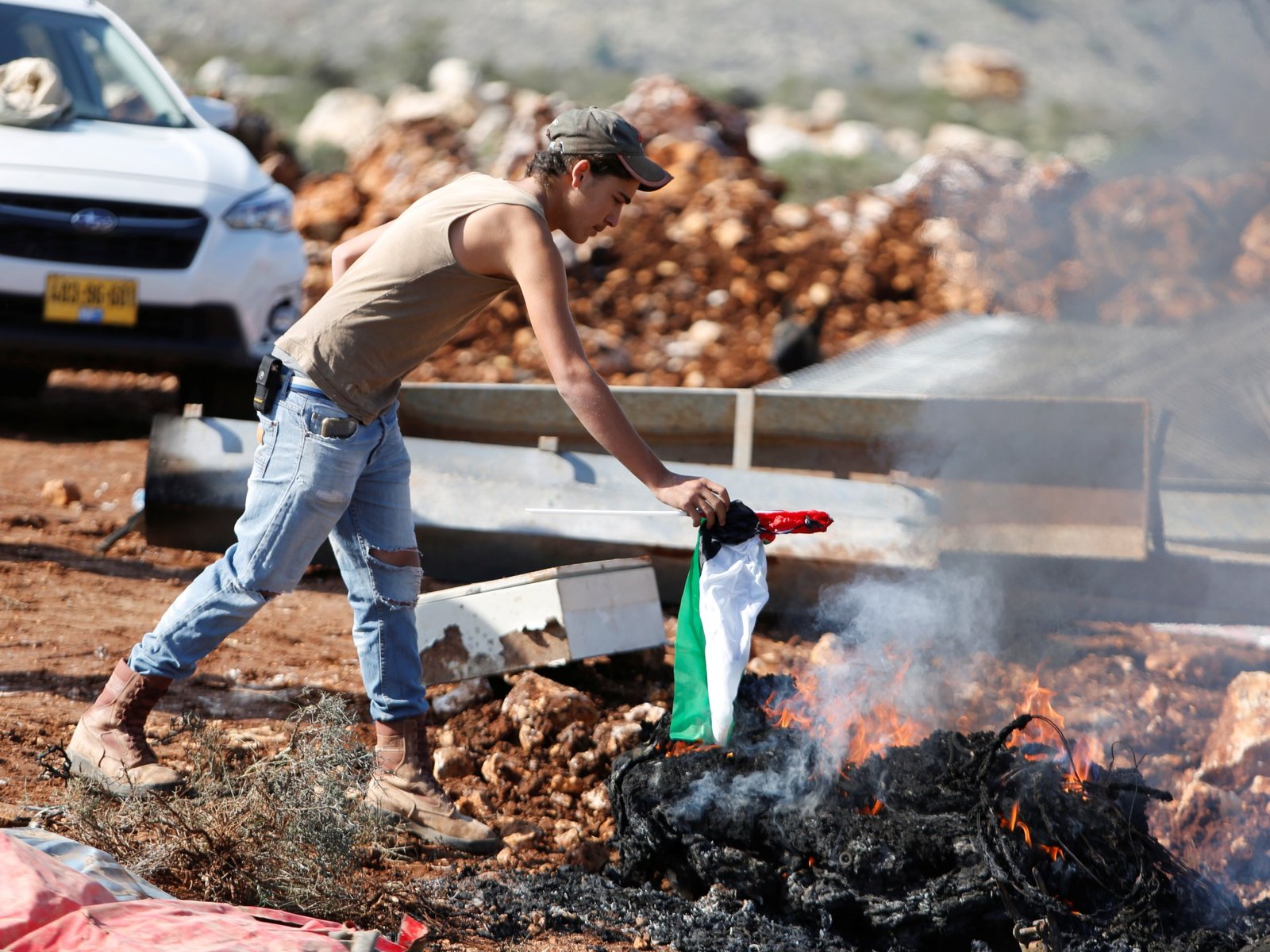
Israel and its supporters would have you believe that just being a Palestinian is a lethal threat.
I am a Palestinian. And increasingly, that fact alone is treated as a provocation.
In recent months, I have watched anti-Semitism — a real, lethal form of hatred with a long and horrific history — be stripped of its meaning and weaponised to silence Palestinians, criminalise solidarity with us, and shield Israel from accountability as it carries out a genocide in Gaza. This is not about protecting Jewish people. It is about protecting power.
The pattern is now impossible to ignore.
A children’s educator, Ms Rachel, whose entire public work is built around care, learning, and empathy, is branded “Anti-Semite of the Year” — not for her engaging in any form of hate speech, but for expressing concern for Palestinian children. For acknowledging that children in Gaza are being bombed, starved, and traumatised. For expressing compassion.
As a Palestinian, I hear the message clearly: even empathy for our children is dangerous.
Then there is Palestine Action, a protest movement that targets weapons manufacturers supplying Israel’s military. Instead of being debated, challenged, or even criticised within a democratic framework, it is proscribed as a “terrorist” organisation, casually equated with ISIL (ISIS) – a group responsible for mass executions, sexual slavery, and genocidal violence.
This comparison is not just obscene. It is deliberate. It collapses the meaning of “terrorism” so completely that political dissent becomes extremism by definition. Resistance becomes pathology. Protest becomes “terror”. And Palestinians, once again, are framed not as a people under occupation, but as a permanent threat.
Language itself is now being criminalised. Phrases like “globalise the Intifada” are banned without any serious engagement with history or meaning. Intifada — a word that literally means “shaking off” — is torn from its political context as an uprising against military occupation and reduced to a slur. Palestinians are denied even the right to name their resistance.
At the same time, international law is being actively dismantled.
Staff and judges at the International Criminal Court are sanctioned and intimidated for daring to investigate Israeli war crimes. Francesca Albanese, the United Nations special rapporteur on Palestine, has not only been sanctioned, but also relentlessly smeared — because she uses the language of international law to describe occupation, apartheid, and genocide.
When international law is applied to African leaders, it is celebrated.
When it is applied to Israel, it is treated as an act of hostility.
This brings us to Australia — and to one of the most revealing moments of all.
After the horrific Bondi Beach attack, which shocked and horrified people across Australia, Israel’s Prime Minister Benjamin Netanyahu accused the Australian government of encouraging anti-Semitism. Not because of any incitement, not because of inflammatory rhetoric — but because Australia had moved towards recognising Palestine as a state.
Read that again.
The diplomatic recognition of Palestinian statehood — long framed as essential to peace and grounded in international law — is presented as a moral failing, even as a contributor to anti-Semitic violence. Palestinian existence itself is treated as the problem.
What makes this moment so disturbing is not only that Netanyahu made this claim, but that so many centres of power ran with it rather than challenged it.
Instead of forcefully rejecting the idea that recognising Palestinian rights could “encourage anti-Semitism”, governments, institutions, and commentators allowed the premise to stand. Some echoed it outright. Others stayed silent. Almost none confronted the dangerous logic at its core: that Palestinian political recognition is inherently destabilising, provocative, or threatening.
This is how moral collapse happens — not with thunder, but with acquiescence.
The result is not safety for the Jewish people, but erasure of the Palestinian people.
As a Palestinian, I find it devastating.
It means my identity is not merely contested — it is criminalised. My grief is not simply ignored — it is politicised. My demand for justice is not debated — it is pathologised as hatred.
Anti-Semitism is real. It must be confronted seriously and without hesitation. The Jewish people deserve safety, dignity, and protection — everywhere. But when anti-Semitism is stretched to include children’s educators, UN experts, international judges, protest movements, chants, words, and even the diplomatic recognition of Palestine, then the term no longer serves to protect Jewish people.
It protects a state from accountability.
Worse still, this weaponisation endangers Jews by collapsing Jewish identity into the actions of a government committing mass atrocities. It tells the world that Israel speaks for all Jews — and that anyone who objects must therefore be hostile to Jews themselves. That is not protection. It is recklessness masquerading as morality.
For Palestinians like me, the psychological toll is immense.
I am tired of having to preface every sentence with disclaimers.
I am deeply pained by watching my people starve while being lectured about tone.
I am angry that international law seems to apply only in certain politically convenient cases.
And I am grieving — not just for Gaza, but for the moral collapse unfolding around it.
Opposing genocide is not anti-Semitism.
Solidarity is not “terrorism”.
Recognising Palestine is not incitement.
Naming your suffering is not violence.
If the world insists on calling me an anti-Semite for refusing to accept the annihilation of my people, then it is not anti-Semitism that is being countered.
It is genocide that is being justified.
And history will remember who helped make that possible.
The views expressed in this article are the author’s own and do not necessarily reflect media’s editorial stance.
