
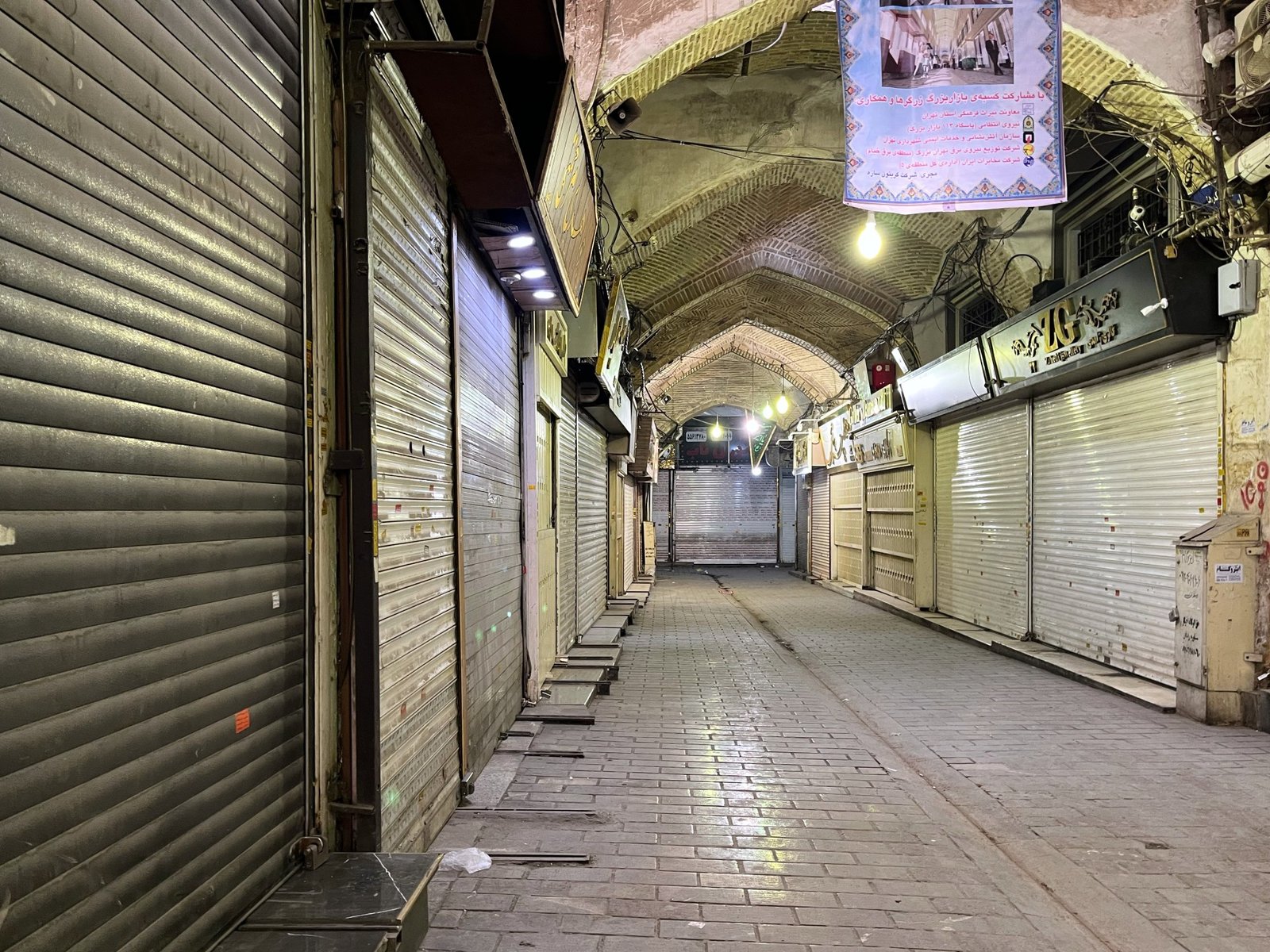
Two decades of economic changes have eroded the bazaar’s economic power and political sway in Tehran.
In his first public remarks since mass protests broke out in Iran, Supreme Leader Ali Khamenei sought to draw a sharp line between what he deemed the “legitimate” grievances of the bazaar and outright rebellion across the country. “We talk to protesters; the officials must talk to them, but there is no benefit to talking to rioters. Rioters must be put in their place,” he said.
The distinction was deliberate. Khamenei went on to praise the bazaar and its merchants as “among the most loyal sectors” of the Islamic Republic, insisting that the enemies of the state could not exploit the bazaar as a vehicle to confront the system itself.
Yet his words failed to mask the reality on the ground. Protests continue in the Tehran Bazaar, prompting authorities to deploy tear gas against demonstrators chanting antistate slogans, including ones targeting the supreme leader. The state’s attempt to symbolically separate the bazaar from the broader unrest failed in practice, exposing the limits of its narrative control.
Khamenei’s invocation of the revolutionary legacy of the bazaar is rooted in historical facts. The bazaar played a decisive role in the 1979 revolution that overthrew Mohammad Reza Shah Pahlavi and remained aligned with conservative political networks in the following decades. But this historical loyalty no longer guarantees political quiescence.
Over the past 20 years, the economic standing of the bazaar has been steadily eroded by state favouritism towards the economic machinery of the Islamic Revolutionary Guard Corps (IRGC) and large religious-revolutionary foundations (bonyads), sanctions management, and chronic inflation. As a result, what was once a staunch base of the regime has become another casualty of systemic dysfunction.
From power to marginalisation
In the aftermath of the 1979 revolution, powerful bazaar merchants, often operating through the bazaar-affiliated Islamic Coalition Party, were folded directly into the architecture of the new state. They gained influence over key institutions and ministries, including the Ministry of Trade and Commerce, the Ministry of Labour, and the Guardian Council.
This political access translated into material advantage. Despite the enthusiasm of powerful figures in the new revolutionary state for total nationalisation, including control over foreign trade, the bazaar maintained a dominant role in Iran’s commercial trade throughout the 1980s. Bazaar merchants secured import licences, ran the largest trading firms under the supervision of the Ministry of Commerce, and benefitted from preferential access to the official exchange rate, which was far below market value. These imported goods were sold to Iranians at market prices, generating substantial profits.
When the Islamic Republic turned towards economic liberalisation in the 1990s, political forces tied to the bazaar, often described as the “traditional right”, backed President Akbar Hashemi Rafsanjani in sidelining Islamist leftists from both the cabinet and the Majles. Although some of Rafsanjani’s market reforms later collided with bazaar interests and gave rise to the so-called “new right”, most notably the Servants of Reconstruction Party, the bazaar and its allies retained substantial influence within the state.
The reformist agenda of Rafsanjani’s successor, President Mohammad Khatami, also did not fundamentally threaten the economic position or political clout of the bazaar. Key institutions—the Guardian Council, the Assembly of Experts, and the judiciary—remained firmly under the control of the “traditional right”, insulating the bazaar from meaningful challenge.
Although the bazaar overwhelmingly supported the presidential bid of Mahmoud Ahmadinejad in 2005, the economic and foreign policies of his administration ultimately accelerated the erosion of its economic power.
During Ahmadinejad’s presidency, “privatisation” became a vehicle for the transfer of major state assets to firms affiliated with the IRGC and bonyads. Reclassified as “public, nongovernmental entities” under a new interpretation of Article 44 of the Constitution, these bodies absorbed vast swaths of the economy. Backed by the supreme leader and a cabinet dominated by military and security figures, many of them former IRGC officers, this redistribution of wealth encountered little institutional resistance.
The result was a profound shift in Iran’s political economy. The IRGC emerged as a dominant economic actor, expanding its reach across infrastructure, petrochemicals, banking, and beyond. Major bonyads, including the Mostazafan Foundation, the Imam Reza Shrine Foundation, and Setad, similarly consolidated their power by acquiring state firms and building sprawling corporate empires. Together, these entities formed an extensive web of interlocking conglomerates that fused revolutionary foundations with military institutions, giving rise to a powerful new political bloc within the state: the Principlists.
The bazaar’s discontent
This consolidation came directly at the expense of the bazaar and the political forces historically aligned with it. Disillusioned by the economic policies of the Ahmadinejad government, bazaar merchants coordinated their first open act of defiance since the revolution, staging strikes in several cities in 2008.
Their position deteriorated further as international sanctions escalated in response to the hardline nuclear policies of Ahmadinejad’s government. By 2012, US and EU restrictions on Iran’s oil and banking sectors and its exclusion from the SWIFT system placed the country under severe economic constraints.
The state responded by developing sanction-evasion mechanisms, including smuggling routes through neighbouring countries. The IRGC played a central role, exploiting ports and airports under its control to import goods. Over time, this sanctions economy entrenched the dominance of the IRGC and bonyads while further marginalising the bazaar.
Politically, the consequences were equally stark: the Principlists consolidated control over the state, sidelining the “traditional right” and dismantling the longstanding arrangement that had traded the bazaar’s loyalty for access and influence within the Islamic Republic.
A challenge to the regime
The ongoing bazaar protests are not an anomaly but a warning. They reveal a political-economic transformation years in the making—one that is hollowing out even the traditional backbone of the state.
For decades, the regime relied on the bazaar as a stabilising force: a guarantor of economic compliance in times of crisis and a bedrock of political loyalty. Yet the unrest originated in the bazaar and continues there, even as Khamenei insists on their loyalty. His remarks signal not confidence, but anxiety, and the bazaar’s open defiance demonstrates that the challenge confronting the Islamic Republic is far harder to contain.
In theory, the Islamic Republic could still seek to win back the bazaar by easing sanctions and curbing the dominance of IRGC-linked conglomerates. In practice, this is increasingly difficult to do. Sanctions relief remains remote amid deepening tensions with the United States and Europe over Iran’s nuclear programme, while rolling back the economic and political power of the IRGC and the bonyads offers the regime little incentive and even less strategic logic. Confronted with these constraints, the state’s room for manoeuvre is narrow, leaving repression as its most readily available option, even at the cost of further alienating a traditional constituency it once relied on for stability and loyalty
The views expressed in this article are the author’s own and do not necessarily reflect media’s editorial stance.
