
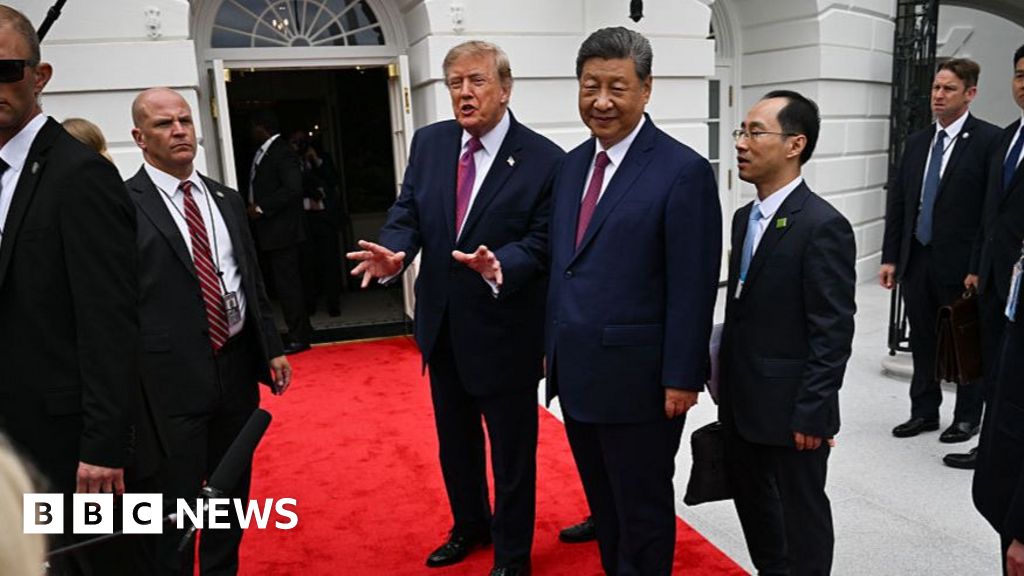
At least so far, Chinese President Xi Jinping’s visit to Washington has been all pomp and little obvious progress on pressing issues.
From the ceremonial welcoming at a military air base on Wednesday to the honour-guard arrival at the White House this morning, President Donald Trump rolled out the red carpet – literally and figuratively – for his Chinese counterpart.
The public remarks from the two leaders have teemed with warm words and diplomatic niceties. In a statement before today’s formal meetings, Xi announced a gift of Chinese pandas and unveiled a new student exchange programme.
“Let us keep advancing the cause of friendship between our two peoples and work together to build a better world,” he said.
Trump says he and Xi held ‘great meeting’ as Chinese leader visits White House
“The decisions we make in these areas today can promote peace and prosperity for decades and decades to come,” he said.
The marching bands and military flyovers on Thursday may serve a larger purpose, however – at least for Trump.
“This is a little bit of intentional pageantry to talk up the positive vibes of the summit,” Jennifer Welch, chief economic analyst for Bloomberg Economics, told the BBC. “This is very much how President Trump sees the summit and the role he plays in the US-China relationship, as ballast to provide stability.”
Even so, there is still an edge to some of Xi’s rhetoric, she notes.
In remarks at the White House, the Chinese leader again mentioned the “Thucydides trap” – a theory that shifts in global power tend to lead to conflict between rising and declining nations.
“China and the United States are different in national conditions, but through candid, in-depth and continued dialogue, our two countries can understand each other better, seek common ground while shelving differences, and build up mutual trust,” Xi said.
The obstacles in the way of reaching any substantive agreement between the two nations are significant, however. When Trump and Xi met in Beijing in May, the men agreed to form boards of trade and investment to oversee economic interactions, and little more.
On Wednesday, US Treasury Secretary Scott Bessent said a year-long trade “truce” between the two nations that had kept tariffs lower would be extended another two months. Financial analysts expect a further extension could come before this week’s summit ends, given that neither side wants a renewal of last year’s trade war.
The outlook for progress is much dimmer on other topics, like the US war with Iran, the Ukraine war and regulating AI.
China’s reneging on promises to buy more American agricultural products and to also sell more rare earth minerals to the US is helping cloud the outlook. China, meanwhile, is watching to see if Trump follows through on a proposed sale of American weapons to China, which has been on hold for months.
When it comes to AI, China and the US have two very different goals for any agreement on the race to develop the technology, Robyn Klingler-Vida, a professor of political economy at Kings College London, told the BBC.
“On the US side, it’s about existential risk and slowing down AI potentially,” she said. “Whereas in China, it’s about acceleration, maybe winning the AI tech race and the application of AI to the real economy.”
A number of leading American AI executives plan to attend tonight’s formal state dinner at the White House, which many view as a means for the US side to tout its current technological advantage.
Muscle-flexing aside, more pageantry – and the promise of stability – may be the end result of Xi’s China visit, even with additional face time between the two leaders to come before Xi departs on Friday afternoon.
“What China talks about is metaphysical and abstract. The United States wants to solve specific problems,” Miles Yu, who served as principal China policy planner and strategist to Secretary of State Mike Pompeo during Trump’s first term, told the BBC.
“These different approaches are not going to lead to any result.”
Trump and Xi come face-to-face as US and China battle to win the AI race

Follow the twists and turns of Trump’s second term with North America correspondent Anthony Zurcher’s weekly US Politics Unspun newsletter. Readers in the UK can sign up here. Those outside the UK can sign up here.
