
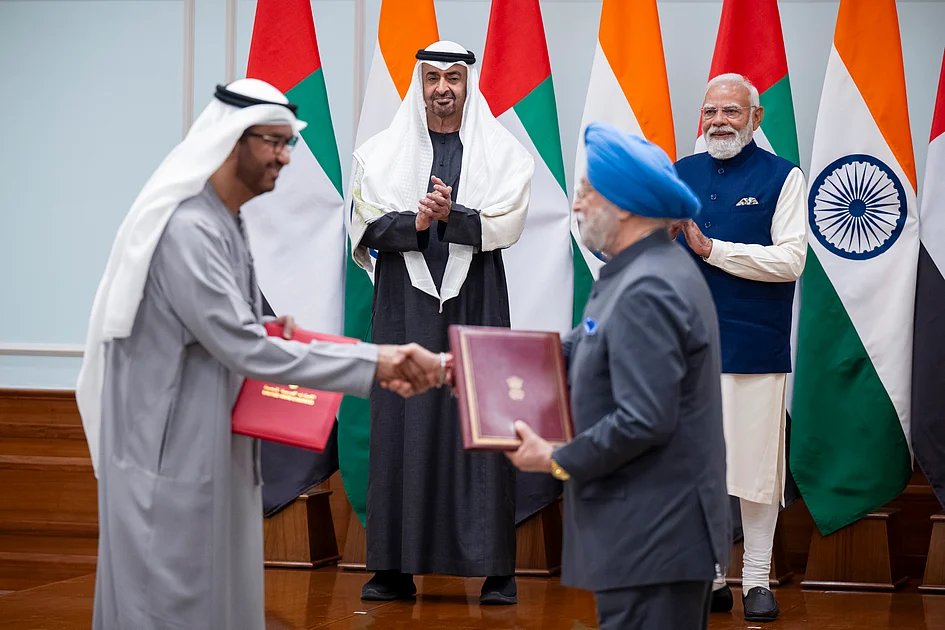
UAE President Sheikh Mohamed bin Zayed Al Nahyan’s latest visit to India has raised the ambition level of the UAE-India economic partnership, with both countries committing to double bilateral trade to $200 billion by 2032, building on the dramatic gains delivered by the Comprehensive Economic Partnership Agreement (Cepa) that came into force in 2022.
On his third official visit to India as President and his fifth trip over the past decade, Sheikh Mohamed held talks with Indian Prime Minister Narendra Modi and witnessed the signing of multiple agreements spanning trade, investment, technology, energy, defence and education.
The leaders said the Cepa has entered a new phase of execution, with trade, capital flows and digital integration emerging as the main engines of growth.
Bilateral trade has surged to around $100 billion in the 2024-25 financial year — five years ahead of the target year — nearly doubling in less than three years after Cepa eliminated tariffs on more than 80 per cent of traded goods and simplified customs procedures.
UAE Ministry of Economy figures show non-oil trade with India has been expanding at double-digit rates, driven by rising shipments of food products, pharmaceuticals, engineering goods, electronics and gems and jewellery, alongside strong growth in services trade.
Officials on both sides see the $200 billion target as achievable on the back of deeper supply-chain integration, logistics expansion and cross-border investment. India is now one of the UAE’s top trading partners globally, while the UAE remains India’s largest trading partner in the Arab world and a key gateway to Africa and West Asia.
Sheikh Mohamed and Modi agreed to fast-track trade infrastructure projects designed to broaden Cepa’s impact beyond large corporates. These include Bharat Mart, the Virtual Trade Corridor and Bharat-Africa Setu, which aim to digitally connect micro, small and medium enterprises and expand market access for exporters across the Middle East, Africa and Eurasia. Policymakers see MSME integration as critical to sustaining trade growth and improving resilience against global volatility.
Investment cooperation featured prominently in the discussions. The leaders welcomed the growing impact of the Bilateral Investment Treaty signed in 2024, which has strengthened investor protection and regulatory certainty. They explored a potential UAE partnership in India’s Special Investment Region in Dholera, Gujarat, a flagship industrial and logistics project that includes an international airport, greenfield port, energy infrastructure, rail connectivity and a smart urban township. The project aligns with the UAE’s sovereign wealth funds’ long-term infrastructure strategy and India’s manufacturing expansion agenda.
Modi also invited UAE sovereign funds to participate in the second National Infrastructure Investment Fund, scheduled for launch in 2026. The first NIIF platform has already attracted billions of dollars from Middle Eastern investors into Indian roads, renewable energy, ports and digital infrastructure, underscoring the scale of capital flows underpinning the partnership.
Financial sector integration has accelerated alongside trade. The leaders welcomed the establishment of DP World and First Abu Dhabi Bank branches in Gujarat International Finance Tec-City, reinforcing GIFT City’s ambition to become a regional financial hub. FAB’s presence is expected to provide Indian corporates with greater access to GCC and Mena capital markets, while DP World’s footprint strengthens trade finance and logistics linkages.
“The UAE and India relationship is deep-rooted, across various spheres. Standard Chartered’srecent research states that the UAE is one of the standout markets shaping trade corridors. About 50per cent of corporates from India, in addition to Saudi Arabia and Egypt, intend to expand trade and investment with the Emirates, underlining a strengthening UAE–India corridor,” said Rajesh Kannan, head, Wealth & Retail Banking UAE and head of Global Indian Clients at Standard Chartered.
Kannan added, “At Standard Chartered, we actively engage the global Indian client base, whether corporates or individuals, catering to their needs with cross-border banking, wealth management and investment solutions, with one of our dedicated global financial wealth hubs right here in the UAE.”
