
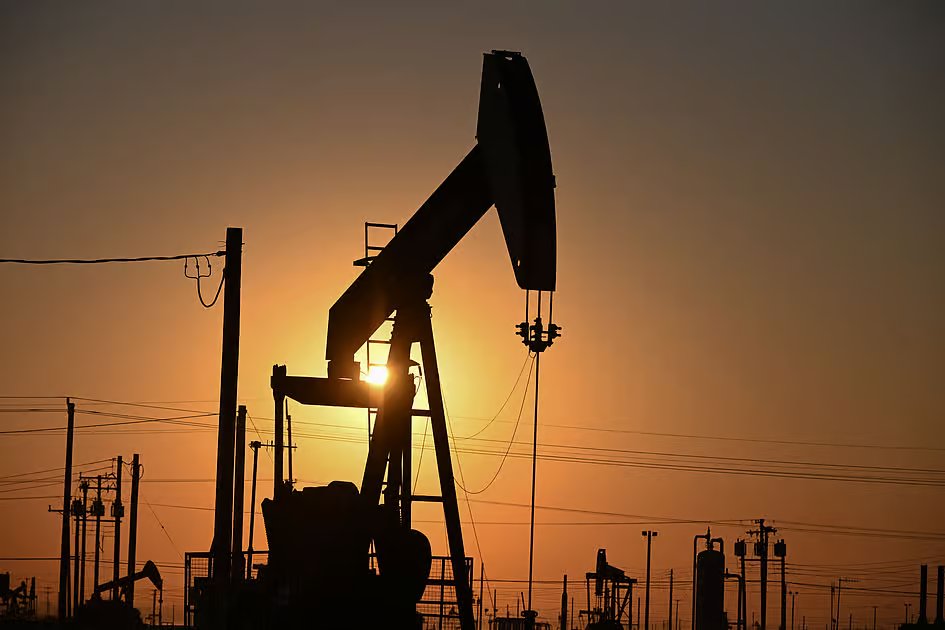
Oil prices retreated in early Asian trading on Tuesday after US President Donald Trump said he had paused a planned military strike on Iran to allow negotiations to continue, offering temporary relief to markets rattled by fears of a prolonged energy supply crisis.
Brent futures for July were down $1.27, or 1.13 per cent, at $110.83 a barrel by 1319 GMT, Reuters reported. The US West Texas Intermediate crude contract for June delivery, which expires on Tuesday, slipped 45 cents, or 0.41 per cent, to $108.21. The more active July contract fell 38 cents, or 0.36 per cent, to $104.
Both benchmarks had surged sharply a day earlier.
The pullback followed Trump’s announcement that a planned military operation against Iran had been postponed at the request of leaders from Saudi Arabia, the UAE and Qatar to create space for diplomacy.
In a social media post, Trump said “serious negotiations are now taking place”, although he also warned that military action could still be launched “at a moment’s notice” if talks failed.
Despite the decline in prices, analysts warned that oil markets remain deeply fragile as the Strait of Hormuz continues to face severe disruption following weeks of the Iran conflict.
No quick resolution
Market analysts said traders are no longer pricing in a quick resolution to the conflict. Instead, growing attention is shifting towards the possibility of a sustained global supply crunch that could eventually push oil markets into a deeper crisis.
Energy intelligence firm Kpler estimated cumulative Middle East oil supply losses since late February at 782 million barrels as of May 8, with disruptions potentially approaching one billion barrels by the end of this month if conditions fail to improve.
The production losses are substantial. Saudi Arabia alone is estimated to be losing more than 3 million barrels per day of output, while Iraq, Iran and Kuwait have also seen major disruptions.
The worsening supply outlook has forced global markets to increasingly depend on emergency oil inventories that were once viewed as ample enough to offset disruptions.
In its latest assessment, the International Energy Agency forecast global oil supply could decline by around 3.9 million barrels per day this year, while demand is expected to fall only marginally by about 420,000 barrels daily.
Inventories exhausting
Industry experts warn that the imbalance could rapidly exhaust available inventories if the Strait of Hormuz remains partially blocked. “You can only decrease consumption so much, and when inventories run out, they are going to run out,” Ellen Wald, senior fellow at the Atlantic Council’s Global Energy Centre, told the Wall Street Journal. “At some point the market is going to collide and prices are going to shoot up.”
Saudi Aramco chief executive Amin Nasser has also warned that global fuel inventories are being depleted at record pace, leaving the market increasingly vulnerable to prolonged supply disruptions. “The only buffer available today is materially depleted,” Nasser said recently.
JP Morgan analysts echoed those concerns, warning that commercial oil inventories in developed economies could soon approach “operational stress levels”.
Natasha Kaneva, the bank’s head of global commodities strategy, said the market’s next phase could evolve into “a refining and end-user fuel crisis” rather than merely another crude price spike if the conflict drags on.
