
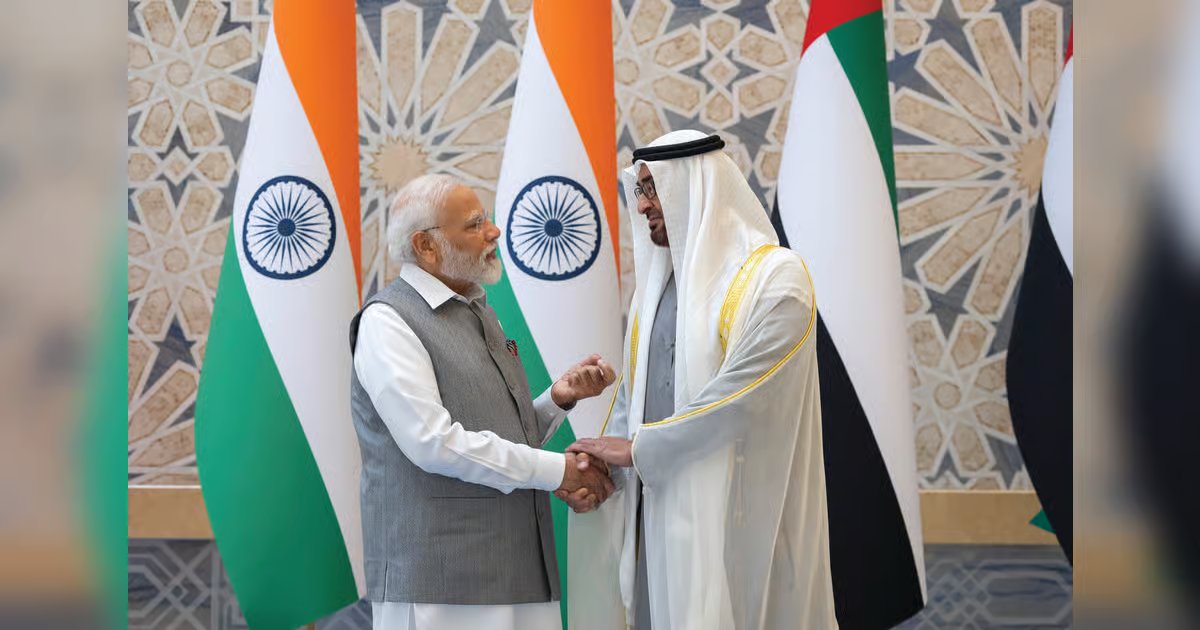
Indian Prime Minister Narendra Modi arrived in the UAE on May 14 on his eighth visit since taking office in 2014, as the two nations moved to further strengthen one of the world’s fastest-growing strategic and economic partnerships amid mounting geopolitical uncertainty in the Gulf.
The visit, the first leg of Modi’s six-day, five-nation diplomatic tour, came at a critical moment marked by escalating tensions involving Iran, Israel and the US, rising concerns over the security of the Strait of Hormuz, and increasing urgency among major economies to secure resilient energy and trade corridors.
Against this backdrop, the UAE and India focused on advancing cooperation across energy security, trade, logistics, defence, technology and strategic investments, while also laying the groundwork for a long-term economic roadmap targeting bilateral trade of $200 billion by 2032.
Trade relationship transformed
Over the past decade, UAE-India ties have evolved dramatically from a traditional oil-and-diaspora relationship into a multi-dimensional strategic alliance encompassing trade, infrastructure, fintech, artificial intelligence, defence manufacturing, renewable energy, logistics and food security.
The transformation gained momentum after the landmark Comprehensive Economic Partnership Agreement (Cepa), signed in 2022, which eliminated tariffs on more than 80 per cent of traded goods and streamlined customs procedures. The agreement has delivered explosive growth in bilateral commerce.
Total bilateral trade surged to more than $100 billion in the 2024-25 financial year, achieving a major economic milestone five years ahead of schedule and nearly doubling within three years of Cepa’s implementation.
Non-oil trade between the two countries rose 20.5 per cent to more than Dh240 billion in 2024, while India emerged as the largest destination for the UAE’s non-oil exports, accounting for 13.5 per cent of total global non-oil exports.
Sectors benefiting most from Cepa include gems and jewellery, engineering goods, pharmaceuticals, electronics, smartphones and agricultural products.
Energy security focus
Energy security dominated Modi’s discussions with UAE President Mohamed bin Zayed Al Nahyan in Abu Dhabi.
With India heavily dependent on Gulf energy imports, recent regional tensions and risks to maritime trade routes had intensified the need for stable and diversified supply arrangements.
Officials discussed new agreements involving Liquefied Petroleum Gas (LPG), strategic petroleum reserves, and long-term energy cooperation, alongside contingency planning for alternative logistics and supply chains in the event of disruptions in the Strait of Hormuz.
The UAE remained one of India’s most important crude suppliers, while bilateral cooperation had expanded rapidly into renewables, hydrogen, petrochemicals, and climate-focused investments.
Investment and connectivity
The UAE has also emerged as one of the largest investors in India, with sovereign wealth funds including Abu Dhabi Investment Authority, Mubadala and ADQ investing heavily in infrastructure, logistics, renewable energy, ports, highways and digital platforms.
More than 72,000 Indian companies are now registered with the Dubai Chamber, reinforcing the UAE’s status as India’s most important commercial gateway to the Middle East, Africa and Europe.
Key strategic initiatives expected to gain momentum include Bharat Mart in Dubai, the Virtual Trade Corridor and Bharat-Africa Setu, all aimed at strengthening supply-chain integration and expanding access for Indian exporters to global markets.
The two sides also advanced discussions on the India-Middle East-Europe Economic Corridor (IMEC), regarded as one of the most ambitious connectivity projects linking India, the Gulf and Europe through ports, railways and logistics infrastructure.
Defence and Technology Ties
Strategic cooperation between the two countries has broadened significantly since Modi came to power.
Defence partnerships, cybersecurity cooperation, intelligence-sharing and counter-terror coordination are expected to feature prominently during the visit.
The UAE and India have also accelerated collaboration in emerging technologies, fintech, digital payments and artificial intelligence.
The integration of India’s Unified Payments Interface (UPI) with UAE payment platforms has strengthened cross-border financial connectivity for millions of Indians living and working in the Emirates.
The Indian expatriate community — estimated at more than 4.5 million people remains the human bridge underpinning bilateral ties and one of the strongest pillars of economic integration.
Leadership diplomacy drives ties
Frequent high-level exchanges between Modi and UAE leaders have played a defining role in reshaping bilateral relations.
Alongside Modi’s repeated visits to the UAE, President Mohamed bin Zayed Al Nahyan has made several high-profile visits to India, including as Chief Guest at India’s Republic Day celebrations in 2017 and again in January 2026, when both countries agreed to raise ambitions further by targeting $200 billion in bilateral trade by 2032.
That visit resulted in agreements spanning trade, defence, technology, logistics, education and investment, while also advancing plans for deeper sovereign wealth participation in India’s infrastructure expansion and manufacturing ecosystem.
Analysts say the UAE-India corridor has now evolved into one of the most strategically significant economic partnerships in Asia, driven by India’s scale and growth potential and the UAE’s global connectivity, capital strength and geopolitical positioning.
With regional instability reshaping global supply chains and investment flows, Modi’s eighth UAE visit is expected to reinforce the Emirates’ role as India’s most trusted Gulf partner and accelerate a new phase of strategic economic integration.
Seven visits that reshaped Bilateral ties
From trade and energy to connectivity, culture and climate cooperation, each visit marked a new phase in the rapid evolution of UAE-India strategic relations. Prime Minister Narendra Modi has made seven previous visits to the UAE since 2015, with each trip significantly expanding the scope of bilateral cooperation.
August 2015: Strategic Reset
Modi’s first UAE visit in August 2015 was historic as it marked the first visit by an Indian prime minister to the UAE in 34 years.
The visit established a Comprehensive Strategic Partnership and opened a new chapter in cooperation across trade, security, infrastructure and investment.
February 2018: Tolerance Milestone
During his second visit in February 2018, Modi strengthened energy and defence ties and visited the site allocated for the first traditional Hindu temple in Abu Dhabi — a landmark symbol of the UAE’s commitment to coexistence and religious tolerance.
August 2019: Highest Honour
Modi’s third visit in August 2019 saw him receive the Order of Zayed, the UAE’s highest civilian honour, from Mohamed bin Zayed Al Nahyan in recognition of efforts to deepen bilateral relations.
June 2022: CEPA Breakthrough
His fourth visit in June 2022 came after the signing of the Comprehensive Economic Partnership Agreement (Cepa), one of India’s fastest and most ambitious trade deals. The agreement dramatically accelerated bilateral trade and investment flows.
July 2023: Connectivity Push
During Modi’s fifth visit in July 2023, the two countries advanced discussions on the India-Middle East-Europe Economic Corridor (IMEC), fintech integration and local currency trade settlements.
December 2023: Climate Partnership
The sixth visit took place during COP28, where both countries deepened cooperation in renewable energy, hydrogen, sustainability and climate finance.
February 2024: Temple Inauguration
Modi’s seventh visit in February 2024 witnessed the inauguration of the BAPS Hindu Mandir in Abu Dhabi, one of the most symbolic moments in modern UAE-India relations. The visit also reinforced cooperation in logistics, defence, technology and investment.
Repeated leadership engagements between Modi and UAE leaders over the past decade have transformed bilateral relations into one of the Middle East’s most dynamic and strategically important partnerships.
