
WASHINGTON (news agencies) — A prescription refill program that quietly launched in Utah earlier this year has kicked off a big medical debate: Is artificial intelligence ready to take over tasks that, until now, could only be performed by doctors?
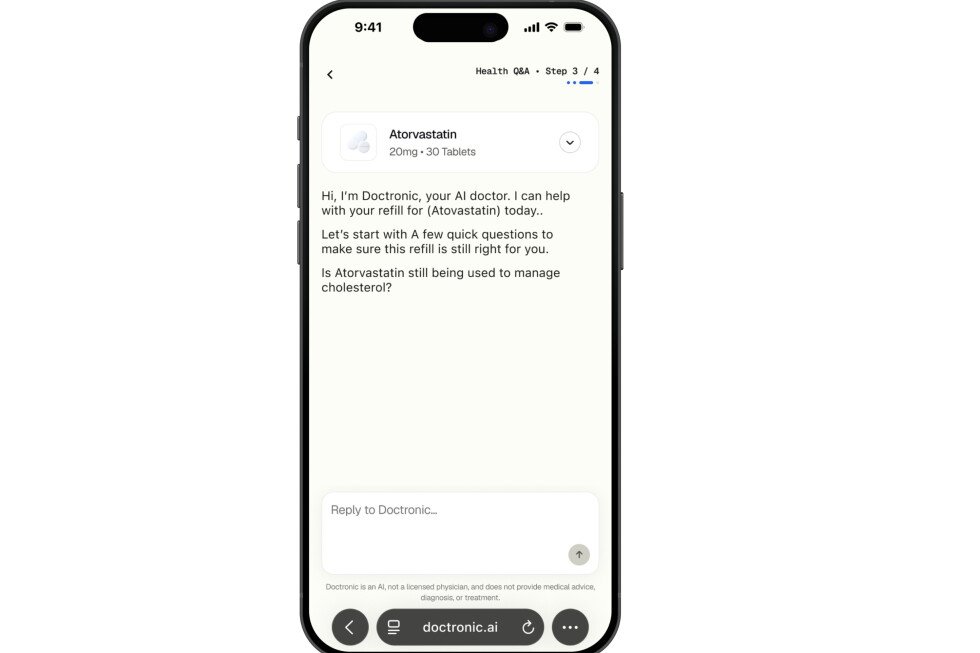
The program allows Utah residents to skip the doctor’s office and get their prescriptions refilled online by an AI chatbot called Doctronic. It’s a seemingly simple step toward making healthcare more convenient for patients and prescribers.
But it’s also a precedent-shattering milestone that has set off alarm bells for doctors, lawyers and public health experts. The pilot program has laid bare a host of questions about the role of AI in medicine, including how it should be regulated, whether doctors should be able to veto it, and what kind of safety measures are needed to protect patients.
At the center of the debate: state and federal laws limit prescribing to licensed medical professionals. Proponents say those laws, which have underwritten American medicine for over 100 years, should be updated to include AI chatbots and other new technologies.
“We have crossed a threshold in terms of giving something that is not human a medical license, whether or not we want to call it that,” said Dr. Eric Bressman of the University of Pennsylvania.
Bressman and other experts say they aren’t opposed to AI prescribing. But they say it should have to meet rigorous standards akin to human doctors, who undergo years of testing and training before being licensed to practice medicine.
In Utah, Doctronic was able to launch thanks to a “regulatory sandbox” that allows state officials to waive laws for AI companies offering promising technology.
The refill program is currently overseen by a five-member board of AI specialists, none of whom are doctors, who say they have implemented numerous safeguards. During the program’s initial phase, for example, human doctors review all Doctronic refill orders. The company expects to soon transition to fully automated refills.
The head of the state’s medical licensing board says he and his colleagues learned of the program when its January launch was reported in the news. In a March letter to the state, 11 board members called for the program to be halted, citing the risks of automatically renewing medicines that can have side effects or drug interactions.
“We were essentially told: ‘Yes this is going on. And no, you don’t have a say in it,’” said Dr. Alan Smith, a family physician who heads the board but said he was speaking only for himself.
Complicating the picture is the fact that medical technology is traditionally regulated at the federal level, while medical professionals are overseen by states.
Doctronic executives consider their AI part of the state-regulated practice of medicine. But the federal Food and Drug Administration is supposed to oversee AI that directly impacts medical care or decision making, a line that some experts believe Doctronic has crossed.
In an interview, Doctronic’s executives wouldn’t say whether they have sought permission from the FDA.
“Our goal here is really just to meet patients where they need healthcare,” said Dr. Adam Oskowitz, who co-founded the company with a tech industry entrepreneur. “We try not to get too deep into the weeds on the regulatory side.”
In Utah, residents can visit a Doctronic website built for the refill program. After confirming their identity, the AI chatbot asks users about their prescriptions and medical history, verifying that they have a valid prescription by tapping into a national pharmacy database. If there are no issues, the AI can renew the prescription and send it to a local pharmacy. If the request requires more attention, the chatbot transfers the patient to a doctor who works for Doctronic’s telehealth service.
